Malaysia's RM50.27 billion East Coast Rail Link project is on track to deliver substantial economic returns, with projections showing the 665-kilometre infrastructure connecting the nation's east coast could contribute between RM80 and RM90 billion in cumulative value added to gross domestic product by 2047. The ambitious transport initiative, which is scheduled for completion in December 2026 and commence operations in January 2027, represents far more than a simple rail connection—it embodies the government's vision for spatially balanced economic development and regional empowerment that aligns with the MADANI Economy framework.
The economic windfall will materialize through the strategic deployment of 21 Economic Accelerator Projects positioned throughout the ECRL corridor, according to Deputy Economy Minister Datuk Mohd Shahar Abdullah. These catalytic ventures are explicitly designed to unlock investment opportunities and stimulate sustainable growth across Malaysia's underutilized eastern regions. By concentrating development around key nodes, policymakers aim to transform a linear rail infrastructure into a comprehensive economic ecosystem that generates multiplier effects across multiple sectors.
Three logistics hubs have been prioritized for transformation into modern freight and distribution centers, each serving distinct strategic functions within the emerging regional supply chain architecture. Pasir Puteh in Kelantan will command 213 acres dedicated to logistics operations, whilst Kemaman in Terengganu secures 68 acres for warehousing and distribution facilities. Temerloh, Pahang, rounds out the triad with a 50-acre allocation, creating a distributed network that spans the entire east coast and positions Malaysia to capture shifting regional trade patterns. These designations reflect deliberate spatial planning intended to decentralize economic activity away from the congested Klang Valley corridor.
The infrastructure's connectivity purpose extends beyond mere transportation efficiency. By establishing purpose-built logistics infrastructure at strategic nodal points, the ECRL will enable the integration of Malaysia's east coast into broader regional and global supply networks. This positioning proves particularly significant given Southeast Asia's emergence as a critical hub in the global semiconductor supply chain and the region's growing role in redistributing goods across Indo-Pacific trade routes. Malaysian policymakers recognize that rail-based logistics represent a competitive advantage for domestic industries seeking to diversify away from the congested Port Klang model.
Local industrial development constitutes another pivotal dimension of the ECRL's economic calculus. The first phase of the Perodua logistics hub in Paya Besar, Kuantan—serving as both a functional facility and a symbolic commitment to automotive sector continuity—is targeted for completion by 2029. This investment signals confidence in the automotive industry's resilience and demonstrates the government's intent to nurture manufacturing capabilities in less developed regions. Rather than abandoning traditional industries, the ECRL strategy seeks to modernize their operational frameworks through improved transport connectivity and supply chain efficiency.
Employment generation through ECRL-related activities will extend beyond the rail operations themselves to encompass warehousing, logistics management, light manufacturing, and services sectors. Deputy Minister Mohd Shahar emphasized that job creation remains a central objective, with quality employment opportunities designed to retain talent within east coast communities rather than perpetuating rural-to-urban migration patterns that have historically drained regional human capital. This employment dimension addresses a persistent Malaysian policy challenge: creating meaningful livelihoods outside the major metropolitan centers.
The distinction between the ECRL as a complementary infrastructure and a replacement for existing maritime routes deserves particular emphasis. Rather than positioning rail transport as a zero-sum competitor to established shipping corridors, government messaging frames the initiative as a network-enhancing addition that strengthens Malaysia's overall logistics capacity. This positioning reflects sophisticated thinking about regional trade dynamics: the ECRL will capture domestic and intra-regional movements that might otherwise require circuitous maritime routing or road transportation, whilst major international shipping routes remain primarily serviced through conventional port infrastructure.
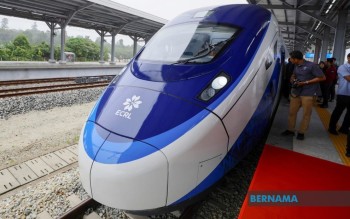
The project's technological specifications underscore its modern operational capacity. Allocation of 11 six-car electric multiple unit train sets for passenger services ensures capacity for commuter and intercity mobility, whilst 12 electric locomotives designated for cargo operations demonstrate serious commitment to freight efficiency. The electrified configuration minimizes environmental externalities and operational costs, aligning transport infrastructure development with climate change mitigation objectives increasingly central to Malaysian policy discourse.
Integration with the 13th Malaysia Plan's broader development agenda signals institutional coherence in approaching regional inequality. By leveraging the Malaysia Development Composite Index and MyRMK system to target allocations strategically, policymakers attempt to ensure that ECRL-adjacent development benefits flow to genuinely disadvantaged communities rather than concentrating within already-prosperous nodal centers. This allocation mechanism represents an evolving approach to infrastructure investment that acknowledges previous patterns of uneven development benefiting already-established economic hubs.
The RM80 to RM90 billion GDP contribution projection extends across two decades, reflecting the long-term nature of infrastructure-driven economic transformation. Unlike short-term stimulus measures, the ECRL's value proposition accumulates gradually as logistics networks mature, supply chains reorganize around improved connectivity, and local industries adapt business models to capitalize on enhanced market access. This temporal dimension requires patience from stakeholders and sustained policy commitment across successive administrations.
Regional equity considerations permeate the ECRL narrative, with explicit emphasis on narrowing development gaps between Malaysia's prosperous west coast and the historically marginalized east coast. By channeling investment toward Kelantan, Terengganu, and Pahang, the government acknowledges persistent regional disparities that have characterized Malaysian development for decades. The ECRL represents a spatial rebalancing strategy that recognizes east coast potential whilst simultaneously improving national logistics efficiency through better network utilization.
For Malaysia's broader integration into global and regional economic structures, the ECRL constitutes an essential infrastructure investment addressing a critical supply chain vulnerability. As regional supply chains reorganize following pandemic disruptions and geopolitical tensions, transport connectivity emerges as a competitive differentiator. Malaysian infrastructure capacity to efficiently move goods at reasonable costs translates directly into sectoral competitiveness for industries ranging from semiconductors to automotive components. The ECRL therefore functions as both regional development instrument and national competitiveness enhancement mechanism.

