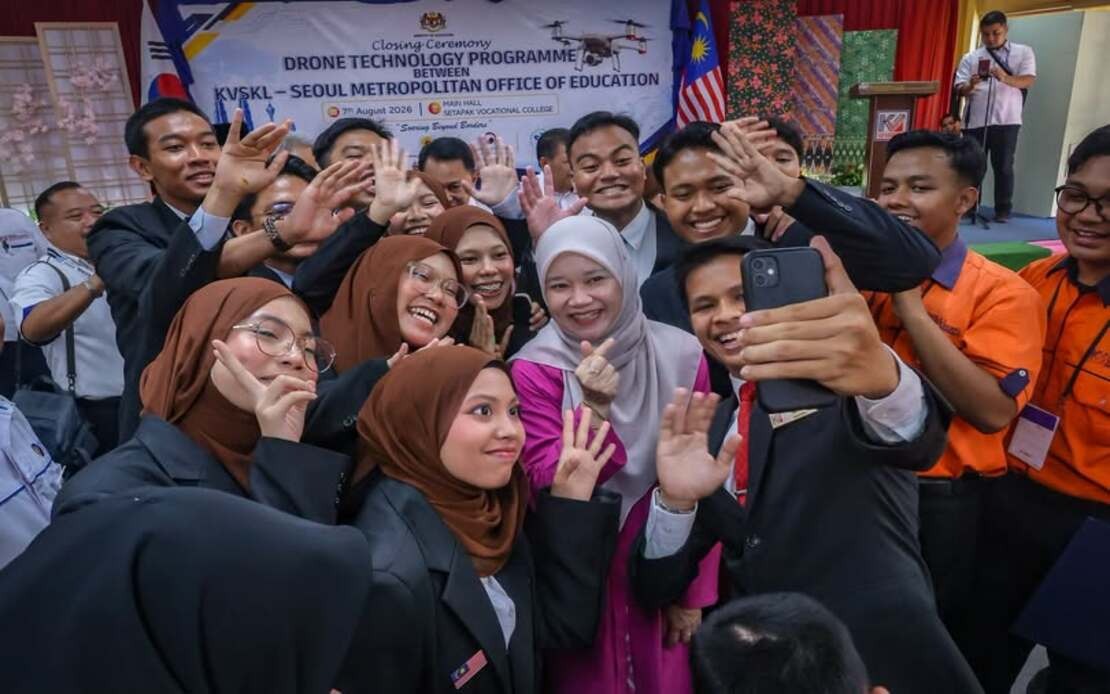
Education Minister Fadhlina Sidek has launched an ambitious initiative at Setapak Vocational College, tasking its students with developing practical applications of drone technology to strengthen campus security measures. The challenge, announced during a collaborative learning session between the college and South Korea's Seoul Metropolitan Office of Education, gives participants a month to research, conceptualise, and present workable proposals on how unmanned aerial systems could enhance institutional safety.
The initiative reflects a broader shift in Malaysian vocational education towards problem-based learning that bridges classroom instruction with tangible community needs. Rather than teaching drone operation as an abstract technical skill, Fadhlina's directive encourages students to think systemically about security vulnerabilities and technological solutions. This approach aligns with international best practices in skills development, where learners are motivated to address genuine challenges within their immediate environment.
During the collaboration programme, which included South Korean Ambassador to Malaysia Yeo Seung-bae, Fadhlina witnessed firsthand the students' engagement with robotics and drone systems. Her observations highlighted both successes and failures during live demonstrations, which she characterised as essential components of authentic learning. This candid acknowledgment of trial-and-error in the educational process signals a cultural shift away from perfection-oriented assessment towards fostering resilience and experimental thinking among vocational students.
The partnership with Seoul Metropolitan Office of Education provides Setapak students with exposure to South Korean expertise in emerging technologies, creating a valuable knowledge exchange that strengthens bilateral educational ties. South Korea's reputation for technological innovation and vocational excellence makes this collaboration particularly significant for Malaysian students seeking to develop globally competitive skillsets. The sharing of pedagogical approaches and technical knowhow between the two countries could serve as a model for future educational partnerships across Southeast Asia.
Fadhlina's comments underscore a critical gap in current Malaysian education policy. Robotics, drone technology, and artificial intelligence are no longer futuristic concepts relegated to research laboratories or science fiction discussions; they have become standard tools in contemporary workplaces across multiple sectors. From infrastructure inspection and environmental monitoring to security operations and emergency response, these technologies are reshaping job market expectations. Vocational colleges must therefore evolve their curricula to ensure graduates remain competitive in an increasingly technology-dependent economy.
The challenge also reflects growing concerns about campus security in Malaysia, a topic that has gained prominence amid broader discussions on institutional safety and safeguarding. By engaging students in identifying drone-based solutions, Fadhlina simultaneously addresses practical security concerns whilst providing meaningful learning opportunities. This dual-purpose approach demonstrates how educational initiatives can tackle real institutional challenges whilst developing student capability in cutting-edge fields.
For vocational education in Malaysia, this initiative carries significant implications. Traditionally, vocational colleges have focused on imparting technical trades and manual skills. The Setapak example suggests a reorientation towards technology integration across disciplines, preparing students to work alongside sophisticated equipment and systems rather than as replacements for manual labour. This positioning is essential as Malaysia seeks to move up the value chain in manufacturing and services, requiring a workforce capable of managing and innovating with advanced technologies.
The one-month timeline Fadhlina imposed is deliberately ambitious, mirroring real-world project management pressures that graduates will encounter professionally. Students must rapidly move from technology exploration to practical problem-solving, synthesising technical knowledge with critical thinking. This compressed schedule develops project management and prioritisation skills that are equally valuable as the drone technology itself, preparing participants for the pace of modern professional environments.
The initiative also carries implications for how Malaysian institutions integrate international partnerships. Rather than treating South Korean expertise as a one-off exchange, Fadhlina's challenge demonstrates how external knowledge can catalyse local innovation and problem-solving. Students benefit not only from foreign technical expertise but from exposure to different methodologies and thinking frameworks that characterise South Korean approaches to technology education.
Looking forward, the student proposals generated from this challenge could inform broader policy decisions within Malaysian education and potentially security sectors. If viable drone-based security concepts emerge, they might be pilot-tested at other institutions or even scaled beyond educational settings. This potential downstream impact transforms what appears as a student competition into a genuine research and development opportunity with policy relevance.
The challenge also signals Fadhlina's confidence in vocational students' capacity for sophisticated technological engagement. Often marginalised compared to academic tracks, vocational education in Malaysia has historically been perceived as a secondary pathway. By publicly championing vocational students' ability to tackle complex technological problems, the minister helps reshape perceptions about the calibre and potential of these institutions and their learners.
Ultimately, the Setapak initiative exemplifies how targeted challenges can galvanise educational institutions around meaningful objectives. By connecting technology learning to real security needs, establishing an international partnership framework, and setting clear deliverables, Fadhlina has created conditions where vocational education transcends rote skill acquisition to become a laboratory for practical innovation. As Malaysia positions itself within the broader regional and global economy, such initiatives become essential mechanisms for ensuring that educational systems produce graduates capable of not merely using technologies but innovating with them to solve problems.

