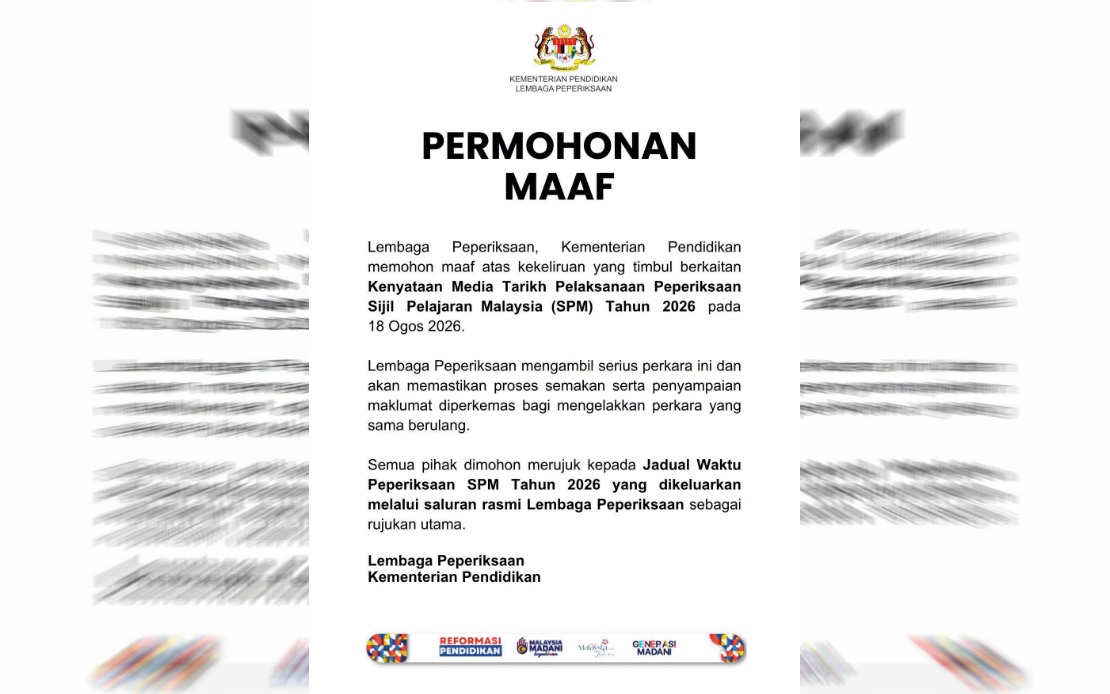
The Examination Board under Malaysia's Ministry of Education issued a formal apology on Tuesday for the administrative confusion stemming from a press release distributed the previous day regarding the 2026 Sijil Pelajaran Malaysia examination schedule. The clarification comes as the education sector seeks to restore confidence in its communication channels ahead of one of the nation's most significant annual assessment exercises, which affects hundreds of thousands of secondary school students and their families across the country.
In its statement, the Examination Board emphasised that the matter has been treated with appropriate urgency and that internal processes governing information verification and public communication will undergo comprehensive review. The acknowledgement reflects growing awareness within government education bodies of the critical need for accuracy when announcing examination schedules, given the far-reaching implications such announcements carry for students, parents, educators, and institutional planning across Malaysia's secondary education system.
The board has directed all stakeholders—including schools, students, parents, and educational media—to rely exclusively on the official 2026 SPM Examination Timetable released through the Examination Board's designated channels. This directive aims to eliminate any lingering uncertainty and establish a single authoritative reference point, preventing further misinterpretation or confusion that could disrupt preparation timelines for the affected cohort of students.
The scale of this examination cycle underscores why accuracy in scheduling announcements matters profoundly. A total of 420,879 candidates have registered to participate in the 2026 SPM assessment, distributed across 3,334 examination centers situated throughout Malaysia. These figures demonstrate the examination's role as a critical checkpoint in the Malaysian education system, determining progression pathways for a generation of learners and influencing university admission decisions nationwide.
The actual examination window has been confirmed as spanning from November 23 to December 17, 2026, providing a month-long period during which assessment activities will occur. This extended timeline reflects the complexity of administering simultaneous examinations across multiple subjects for several hundred thousand candidates, requiring meticulous coordination between the Examination Board, individual schools, and invigilators deployed nationwide.
The incident highlights persistent challenges within Malaysia's public sector communication infrastructure, particularly regarding the coordination between different departmental units before releasing information to the media and general public. Examination scheduling represents a category of announcement where errors carry tangible consequences—alterations or confusion about dates can trigger cascading disruptions to school calendars, teacher preparation, student revision schedules, and family planning during the examination period.
For secondary schools throughout Malaysia, accurate and timely examination schedules are foundational to curriculum planning and resource allocation. Teachers design teaching calendars around confirmed assessment dates, while school administrators coordinate venue preparations, staffing assignments, and logistics based on official examination timetables. Any confusion or subsequent corrections require costly recalibration of these institutional systems.
The Ministry of Education's commitment to streamlining its information delivery processes signals recognition that public trust in government educational institutions depends partly on the reliability and clarity of official communications. When ambiguity or errors occur, they risk undermining stakeholder confidence in the board's competence to manage the examination system itself—a particularly sensitive concern given that SPM results directly shape young Malaysians' academic and career trajectories.
Looking forward, the Examination Board's decision to conduct internal process reviews represents a positive step toward preventing similar incidents. Enhanced verification procedures, clearer approval chains for press releases, and improved coordination between communications and examination management divisions could substantially reduce recurrence risks. Many comparable education systems have implemented multi-stage approval mechanisms and designated single spokespersons for sensitive announcements to achieve greater consistency.
For the 420,879 registered candidates and their families, the clarification provides reassurance that the established November-December 2026 timeframe remains firm. Students can now proceed with confidence in their examination preparation, knowing the official schedule has been confirmed through proper channels. Educational institutions can similarly proceed with finalising their examination administrative arrangements based on the confirmed timetable.
The incident also carries implications for Malaysia's broader education governance framework. As the nation's secondary education system continues evolving, including recent reforms to curriculum and assessment approaches, maintaining clear communication channels becomes increasingly important. Parents and students navigating these reforms depend on reliable official information to make informed decisions about subject selection, study strategies, and post-secondary planning.
Moving forward, maintaining the integrity and accuracy of examination-related announcements will remain critical for sustaining the credibility of Malaysia's national assessment system. The Examination Board's transparency in acknowledging the error and outlining corrective measures demonstrates institutional accountability—a quality that extends confidence among the millions of stakeholders who depend on the SPM examination as a measure of educational achievement and a gateway to future opportunities.

