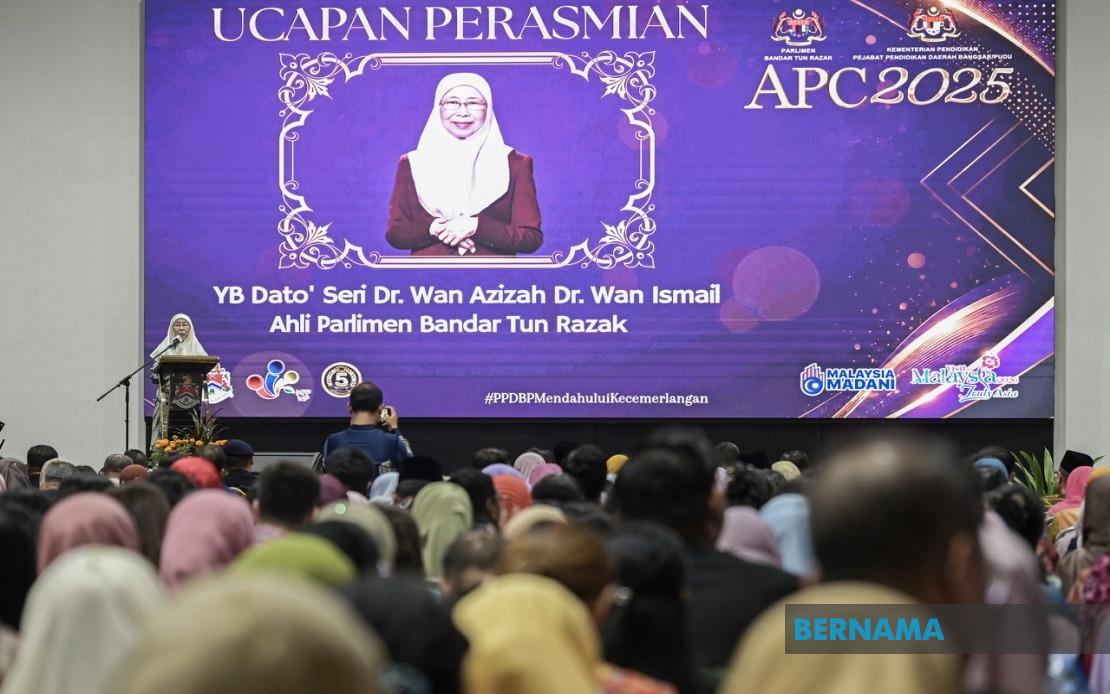
The bedrock of a nation's prosperity and resilience rests not primarily on its gross domestic product or technological prowess, but fundamentally on the quality of citizens it produces, Prime Minister's wife Datuk Seri Dr Wan Azizah Wan Ismail declared at a major education sector gathering in Kuala Lumpur this week. Speaking at the 2025 Excellent Service Award ceremony organised by the Bangsar/Pudu District Education Office, she positioned character development and ethical formation as central pillars of national development, challenging conventional metrics that privilege material progress over human development.
Dr Wan Azizah, who also represents Bandar Tun Razak as Member of Parliament, articulated a vision of education that transcends the transmission of subject knowledge. She contended that schools serve as incubators for cultivating integrity, moral reasoning and compassion—qualities that she presented as equally vital to any nation's long-term competitive advantage. Her remarks come amid growing debate globally about whether education systems adequately prepare citizens for increasingly complex moral and social challenges alongside technological disruption.
The observations carry particular weight given Malaysia's ongoing transformation. Urban centres across the country have witnessed intensifying pressure on educational institutions as dual-income households become the norm, placing greater responsibility on teachers and schools to provide formative guidance. Dr Wan Azizah pointedly noted that many Malaysian children, especially those in urban areas, spend more waking hours in classrooms than at home, making educators' influence profoundly consequential. This structural reality elevates teachers from mere subject specialists to primary architects of socialization and character formation during critical developmental phases.
Teachers themselves emerged as central to her thesis. Rather than viewing education primarily as knowledge delivery, she framed the profession as a stewardship of national potential. Educators, she suggested, shoulder responsibility for shaping what she termed "the nation's greatest asset"—the younger generation who will inherit and shape Malaysia's future trajectory. This characterization elevates the teaching profession conceptually, positioning it as fundamentally nation-building work rather than a technical service delivery function.
Artificial intelligence and the accelerating pace of information dissemination featured prominently in her analysis of contemporary educational imperatives. Rather than suggesting AI represents a threat to be resisted, Dr Wan Azizah identified it as a catalyst making values-based education increasingly urgent. In an environment where information proliferates at unprecedented speed and algorithmic content curation shapes what citizens encounter, she argued that critical thinking capacity becomes essential infrastructure for democratic citizenship. Students equipped to evaluate truth claims, recognise bias and distinguish substantive information from manipulation will navigate the AI-inflected world more effectively than those trained primarily for knowledge retention.
The values-based education framework she emphasized reflects a broader recognition within Malaysian policymaking circles that economic development alone cannot secure social stability or individual flourishing. Countries across Southeast Asia have begun recalibrating educational priorities toward holistic formation, acknowledging that technically skilled workers disconnected from ethical anchors generate distinct societal risks. Dr Wan Azizah's articulation of this principle at a high-profile government event signals official endorsement of this recalibration within Malaysia's education strategy.
Her remarks carried implicit recognition that recognition and incentive structures matter profoundly for workforce motivation. The 2025 Excellent Service Award ceremony itself exemplified this principle through scale—approximately 746 teachers and school administrators representing 143 schools received formal recognition for exceptional performance and dedication throughout the preceding year. The gathering of roughly 1,000 participants underscored the government's investment in publicly celebrating educator contributions, suggesting that visible acknowledgement of excellence remains a governmental priority for sustaining professional commitment across the education sector.
The event's framing also reflected deliberate institutional communication strategy. Prime Minister's Political Secretary Datuk Azman Abidin and Kuala Lumpur Federal Territory Education Department director Megat Affandi Ismail attended alongside Dr Wan Azizah, signalling unified executive commitment to education sector priorities. This visible alignment across political and administrative structures at the federal level communicates seriousness about implementing the values-based, character-focused educational approach she articulated.
For Malaysian educators and parents, the remarks articulate official validation of professional importance that extends beyond conventional performance metrics. Teachers grappling with curriculum pressures, examination-driven pedagogy and resource constraints received explicit affirmation that their character-shaping function deserves recognition and support. The emphasis on nurturing "well-rounded individuals" of "noble character, good manners and compassionate hearts" challenges narrower conceptions of educational success focused primarily on examination results or skills certification.
The implications extend beyond rhetoric into policy implementation. If values-based and critical thinking education receives sustained prioritization, curriculum development, teacher training initiatives and assessment frameworks should progressively reflect these priorities. The challenge for Malaysia's education system lies in translating aspirational statements into concrete pedagogical changes that genuinely develop ethical reasoning and character formation alongside subject competency.
Regionally, Malaysia's articulation of this educational philosophy contributes to broader Southeast Asian conversations about quality education. As nations across the region compete for skilled workers and grapple with social fragmentation, the emphasis on ethical formation and critical thinking resonates with comparable initiatives in neighbouring countries seeking to develop citizens capable of navigating technological change while maintaining social cohesion and democratic values.

