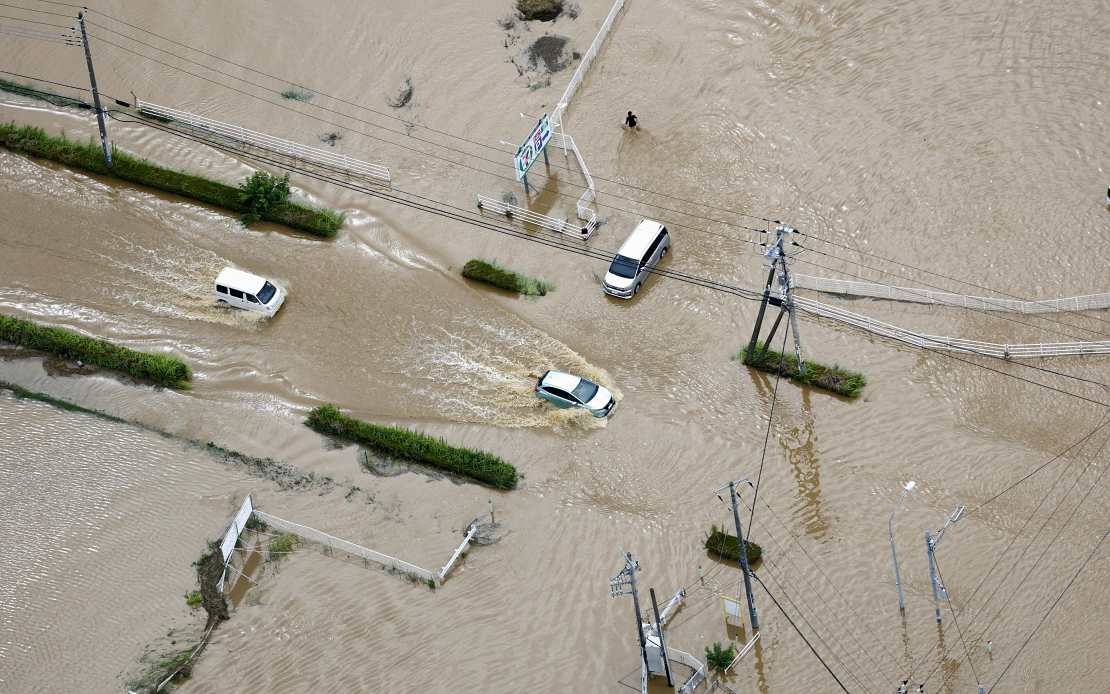
Eastern Japan confronted a severe weather crisis on Friday as Chiba Prefecture bore the brunt of extraordinary rainfall that left eight people dead and forced the evacuation of more than 100,000 residents. The deluge, which intensified through Thursday evening and into early Friday morning, marked one of the prefecture's most dangerous meteorological events in recent memory, overwhelming emergency services and paralysing transportation networks across the region. Authorities confirmed fatalities in Chiba City, Kashiwa, Ichikawa, Sakura and Yachiyo, whilst four additional individuals sustained minor injuries during the storm.
The scale of the precipitation was unprecedented. Chiba City recorded 348 millimetres of rain in just twelve hours through 1.40 am on Friday—a figure that represents approximately three months' worth of the city's typical August rainfall compressed into a single half-day period. The Japan Meteorological Agency documented this as a record-breaking measurement, underscoring the exceptional nature of the weather system that affected the prefecture. Such concentrated downpours pose extraordinary challenges for urban drainage infrastructure and natural water management systems, inevitably leading to flooding, landslide hazards and other cascading disasters.
Recognising the severity of the unfolding situation, Japan's meteorological authorities had escalated warnings to Level 5—the highest alert classification—for heavy rain and potential landslides across portions of Chiba Prefecture during the peak of the storm. This maximum-level warning signals imminent and extreme danger requiring immediate protective action from residents in affected areas. However, as conditions stabilised on Friday morning, the Japan Meteorological Agency progressively downgraded these alerts to Level 4 or lower, suggesting that the most acute phase of the emergency had passed. Nevertheless, weather forecasters cautioned that additional rainfall remained possible and urged residents to maintain heightened vigilance against secondary hazards.
The immediate human cost extended beyond those who perished. The Chiba Prefectural Government reported that approximately 102,600 people remained under official evacuation orders as of Friday morning, having fled their homes to escape inundation and landslide risks. This massive displacement reflects the scale of the threat posed by such extreme weather events to residential communities in densely populated prefectures. For Malaysian observers accustomed to tropical monsoon systems, the intensity and rapid concentration of Japan's temperate rainfall demonstrates how different climatic zones produce distinct hazard profiles—whilst Southeast Asia typically experiences extended rainy seasons, Japan's meteorological systems can generate dangerous volumes of precipitation within compressed timeframes.
Transportation infrastructure, which forms the lifeblood of Japan's interconnected metropolitan regions, suffered severe disruption. Narita Airport, a major international gateway serving the Tokyo metropolitan area and located within Chiba Prefecture, found itself unable to operate effectively as the downpour knocked out rail and bus services connecting the facility to urban centres. Approximately 7,000 passengers became stranded at the airport overnight, unable to complete their journeys as ground transportation networks collapsed. This disruption rippled through international travel schedules and illustrated how extreme weather can rapidly compromise critical infrastructure that societies depend upon for economic activity and mobility.
The cascading nature of the disaster illustrates vulnerabilities that extend beyond simple precipitation measurement. When rainfall of this intensity falls over such a brief period, traditional drainage systems become overwhelmed, groundwater saturation increases instability on slopes and hillsides, and river systems struggle to convey floodwaters safely to the sea. Urban areas like Chiba City, built on accumulated development over decades, face particular challenges as concrete surfaces prevent water absorption, forcing dangerous surface runoff. The combination of factors—concentrated rainfall, topography prone to landsliding, and dense human settlement—created conditions where eight fatalities resulted from weather phenomena that, whilst severe, occur with measurable frequency in temperate climates.
For regional perspectives, this disaster carries relevance to Southeast Asia's own climate vulnerabilities. Whilst Malaysia and neighbouring countries experience protracted monsoon seasons rather than Japan's compressed downpours, tropical storms can occasionally deliver comparable rainfall intensities. The Japanese experience underscores how even highly developed nations with sophisticated warning systems and robust infrastructure face challenges when extreme precipitation strikes. The coordination between the Japan Meteorological Agency, the Fire and Disaster Management Agency, and local prefectural authorities demonstrated the multi-layered approach required to manage such emergencies—communication networks that must function even as physical infrastructure fails.
The death toll and evacuation figures confirm that despite Japan's reputation for technological sophistication and disaster preparedness, natural forces retain the capacity to overwhelm human systems. The prefecture's experience serves as sobering reminder that climate systems operate on scales beyond individual preparedness, and that marginally-populated rural areas and densely-populated urban zones alike face distinct but equally serious hazards when extreme weather materialises. Chiba Prefecture's tragedy underscores the ongoing challenge of balancing development and habitation in regions where geological and meteorological hazards remain inherent features of the landscape.

