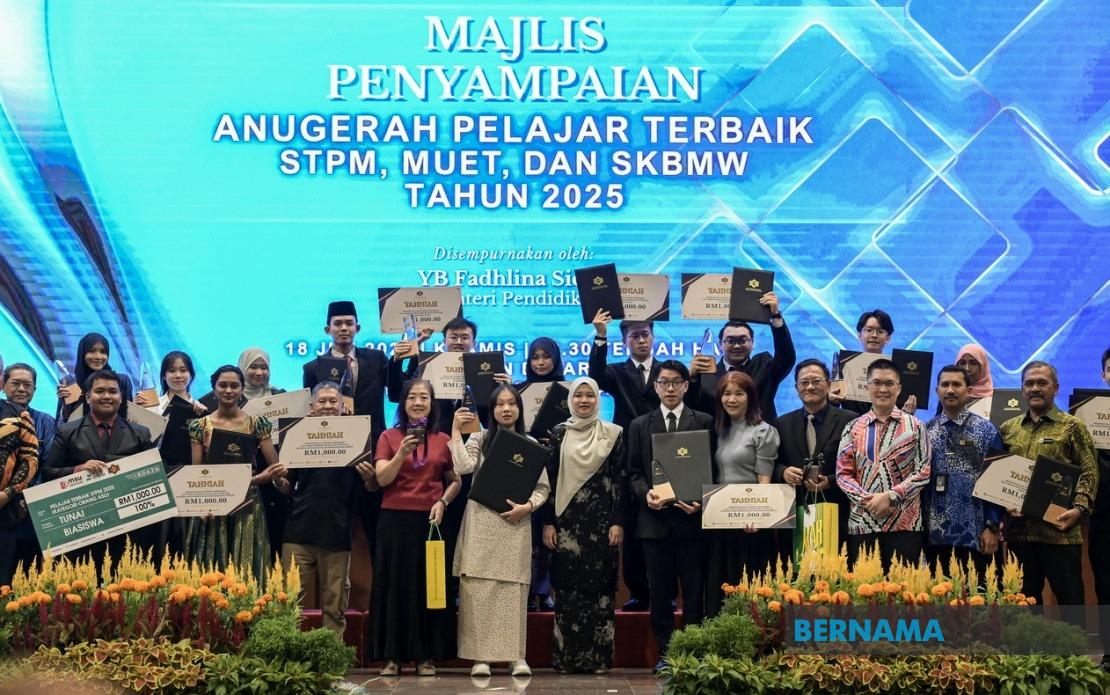
Eighteen high-performing students from the 2025 Sijil Tinggi Persekolahan Malaysia (STPM) examination cohort will receive scholarship packages from the country's public universities, Education Minister Fadhlina Sidek announced today at the Malaysian Examinations Council building in Kuala Lumpur. The tuition fee sponsorship represents a fresh strategic push by the government to bolster Malaysia's Form Six landscape and persuade more secondary school graduates to pursue the traditional pre-university route rather than alternative pathways.
Fadhlina described the initiative as part of a broader institutional commitment, with each public university now tasked with identifying and supporting one or more of the highest-achieving STPM students. The announcement came during the awards ceremony recognising excellence in STPM, the University of Malaysia English Test (MUET), and the Certificate of Proficiency in Malay for Foreigners (SKBMW). She emphasised the government's gratitude toward the public universities for embracing this collaborative approach to talent development and retention within the Malaysian education system.
The timing of this scholarship launch reflects deliberate policy sequencing. For years, stakeholders have flagged concerns about declining Form Six enrolment rates as international schools, private colleges, and overseas education options compete for top students. By channelling scholarship support directly through public universities—institutions that provide undergraduate pathways—the government signals confidence in the quality of education these bodies deliver. The move also potentially reduces financial barriers for academically gifted families who might otherwise view private alternatives as necessary investments.
In her remarks, Fadhlina highlighted a series of complementary measures designed to reinvigorate the Form Six ecosystem. The government has expanded the physical infrastructure by establishing additional Form Six colleges across the nation, recognising that access and locality influence student choice. Simultaneously, digital tools such as smartboards are being deployed to modernise classroom instruction, signalling that pre-university education is not static but evolving with technological advancement. These investments work in concert with earlier student support programmes including early schooling assistance and the MADANI Book Vouchers, which distribute reading materials and educational resources to learners from lower-income households.
A notable data point emerged from the 2025 STPM results: the national Cumulative Grade Point Average (CGPA) climbed to 2.88 from 2.85 the previous year. While incremental, this improvement suggests that curriculum reforms, teacher training initiatives, and student support mechanisms are yielding measurable returns. For Malaysian policymakers focused on human capital development, such metrics carry weight in budget deliberations and strategic planning. The upward trajectory, though modest, counters narratives of educational decline and provides empirical grounding for the minister's assertion that the education system continues to strengthen.
The scholarship announcement must be contextualised within Malaysia's competitive landscape for talented students. Neighbouring Singapore, with its integrated pathway system, attracts Malaysian top performers annually. Within Malaysia itself, elite private institutions and overseas universities actively recruit high-achieving Form Six graduates. By offering tuition-free undergraduate education through public universities, the government attempts to create a compelling domestic option that reduces opportunity costs and financial burden for families. This is particularly significant for merit-based students from rural or lower-income backgrounds who possess exceptional academic credentials but limited financial resources.
For public universities themselves, the initiative carries strategic implications. It formalises their commitment to attracting top-tier undergraduate cohorts and potentially enhances their competitiveness in university rankings that measure student intake quality. It also positions these institutions as partners in national talent development rather than passive recipients of student applications. The scholarship structure—focused on tuition fees rather than living allowances or other support—suggests the government expects public universities to manage administration and possibly coordinate with existing student financial aid programmes to provide comprehensive support.
The broader educational context matters here. Malaysia's skilled workforce needs are substantial as the country pursues higher-value economic activities and digital transformation. Form Six graduates feed into critical fields including engineering, medicine, sciences, and increasingly, technology and data analytics. By making public university pathways more accessible through scholarships, the government directly influences talent flow toward these strategic sectors. The initiative also reflects awareness that private financing barriers should not determine whether talented students can pursue advanced education—a principle increasingly central to discussions on educational equity across Southeast Asia.
Deputy Education Minister Wong Kah Woh, Malaysian Examinations Council (MPM) chairman Prof Datuk Dr Md Amin Md Taff, and Education Malaysia director-general Datuk Dr Mohd Azam Ahmad participated in the announcement, underscoring institutional coordination. This multi-stakeholder presence signals that scholarship distribution, examination administration, and overall education strategy are moving in alignment rather than proceeding in isolation—a governance strength when implementing nationwide initiatives.
The scholarship programme also addresses perceptions about public university prestige. By visibly supporting top STPM performers, public universities reinforce that they offer credible, competitive education aligned with national aspirations. This messaging is crucial as competition for academic talent intensifies globally and regionally. Malaysian parents and students increasingly weigh international options; domestic initiatives that combine excellence, accessibility, and financial support become powerful retention tools.
Looking ahead, several questions will shape the programme's impact. How many institutions will participate beyond token gestures? Will scholarship recipients cluster in high-demand fields or distribute across disciplines? Will the initiative evolve to include living allowances or mobility support for rural students? These operational details will determine whether the framework remains symbolic or translates into substantive educational opportunity expansion.
The 2025 STPM scholarship initiative ultimately represents incremental but meaningful progress toward an accessible meritocratic education system. By anchoring scholarships to demonstrated academic excellence while channelling support through public universities, the government reinforces that capability, not privilege, should determine educational pathway. As Southeast Asia's education systems intensify competition for talented students, such targeted investments become increasingly important to retaining Malaysia's human capital and sustaining long-term development momentum.