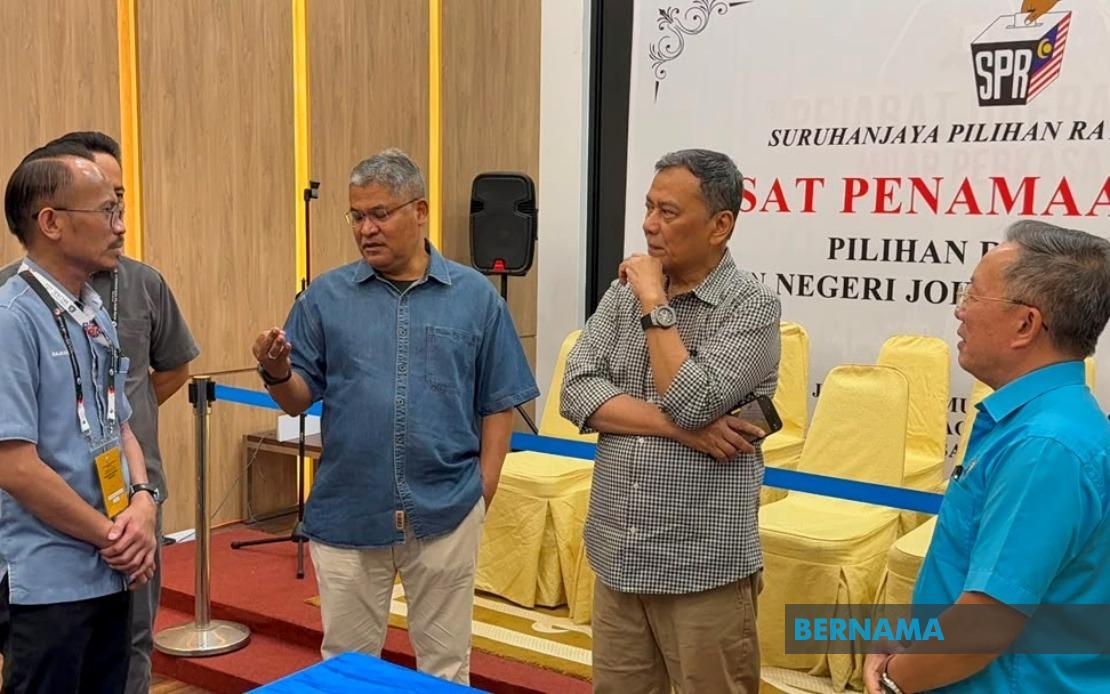
The Election Commission (EC) has wrapped up its preparations to facilitate a seamless nomination day in Johor's state election tomorrow, with officials across the state confirming readiness at various Candidate Nomination Centre locations. Following a comprehensive site survey by Bernama, preparations at multiple venues showed that only residual technical work remained, with authorities confident of meeting the tight timeline. The exercise underscores the logistical complexity involved in orchestrating electoral procedures across a major Malaysian state, particularly given the scale of voter participation expected.
At the Perling constituency nomination centre in Dewan Jubli Intan Hall, returning officer Nazatul Shima Mohamad expressed confidence that all groundwork had been finalised. The venue's layout has been arranged according to specifications, while simulation exercises with participating agencies concluded smoothly on the same day. Her remarks highlighted the collaborative spirit that the EC has fostered with relevant stakeholders, noting that all parties involved share a common commitment to ensuring tomorrow's process unfolds without disruption. The officer's message to prospective candidates emphasised the importance of punctuality and document preparedness, indicating that the centres will operate within strict procedural frameworks designed to maintain order and efficiency.
The Kota Iskandar nomination centre, operated from the Main Hall of Iskandar Puteri City Council in Medini, has similarly completed its organisational protocols. Returning officer Shahrulizam Abdul Rashid outlined a security and crowd management strategy that reflects lessons learned from previous electoral exercises in the state. The approach incorporates comprehensive coordination with police forces to manage the anticipated influx of party supporters, who traditionally gather to show solidarity with their candidates during the nomination process. Road closures proximate to the centre, enforcement of a 50-metre perimeter restriction around the nomination venue, and strategic placement of temporary structures are among the measures designed to maintain orderly proceedings while protecting candidate and supporter safety.
Security considerations have assumed greater prominence in recent state and federal elections, reflecting the increasingly spirited nature of Malaysian political campaigns. The establishment of physical barriers to separate supporters from competing parties acknowledges the potential for tensions when rival political movements converge at a single location. The EC's preventive approach demonstrates recognition that nomination day, despite its primarily administrative character, can generate significant public interest and passionate political expression. Returning officer Shahrulizam's advisory to the public against provocative behaviour underscores the shared responsibility for maintaining civility, extending beyond official personnel to encompass participants themselves.
The Johor state election encompasses a substantial electoral landscape, with 2,727,926 registered voters spread across constituencies that will participate in the upcoming contest. This figure comprises 2,703,175 ordinary voters alongside 12,041 military and police personnel and their spouses, reflecting the diverse composition of the electorate. The voter registration figures provide insight into Johor's demographic breadth and the administrative challenge facing the EC in coordinating simultaneous nomination processes across the state. The inclusion of military and police voters underscores the importance attached to ensuring that security personnel retain full electoral participation rights, a principle observed consistently across Malaysian electoral practice.
Nomination proceedings will commence at 9 am tomorrow and conclude at 10 am across all 56 designated nomination centres, a compressed timeframe that places considerable emphasis on operational efficiency. The brevity of the nomination window creates a natural bottleneck, necessitating careful scheduling and crowd management to prevent last-minute congestion. Following the conclusion of nominations, returning officers will formally announce which candidates meet all legal requirements to contest, with ineligible submissions rejected at that stage. This sequential process, while standard, compounds the pressure on EC personnel and volunteers to process applications with accuracy under time constraints.
The path to tomorrow's nomination day traces back to June 1, when the Johor State Legislative Assembly was formally dissolved, triggering the electoral calendar that the EC established. Early voting has been scheduled for July 7, allowing designated voters such as police and military personnel, election officials, and registered disabled voters to cast ballots in advance of the main polling day. Polling day itself is set for July 11, providing a two-week interregnum between candidate nominations and the actual vote. This timeline permits the EC to finalise the candidate register, undertake electoral boundary and polling station preparations, and conduct standard pre-election procedures. The schedule also affords candidates and political parties adequate time to campaign and mobilise supporters, a consideration embedded within electoral law to ensure fair competition.
The 16th Johor state election carries significance beyond the state's borders, as outcomes may influence the broader Malaysian political landscape and provide indicators of regional voting sentiment. Johor, as Malaysia's southern anchor state and a significant economic contributor, commands considerable attention in national political discourse. The state's electoral results have historically rippled across neighbouring states and occasionally triggered shifts in federal political calculations. Contemporary Malaysian politics has been marked by fluid coalition arrangements and shifting voter allegiances, making state-level contests increasingly unpredictable. Johor's election will provide valuable data regarding voter preferences across multiple demographic segments and geographic constituencies.
The EC's meticulous approach to nomination preparations reflects institutional learning from previous electoral exercises and commitment to maintaining the integrity of Malaysia's democratic processes. The comprehensive involvement of law enforcement agencies in planning crowd management and maintaining order demonstrates recognition that elections extend beyond the act of voting itself. Nomination day, often overshadowed by polling day in public consciousness, serves as the crucial gateway determining which candidates reach voters. The EC's resource investment in ensuring smooth nominations underscores the foundational importance of this procedural step within the broader electoral architecture. Prospective candidates who carefully adhere to document requirements and nomination centre operating procedures will find themselves assisted by personnel prepared through extensive briefing and simulation exercises.

