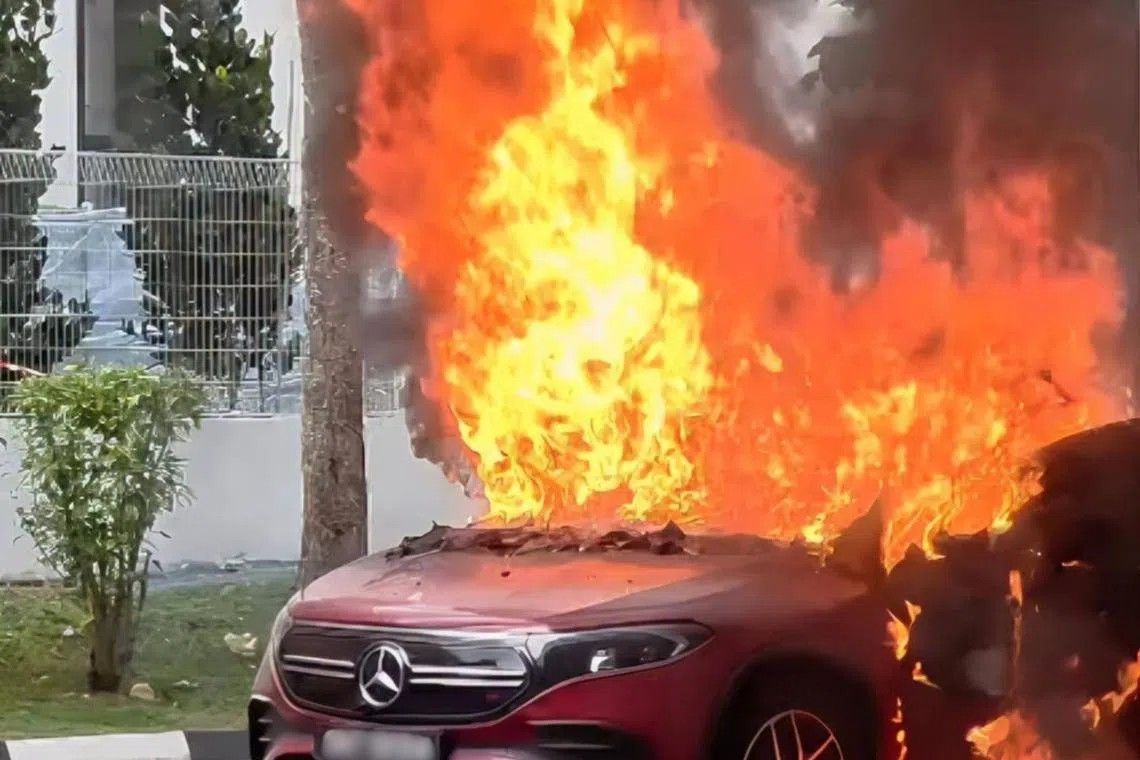
An electric vehicle ignited in the early morning hours of July 21 near the entrance of a multi-storey carpark in Singapore's Woodlands residential estate, prompting a rapid emergency response from the Civil Defence Force. The incident unfolded at Block 548 Woodlands Drive 44, in the vicinity of Vista Point, when dispatchers received a distress call at approximately 10.10am reporting a fire affecting the interior compartment of the vehicle.
The Singapore Civil Defence Force (SCDF) mobilised firefighting crews to the scene, who swiftly contained the blaze using a single water jet before it could spread to adjacent vehicles or structures. The rapid intervention prevented potential secondary incidents that often accompany vehicle fires in confined spaces such as underground or covered carparks, where smoke accumulation and restricted ventilation pose heightened risks to occupants and property. Emergency personnel confirmed that no individuals sustained injuries during the incident, and the vehicle was subsequently removed from the premises at around 12.15pm.
Accounts from the vehicle's driver, who spoke with Shin Min Daily News, shed light on the sequence of events that preceded the emergency call. She described noticing an acrid burning odour while maneuvering the car through the carpark exit, prompting her to steer the vehicle to a safe location. Upon investigation, she observed smoke billowing from the interior, suggesting a fire had originated in the gap separating the driver's seat from the front passenger position—a location directly above where the vehicle's high-capacity battery pack resides.
This positioning is particularly significant given the critical role lithium-ion batteries play in modern electric vehicles. These battery systems generate considerable heat during operation and can be vulnerable to thermal runaway events, a chain reaction where internal resistance causes uncontrolled temperature escalation. The narrow space where the fire began suggests either a manufacturing defect, internal cell degradation, or a collision-induced fracture may have compromised the battery's structural integrity or internal separator layers.
Neither onsite security personnel nor the vehicle's driver proved capable of extinguishing the spreading flames using conventional fire extinguishers typically available at residential facilities. This limitation underscores an emerging challenge for property managers and emergency responders across Southeast Asia, where EV adoption is accelerating rapidly. Standard dry powder or foam-based extinguishers, effective against conventional vehicle fires fuelled by petrol or diesel, often prove inadequate when confronting lithium-ion battery fires, which can reignite after appearing suppressed.
Recognising the escalating danger as the fire intensified, the driver and security personnel prudently withdrew from the immediate vicinity and alerted the SCDF. This decision prevented potential injury from explosion, a genuine hazard when EV battery fires breach the vehicle's structural boundaries and expose pressurised cells to oxygen. Photographic documentation of the aftermath revealed the vehicle's interior had been almost completely charred, with the dashboard warped beyond recognition and the structural frames supporting both front seats reduced to exposed metal skeletons.
The SCDF has initiated a formal investigation into the fire's root cause, a process that typically involves examining the battery management system, electrical wiring integrity, and external factors such as collision history or environmental stress. For Malaysian readers, this incident carries particular relevance given that electric vehicle ownership is expanding substantially in Malaysia, driven by government incentives, improving charging infrastructure, and falling battery prices. The Malaysian automotive sector and regulators must consider whether existing safety protocols and emergency response capabilities are adequately prepared for the distinct hazards posed by battery-electric vehicles.
Property developers and facility managers overseeing carparks throughout Malaysia and the broader region should evaluate their preparedness for EV-related incidents. This extends beyond acquiring specialised extinguishing agents—dedicated lithium battery fire suppression systems are available but remain expensive—to training security and maintenance personnel to recognise early warning signs of thermal distress and establishing evacuation protocols specific to battery fires. Many carpark operators remain unprepared, relying on generic vehicle fire procedures that may inadequately address the unique characteristics of electrical battery system failures.
Singapore's swift SCDF response demonstrates the importance of adequate emergency resource allocation and training, yet even well-resourced jurisdictions face challenges when scaling EV safety preparedness across numerous residential and commercial facilities. The incident also highlights potential insurance and liability complexities: manufacturers must ensure battery integrity through rigorous quality control and robust thermal management systems, whilst vehicle owners have responsibility for regular maintenance and timely reporting of battery performance anomalies to authorised service centres.
As Malaysia and neighbouring countries accelerate their transition toward electric mobility, this Woodlands carpark incident serves as a crucial reminder that infrastructure modernisation must accompany vehicle electrification. Carpark designers should incorporate enhanced ventilation systems, dedicated EV charging zones with advanced monitoring capabilities, and strategically positioned fire suppression equipment tailored to battery emergencies. Public awareness campaigns educating drivers about recognising battery distress symptoms—unusual smells, dashboard warning indicators, or performance irregularities—can enable early intervention before catastrophic failure occurs.
The investigation findings, once released by Singapore authorities, will likely inform regulatory discussions across the region regarding EV safety standards, carpark design specifications, and emergency service training protocols. Until these systemic improvements materialise, such incidents will remain instructive opportunities for policymakers, developers, and emergency services to strengthen their collective response to the challenges accompanying widespread EV adoption.

