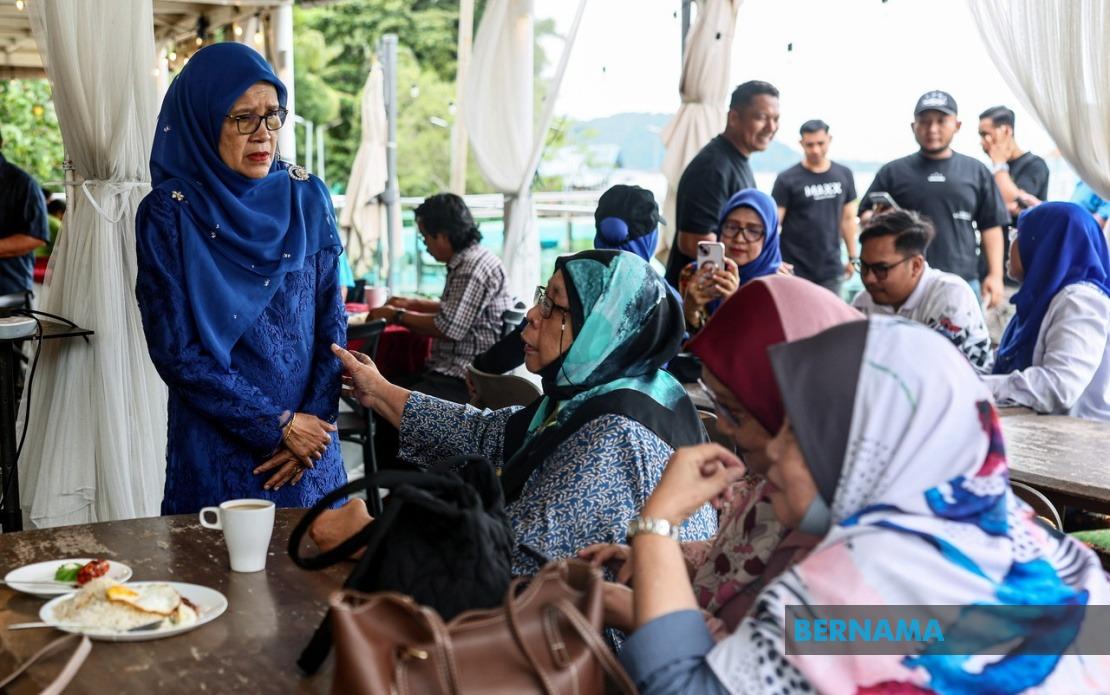
The Endau state seat in Johor is shaping up as one of the more substantive contests in the July 11 state election, pitting the accumulated influence of a two-term incumbent against an intellectual challenger armed with structural economic proposals. Alwiyah Talib, the Barisan Nasional candidate who previously held the seat under Perikatan Nasional before switching allegiance, is anchoring her re-election campaign on the tangible outcomes of her existing tenure and plans for sustained development. Ranged against her is 42-year-old Saiful Nizam Samat of Pakatan Harapan, a PhD candidate in economics bringing a data-driven approach to long-standing community concerns. The contest is further complicated by the presence of Perikatan Nasional's Hasnul Hakimi Hussien and Parti Orang Asli Malaysia's Jati Awang, making this a four-cornered fight that reflects the fragmented political landscape now endemic to Malaysian state-level contests.
Alwiyah's campaign messaging revolves around continuity and the deepening of existing development trajectories, particularly in tourism—a sector she views as Endau's economic cornerstone. Her platform emphasises the potential embedded in inland tourism facilities such as KampungStay@Teluk Buih, Penyabong and Tanjung Resang, where occupancy rates already demonstrate visitor demand. Rather than starting afresh, she argues that momentum must be sustained and amplified through improved marketing and infrastructure. This reflects a broader challenge for Mersing District: its reputation has been hollowed out to that of a mere transit point for island-hoppers, obscuring the terrestrial attractions and homestay opportunities that could anchor longer visitor stays and more dispersed economic benefits throughout the hinterland.
Beyond tourism, Alwiyah has incorporated educational expansion into her platform, committing to establish a new secondary school within Pekan Endau to alleviate reliance on the solitary SMK Ungku Husin. This addresses a genuine bottleneck affecting student mobility and post-secondary pathways, though it also highlights how incremental improvements can only partially solve larger systemic challenges. She frames her approach as rooted in sincerity and sustained commitment rather than campaign promises, acknowledging the electoral hazards inherent in constituency work. Her career trajectory—winning the seat in 2022 as a PN candidate before realigning to BN—itself raises questions about political loyalty versus pragmatic survival that voters in Endau must weigh.
Saiful Nizam's platform operates on a different intellectual register, deploying a comprehensive systems-level approach grouped under five pillars: education, economic progress, food security, infrastructure and quality of life. His signature proposal, the Fishermen's Economy 2.0 initiative, attempts to move beyond subsidy-dependent fishing livelihoods toward sustainable, higher-margin operations integrating value-added production and market modernisation. This agenda directly addresses why rural youth continue gravitating toward urban centres—not because of insufficient welfare, but because local economic structures generate insufficient return on human capital. By coupling fisheries modernisation with coordinated SME support, digital marketing capability-building and entrepreneurship facilitation, Saiful Nizam posits a multiplier effect wherein improved coastal sector productivity elevates prosperity throughout the local supply chain.
The economic reasoning underlying Saiful Nizam's proposals reflects contemporary development thinking increasingly embraced across Southeast Asia: that fishing communities require structural economic transformation rather than ameliorative assistance. His emphasis on technical and vocational training, STEM education and English-language proficiency aligns with workplace demands in higher-productivity sectors, attempting to create pathways out of subsistence fishing without requiring geographic displacement. The proposed Endau Children's Education Fund represents targeted intervention addressing the liquidity constraints preventing talented students from lower-income households from accessing further training, a problem that blanket assistance often fails to solve.
The education platforms of both candidates reveal different diagnostic frameworks. Alwiyah treats the problem as infrastructure scarcity—too few schools generating logistical bottlenecks—while Saiful Nizam treats it as skills-outcome alignment, questioning whether existing educational structures produce graduates positioned for actual economic opportunity. Both approaches carry validity, though they appeal to different voter constituencies: those prioritising immediate tangible development projects versus those seeking longer-term structural repositioning of the local economy.
The fisheries angle warrants particular attention for Southeast Asian analysts, as it represents a microcosm of regional development challenges. Most ASEAN fishing communities operate under similar structural constraints: dependence on volatile international seafood prices, limited value-addition capacity, insufficient market intelligence and weak integration into higher-margin supply chains. Saiful Nizam's proposal to upgrade the sector through modernisation and entrepreneurial linkages reflects policy frameworks now gaining traction in Thailand, Vietnam and Indonesia—though implementation remains patchy given the capital requirements and coordination complexities involved.
The constituency itself comprises 28,767 registered voters distributed across an area encompassing both maritime and inland communities, with distinct economic profiles and infrastructure needs. This heterogeneity means that campaigns pitched exclusively toward fishing communities or tourism development miss voters whose priorities centre on healthcare access, road maintenance or agricultural support. Neither campaign explicitly addresses such universal concerns, possibly indicating their perceived lower salience in a constituency where fishing and tourism genuinely dominate economic conversation.
The broader context of the 16th Johor state election sees 172 candidates competing for 56 seats, reflecting the fragmentation that now characterises Malaysian electoral politics. In such environments, incumbent advantages intensify—voters may prefer established local representatives whose track records are known, even if contested, over untested challengers regardless of their policy proposals. Alwiyah's prior victory and subsequent party realignment position her as a known quantity, though questions about political consistency may give undecided voters pause. Saiful Nizam's intellectual credentials and comprehensive policy framework appeal to voters craving structural economic renewal, but first-time candidacy confers no track record for implementation or constituent responsiveness.
Facing the July 7 early voting window and July 11 polling day, Endau voters must evaluate whether development continuity or structural economic reform represents the more pressing priority. The choice between these candidates encapsulates a recurring tension in Malaysian politics: whether incremental, established improvements to existing frameworks outweigh the promise of more ambitious systemic change pursued by less-tested actors. This tension will likely decide the outcome more decisively than the specific policy details themselves.

