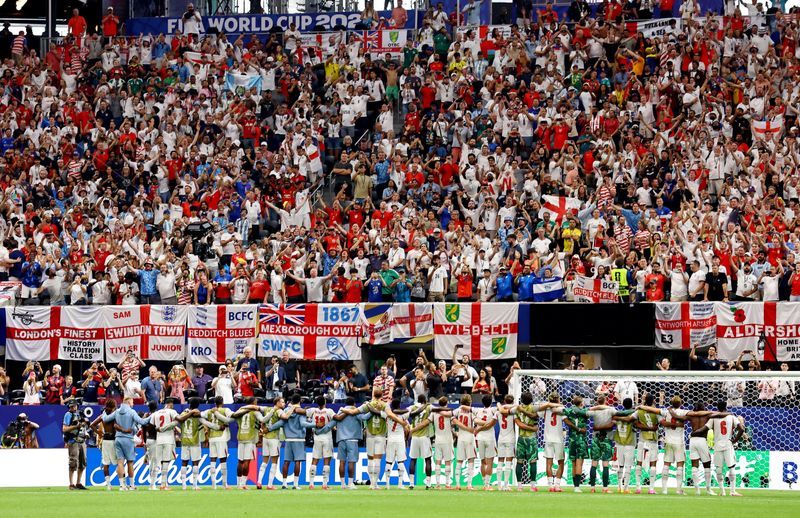
England's World Cup journey has so far been a study in inconsistency. Beginning with an impressive 4-2 victory over Croatia, the defending champions subsequently stumbled through their group stage, managing only a goalless stalemate against Ghana and a laboured 2-0 triumph over Panama. Those performances prompted serious questions about whether Thomas Tuchel's side possessed the defensive solidity expected of contenders. Those concerns would intensify dramatically on Wednesday evening in Atlanta.
The DR Congo side, considered massive underdogs in the round of 32 encounter, arrived with nothing to lose and everything to prove. Within the opening ten minutes, Brian Cipenga's striking finish handed the African nation a shock lead that sent shockwaves through England's campaign. For the first time in the tournament, England found themselves chasing a deficit—a position that felt entirely uncomfortable for a squad that had managed to avoid trailing in the group phase. Adding to the psychological weight was an uncomfortable historical statistic: England had never won a World Cup match after finding themselves behind at the interval.
The atmosphere inside Atlanta Stadium transformed in an instant. Where confidence had previously existed, anxiety now took hold. England supporters, many with St. George's Cross painted across their faces, sat in stunned silence, while others shuffled nervously in their seats, gripping their drinks as if the worst outcome was inevitable. On the pitch, DR Congo's defensive organisation proved suffocatingly effective. The underdogs seemed prepared to absorb everything England could throw at them, building walls in front of goalkeeper Lionel Mpasi and remaining dangerous on the counter-attack. When Yoane Wissa struck the post shortly before halftime following another dangerous forward surge, the possibility of England's elimination loomed dangerously close. Even Harry Kane's vehement appeals for a penalty were waved away, leaving England to trudge toward the interval with little conviction.
Tuchel's evident frustration during the opening period was palpable. The German manager prowled his technical area with visible irritation, at one stage barking instructions at defender Djed Spence following a poorly executed throw-in. However, the second half proved pivotal in shifting momentum. England finally began imposing themselves on proceedings after the first-half hydration break, with Jude Bellingham forcing a superb save from Mpasi through a well-directed header. Declan Rice began delivering dangerous crosses into the penalty area with increased regularity, while Marcus Rashford's efforts were thwarted by desperate defending. Mpasi produced another magnificent intervention to deny Bellingham in stoppage time, yet breakthroughs remained frustratingly elusive.
Tuchel's tactical adjustments gradually bore fruit. By moving Rice to right back and introducing midfielder Eberechi Eze for fresh impetus, the manager attempted to unlock a stubborn Congolese defence. The breakthrough came in the 75th minute when Kane's glancing header, which brushed fingertips off Mpasi's outstretched hand, finally found the net. That moment of release was palpable—the accumulated tension of the previous hours found sudden outlet in celebration. Kane's 83rd international goal would prove merely the prelude, as the England captain struck again in the 86th minute to secure a 2-1 victory. The turnaround represented England's first World Cup comeback victory since they defeated Cameroon in the quarter-finals in 1990, precisely 36 years earlier.
Tuchel's post-match assessment underscored the mental resilience required to engineer such a recovery. He emphasized that England's capacity to maintain belief during periods of adversity would prove essential as the tournament progressed deeper into its knockout phases. Kane echoed similar sentiments, acknowledging that the group stage and knockout football each present entirely different challenges requiring distinct tactical and psychological approaches. The England captain recognised that grinding out victories becomes the primary objective when knockout football arrives, with margins for error evaporating entirely.
Yet the challenge ahead presents complications of a different order. Where DR Congo forced England to question their attacking efficiency and psychological fortitude, Mexico represents an entirely different proposition. The Mexican national team brings an attacking tradition and intensity that could test England's defensive vulnerabilities far more severely than their Congolese counterparts managed. Rather than defending doggedly from deep, Mexico's approach typically emphasises pressing, movement and direct attacking play that could unsettle an England backline already showing signs of brittleness.
Perhaps most significantly, the fixture carries geographical complications that may prove as challenging as any tactical obstacle. The Estadio Azteca in Mexico City sits more than 2,200 metres above sea level, creating atmospheric conditions radically different from the relatively sea-level conditions of Atlanta. At such altitude, oxygen levels diminish substantially, forcing players' cardiovascular systems to work considerably harder throughout matches. The football itself behaves differently at elevation, moving faster through the thinner air—a characteristic that can catch visiting sides accustomed to sea-level conditions off guard. England's players will need to adjust not merely their tactical approach but their physical conditioning and expectations regarding how the game flows.
Tuchel will have limited time to prepare his squad for these dual challenges. Training sessions must address Mexico's attacking patterns while simultaneously conditioning players to cope with the physiological demands of high-altitude football. Substitutions and rotation management become even more critical at elevation, where fatigue accumulates faster and recovery between physical exertions proves slower. England's path to redemption runs directly through Mexican territory—both literally and metaphorically—where the thin air will demand everything from lungs that survived one of their most testing afternoons in recent tournament history.

