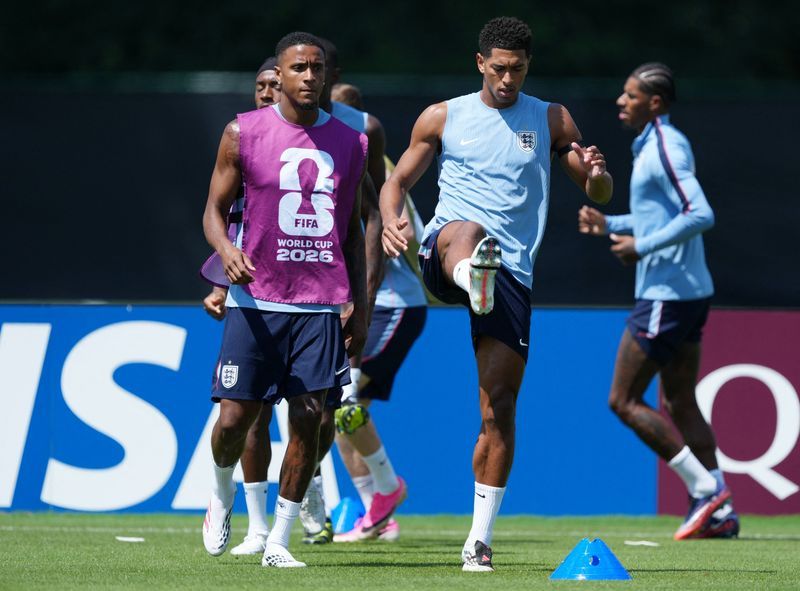
England's players are projecting a message of solidarity and resolve as they prepare to face Argentina in Wednesday's World Cup semi-final in Atlanta, seeking to move past the controversy that emerged following their narrow quarter-final victory over Norway. The squad's apparent unity represents a conscious effort to insulate themselves from the media narrative that has dominated coverage since their 2-1 extra-time win, which saw midfielder Jude Bellingham score both goals but also spark public disagreement with manager Thomas Tuchel over tactical execution and player conditions.
Defender Ezri Konsa acknowledged that external commentary will inevitably shadow England's campaign, a reality that comes with competing at the highest level of international football. However, he emphasized that the current squad possesses the maturity and experience to compartmentalize distractions and maintain focus on the task ahead. The emphasis on blocking out noise reflects a deliberate strategy to prevent the kind of internal fragmentation that has historically undermined English national teams during major tournaments. Konsa's framing suggests the players view media speculation not as a threat but as an occupational hazard that demands professional management.
The tension between Tuchel and Bellingham following the Norway match had threatened to dominate the narrative heading into the semi-final. Tuchel's criticism of his team's performance, juxtaposed against Bellingham's implicit rebuke of the manager's understanding of match conditions, created the kind of public rift that could destabilize squad morale at a crucial juncture. The fact that both camp and coach have since moved to emphasize cohesion suggests a deliberate effort to contain potential damage and present a unified front to Argentina and the broader international audience.
Marc Guehi's assessment of the squad's current state provides the most significant endorsement of Tuchel's stewardship thus far. The defender credited the German manager with fostering an environment of collective purpose and genuine belief in the team's direction. Guehi's language—describing the squad as more united than at any previous point—indicates that the Norway match, despite its surface controversy, may have actually strengthened internal bonds rather than fractured them. The adversity of playing in difficult conditions and the collective achievement of coming from behind appears to have galvanized rather than divided the group.
Tuchel's response to being informed of his players' public endorsement underscores his philosophy regarding team dynamics and motivation. Rather than seeking personal credit, the manager redirected focus to the collective commitment to both national representation and the team ethic. His observation that the broader World Cup has showcased superstars subordinating individual glory to collective purpose presents a counternarrative to the often-individualistic focus of modern football discourse. This framing allows Tuchel to elevate his squad's efforts beyond merely resolving internal disagreements to positioning them as exemplars of principled team football.
The manager's assertion that his team will not yield under pressure identifies resilience as the defining characteristic that differentiates England's current iteration from previous iterations. Tuchel's emphasis on a mentality that manifests primarily behind closed doors—away from media observation—highlights the distinction between public performance and the substantive work of building team culture. This distinction matters particularly for English football, which has often struggled with the tension between individual talent and collective function.
England's potential progression presents a significant geographic and psychological challenge. Should they overcome Argentina, they would face Spain in what would represent a rematch of the Euro 2024 final, which Spain won. Spain's 2-0 dismantling of France in Tuesday's semi-final demonstrates the Spanish team's continued tactical sophistication and efficiency. The prospect of a redemptive encounter against a team that has already defeated England in a major final adds additional narrative weight to Wednesday's fixture against Argentina.
The contrasting preparations of the two semifinalists offers insight into different approaches to managing a World Cup campaign. While England's squad gathered in Atlanta to prepare mentally and physically for their clash with Argentina, defender Marc Guehi remained sufficiently disconnected from immediate developments to sleep through Spain's impressive semi-final victory. His admission reveals the compartmentalization necessary for players to maintain focus on their own objective rather than becoming preoccupied with potential opponents or outcomes beyond their immediate control. This approach aligns with the broader theme of the squad's ability to filter external information and concentrate on internal processes.
The centrality of togetherness to England's messaging reflects both the genuine advancement in squad cohesion under Tuchel and a strategic choice to emphasize collective strength rather than individual brilliance. In the context of a World Cup semi-final against a team with the pedigree and experience of Argentina, projecting unity becomes both a genuine competitive advantage and a form of psychological messaging. Argentina will enter the match as formidable opponents, and England's capacity to function as a coordinated unit under pressure may ultimately prove decisive.
Tuchel's transformation of the squad in the months leading to this tournament appears to have succeeded in establishing the kind of collective identity that England has periodically struggled to maintain. The early controversy with Bellingham, rather than exposing fractures, seems to have clarified the manager's expectations and reinforced the team's commitment to shared objectives. Whether this unity translates into the concrete outcome of defeating Argentina will determine whether this moment represents a genuine turning point in England's World Cup campaign or merely a temporary alignment of interests.

