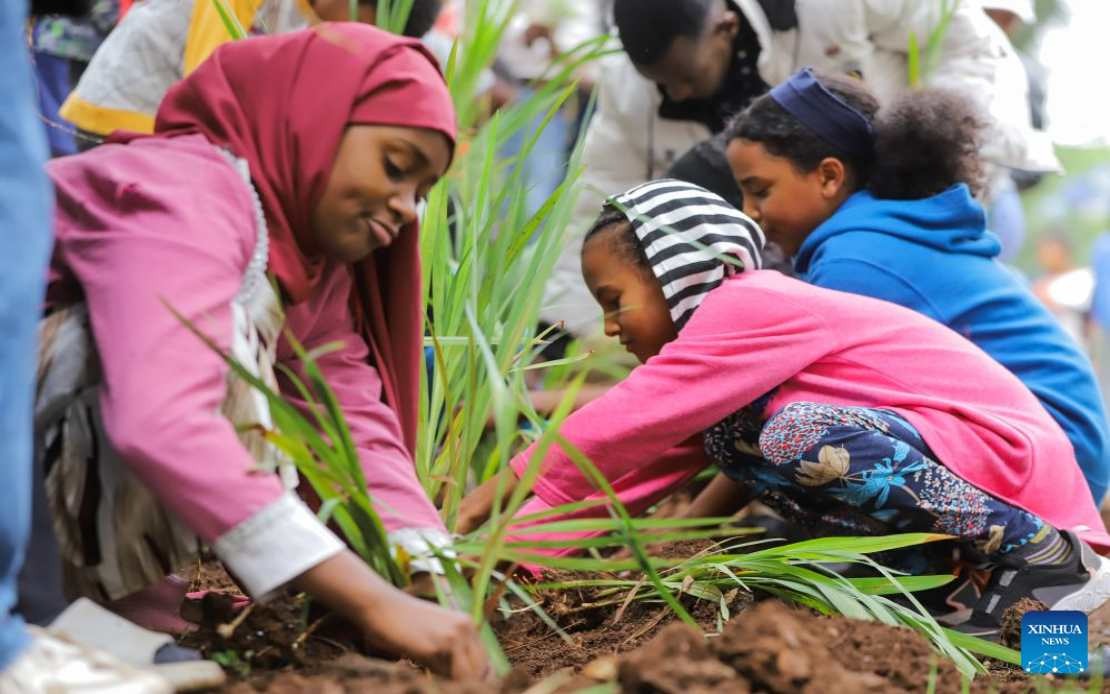
Ethiopia executed an unprecedented environmental mobilization on Monday, bringing millions of citizens and foreign residents together to plant 800 million tree seedlings in a single coordinated effort. The nationwide campaign represents the latest milestone in Prime Minister Abiy Ahmed's Green Legacy Initiative, a sweeping reforestation program that has become central to the country's development strategy. This year's operation aims to plant more than 8 billion seedlings during the rainy season, positioning Ethiopia to exceed its overarching target of 50 billion trees since the initiative's inception five years ago.
The scale of participation underscores how deeply the environmental program has embedded itself into Ethiopian society. From schoolchildren to healthcare workers, citizens across income levels and professions converged on designated planting sites in towns and rural areas alike. Thirteen-year-old Edilawit Legesse, planting seedlings in the Alembank neighborhood outside Addis Ababa, exemplified the generational commitment the initiative has fostered. For Legesse, Monday marked her third consecutive year of participation, a pattern repeated across the country as families and community groups made the annual event a fixture in their calendars.
The organizational complexity of mobilizing such participation should not be underestimated. At individual sites, group commitments were substantial—a nursing contingent near Entoto Mountain in the capital, for instance, fielded 35 healthcare professionals dedicated to planting trees. Such collective efforts multiplied across thousands of locations nationwide created the infrastructure for the record attempt. The coordination required reflects Ethiopia's determination to transform environmental restoration from a peripheral concern into a core national endeavor, with government resources directed toward logistics, seedling distribution, and site preparation.
Prime Minister Abiy Ahmed framed the exercise in terms that extend beyond environmental metrics alone. In remarks posted to social media after participating in the planting, he described the annual one-day effort as a unifying national moment where Ethiopians "from all walks of life come together to create a lasting legacy for generations to come." This language suggests the initiative serves a dual purpose: simultaneously addressing ecological degradation while reinforcing social cohesion and collective identity around shared environmental stewardship.
The Green Legacy Initiative's scope encompasses multiple environmental and economic objectives. Beyond carbon sequestration and afforestation, the program targets the restoration of degraded landscapes that centuries of agricultural pressure and overexploitation have rendered less productive. Expanding Ethiopia's forest cover directly addresses deforestation—a persistent challenge across the Horn of Africa—while simultaneously building resilience against climate variability. For a nation where agriculture remains foundational to rural livelihoods and national income, strengthening ecosystems offers tangible economic benefits alongside environmental ones.
From a regional perspective, Ethiopia's reforestation efforts carry significance beyond its borders. The Horn of Africa faces mounting pressure from desertification, changing precipitation patterns, and competition for water resources. Ethiopia's massive tree-planting initiative serves as a demonstration project for environmental restoration at scale, potentially offering lessons for neighboring countries confronting similar ecological challenges. Kenya, Uganda, and other East African nations have undertaken their own afforestation programs, but few have attempted mobilization on Ethiopia's current scale.
For Malaysian readers and Southeast Asian observers, Ethiopia's approach offers instructive parallels. The region faces its own deforestation crises, particularly in Indonesia, Malaysia, and parts of mainland Southeast Asia, where palm oil expansion and timber extraction have decimated forest cover. Ethiopia's model of converting tree-planting into a mass national event—complete with political endorsement, organized community participation, and ambitious numerical targets—represents one possible approach to reclaiming lost ecosystems. Whether such campaigns can achieve their environmental aims depends on factors including seedling survival rates, ongoing maintenance, and land-use policies that protect newly planted areas from being cleared for agriculture or development.
The 2024 campaign brings Ethiopia toward its 50-billion-tree goal, a figure that emerged from calculations about what reforestation density and extent would meaningfully alter the country's environmental trajectory. Achievement of this target would represent substantial progress, though experts note that tree-planting campaigns must be coupled with forest protection policies and sustainable land management to generate lasting ecological benefits. Seedlings planted during a single enthusiastic day face mortality risks from inadequate rainfall, pests, and competing vegetation if follow-up care remains insufficient.
Beyond environmental outcomes, Ethiopia's Green Legacy Initiative functions as a governance statement. The ability to organize and execute a coordinated nationwide campaign demonstrates state capacity and social mobilization capability. In a country navigating post-conflict reconstruction and political transitions, such coordinated national endeavors may serve to rebuild institutional trust and demonstrate government commitment to tangible improvements in citizen welfare.
Looking forward, sustaining momentum will prove critical. Initial enthusiasm for tree-planting campaigns often wanes after the symbolic one-day event concludes. Ethiopia's challenge lies not merely in planting 8 billion seedlings this year, but ensuring that sufficient percentages survive to maturity and that the broader reforestation program becomes embedded in long-term land-use planning and agricultural practices. The government's willingness to dedicate resources and political attention to the initiative suggests commitment, yet the coming years will test whether the Green Legacy Initiative can translate mass participation into persistent ecological transformation.

