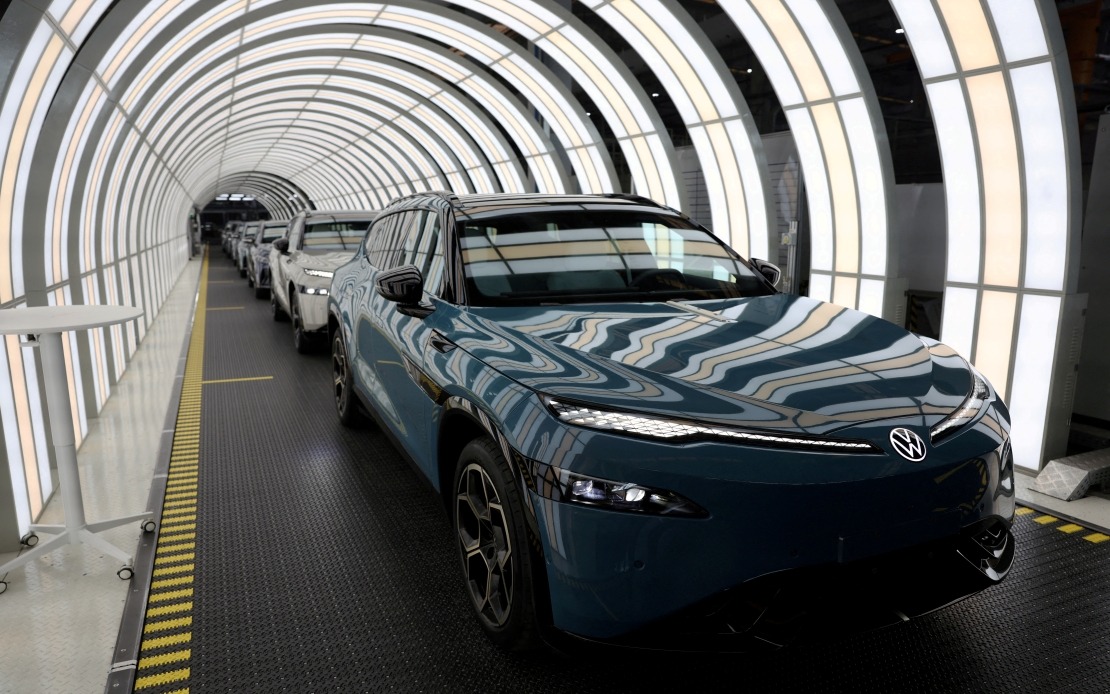
The European Union's punitive tariff regime on Chinese-manufactured electric vehicles has triggered a major recalibration of production strategies among Western automakers, compelling them to shift battery electric vehicle assembly back to European facilities rather than relying on cheaper Chinese imports. New analysis by European transport group T&E demonstrates how trade policy is fundamentally reshaping the global automotive landscape, with immediate consequences for supply chains across Europe and reverberations felt throughout Southeast Asia's emerging automotive sector.
The statistical evidence is striking. Western automakers selling to European consumers saw their reliance on Chinese-produced EVs collapse in just over a year. In the first quarter of 2024, vehicles from established brands such as BMW, Dacia, Volvo, Smart and Tesla that were manufactured in China represented 38 per cent of total EV sales in Europe. By the opening quarter of this year, that proportion had plummeted to 23 per cent—a reduction of 15 percentage points in less than eighteen months. This dramatic shift reveals how tariff structures can swiftly alter manufacturing decisions worth billions in capital investment.
Tesla's trajectory exemplifies this broader trend. The electric vehicle manufacturer's share of China-sourced vehicles in Europe's EV market contracted from 23 per cent to 19 per cent across the same period. For Tesla, which operates the Giga Shanghai facility—one of the world's most efficient EV production plants—this represents a calculated strategic retreat from European-bound exports, likely redirected toward the Chinese domestic market and other Asian destinations where tariff barriers do not apply. The company's decision to prioritize European assembly reflects both the commercial penalties of tariffs and the political necessity of maintaining market access in the bloc.
However, the EU tariff framework has produced markedly different outcomes depending on which Chinese manufacturers face scrutiny. Import volumes from indigenous Chinese automakers including BYD and Geely have defied expectations by continuing to expand despite the protective measures introduced in 2024. Industry analysts attribute this counterintuitive pattern to substantial excess production capacity across China's automotive sector. Rather than curtailing manufacturing, Chinese producers have simply diverted export volumes toward markets perceived as less hostile, or maintained aggressive European entry strategies betting that tariff costs can be absorbed or passed to consumers.
The exception proving this rule involves SAIC, which has experienced a dramatic erosion of its European sales foothold since tariffs took effect. The company's predicament stems from EU investigations concluding that SAIC benefited disproportionately from state subsidies woven throughout its supply chain—from raw material procurement to component manufacturing to final assembly. Consequently, SAIC has faced tariff duties nearly double those imposed on competing Chinese manufacturers, effectively pricing it out of price-sensitive European market segments where it had begun building presence.
Rather than abandon the European market entirely, Chinese automakers have adopted a longer-term strategic pivot toward localized production on the continent itself. Since the European Union initiated its subsidy investigation in 2023—the precursor to subsequent tariff implementation—plans for ten new manufacturing facilities in Europe have been formally announced by Chinese producers. These investments represent a fundamental recalibration: accepting higher European labor costs and regulatory compliance expenses while avoiding tariff exposure and securing stable market access through local production credentials.
Parallel to battery electric vehicle developments, Chinese manufacturers have recalibrated their export strategy to emphasize plug-in hybrid technology, a category perceived as less politically contentious within European policy circles. The market share of Chinese plug-in hybrid vehicles in the EU has accelerated sharply, rising from a negligible 3 per cent in 2024 to 13 per cent currently. This expansion suggests Chinese producers are deliberately diversifying their product portfolio to circumvent concentration of tariff exposure while gradually acclimating European consumers to their technology and brand presence.
For Malaysian and Southeast Asian observers, these developments carry substantial implications. The tariff-induced reshuffling of global EV supply chains creates both opportunities and risks for the region. Southeast Asia's emerging position as a manufacturing hub for automotive components—particularly battery technology and semiconductor-adjacent functions—becomes increasingly valuable as Western and Chinese producers alike seek alternative sourcing beyond mainland China. Regional suppliers positioned in Vietnam, Thailand, and Indonesia may experience heightened demand as diversification becomes corporate imperative rather than cost optimization.
Conversely, the regionalization of EV production within Europe, and the anticipated localization of Chinese production through European facilities, may reduce opportunities for Southeast Asian manufacturers hoping to capture assembly and integration work that previously gravitated toward lower-cost jurisdictions. The tariff structure, by raising the cost disadvantage of distance, incentivizes production clustering near consumption rather than leveraging global arbitrage. This geography of protectionism reshapes competitive dynamics across Asia.
The broader narrative reflects how trade tensions between the United States, the European Union, and China are fragmenting automotive supply chains into regional blocs with distinct tariff and regulatory regimes. The EU's tariff approach, while framed as protection against unfair subsidization, functions simultaneously as industrial policy—deliberately making local production more economically attractive relative to imports. This logic extends beyond automobiles: as other sectors face similar tariff regimes, the incentive structure shifts manufacturing decisions away from global optimization toward regional self-sufficiency.
For Malaysia specifically, which maintains trade relationships across the tariff-divided landscape, the EV sector reconfiguration presents a moment for strategic positioning. The nation's automotive ambitions, historically focused on internal combustion engines, increasingly must account for how EV supply chains are reorganizing around protected markets. Whether Malaysia can attract investment in EV component manufacturing, battery assembly, or related functions depends partly on competitive positioning relative to other Southeast Asian nations and partly on whether the nation develops tariff-adjacent manufacturing advantages for serving regional demand.
The transformation underway is not merely a temporary market correction but reflects deeper structural changes in how multinational manufacturers approach global operations under intensifying protectionist pressure. Western automakers have learned that maintaining European market access requires European production; Chinese manufacturers are learning that European expansion requires European facilities. The era of manufacturing arbitrage across continents, where simple cost differentials drove location decisions, has yielded to an epoch where political risk and regulatory access shape capital allocation more powerfully than labor cost advantages alone.

