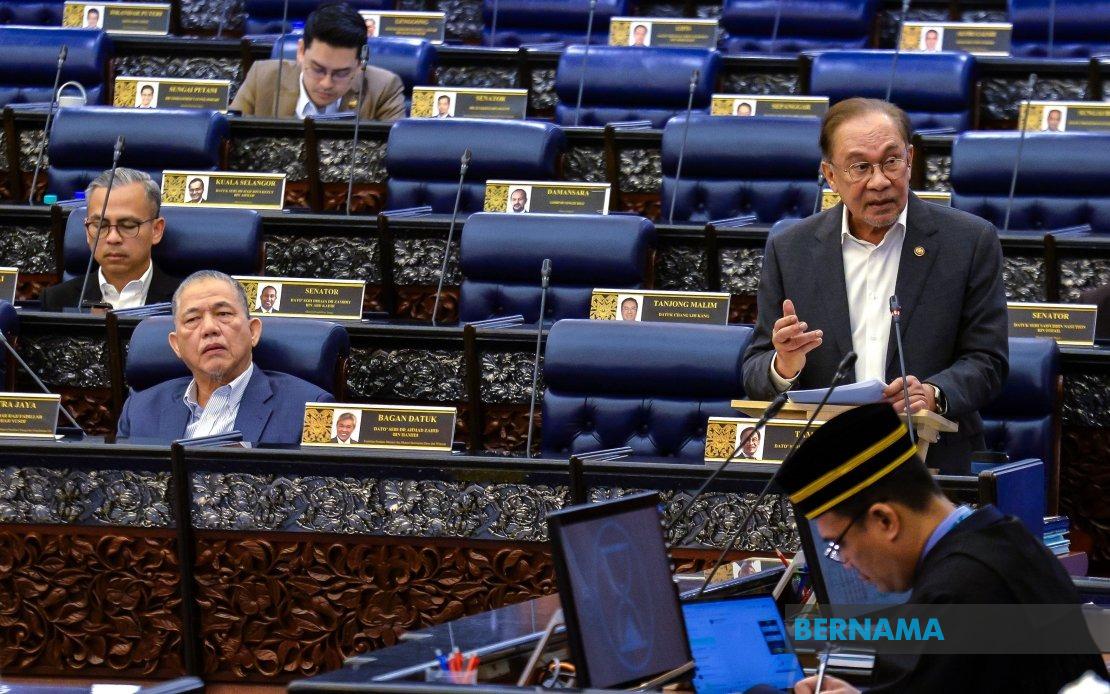
Prime Minister Datuk Seri Anwar Ibrahim has moved to settle longstanding disputes over the fairness of federal budget distribution to states, asserting that allocation decisions are grounded in the specific requirements of individual states rather than merely reflecting their tax contributions to the national treasury. Speaking during Parliamentary Question Time in Kuala Lumpur on June 30, the Prime Minister addressed concerns that some states face marginalisation by the federal government, clarifying instead that the vast majority of state governments benefit from allocations that exceed their revenue contributions.
The only exceptions to this pattern, according to Anwar, are Selangor and Penang, which generate tax revenues exceeding the allocations they receive from the federal government. This distinction underscores a deliberate redistribution mechanism within Malaysia's fiscal federalism framework, whereby wealthier states that collect higher tax revenues subsidise the development needs of less economically advanced regions. The principle reflects a broader national equity objective, ensuring that all states can fund essential services regardless of their individual fiscal capacity.
Anwar outlined the criteria guiding allocation decisions, emphasising that funding priorities encompass flood mitigation infrastructure, critical transportation networks including the Pan Borneo highway expansion, road construction projects, water and drainage system upgrades, poverty reduction initiatives, and educational facility development. This comprehensive approach demonstrates that the federal government evaluates state needs across multiple dimensions—environmental resilience, connectivity, basic services, and human capital—rather than applying a simplistic revenue-sharing formula. The diversity of funded projects reflects the varied demographic and geographical challenges across Malaysia's peninsular and East Malaysian territories.
In directly responding to a question from Datuk Seri Doris Sophia Brodi, a GPS-Sri Aman member, the Prime Minister highlighted the MADANI Government's record in enhancing allocation distribution mechanisms. He emphasised that states traditionally considered less developed, including Kedah, Terengganu, and Kelantan, have received substantially higher federal allocations under the current administration compared to previous governments. This claim positions the MADANI Government's approach as more equitable and responsive to the needs of economically vulnerable regions.
The timing of this clarification reflects the political sensitivity surrounding federal-state fiscal relations in Malaysia, where opposition-controlled or coalition-aligned state governments sometimes contest the adequacy of federal support. By articulating a clear principles-based framework—one rooted in needs assessment rather than simple tax-sharing—Anwar attempts to neutralise accusations of political bias in budget distribution. The distinction matters considerably in Malaysian politics, where state-federal relations have historically become flashpoints for allegations of partisan discrimination.
The MADANI Government's allocation methodology represents a departure from purely mechanical distribution formulas. By prioritising flood mitigation, for instance, states vulnerable to seasonal flooding receive enhanced resources regardless of their tax base—a particularly relevant consideration for Terengganu, Kelantan, and other flood-prone regions that have experienced devastating inundation in recent years. Similarly, allocating substantial funds toward the Pan Borneo highway upgrade addresses long-standing regional development gaps in Sabah and Sarawak, improving connectivity and economic integration across Malaysian territories.
This redistributive approach carries important implications for Malaysia's development agenda. States with higher revenue-generating capacity retain sufficient resources for their operations while contributing disproportionately to national infrastructure and poverty reduction efforts. Simultaneously, states with weaker revenue bases gain access to capital for transformative projects that they could not independently finance. This mechanism theoretically strengthens national cohesion by ensuring equitable access to modern infrastructure and essential services across all regions.
The Prime Minister's emphasis on needs-based allocation also reflects practical governance reality. Different states face fundamentally different challenges—East Malaysian states grapple with vast territories and dispersed populations requiring extensive infrastructure investment, while flood-prone peninsular states require specialised drainage and resilience infrastructure. A uniform allocation formula would inadequately address these heterogeneous requirements. The MADANI Government's approach permits flexibility in responding to specific regional circumstances.
However, the allocation framework raises ongoing questions about transparency and measurement. How are "needs" objectively quantified? What mechanisms ensure that funds intended for specific projects actually reach their intended destinations? The Prime Minister's statement addresses the principle but leaves implementation details unspecified. Malaysian taxpayers and state officials alike would benefit from more detailed published criteria and auditable allocation decisions.
The assertion that Selangor and Penang represent exceptions—states contributing more in tax revenue than they receive in allocations—warrants consideration. These economically dynamic states generate substantial commercial and industrial activity, concentrating Malaysia's most productive economic zones. Federal allocation patterns that extract net resources from these states might influence their long-term competitiveness and investment climate, though such concerns remain largely unexplored in public discourse.
Anwar's parliamentary response also implicitly reframes debates around state government funding as matters of need assessment and resource optimisation rather than zero-sum political contests. This framing potentially depoliticises federal-state fiscal relations, though whether opposition-controlled state governments accept this characterisation remains uncertain. The statement serves notice that the current administration intends to defend its allocation methodology on principled grounds rather than simply asserting discretionary authority.
Looking forward, the MADANI Government's allocation approach represents a significant statement about national priorities and federalism principles. By openly committing to needs-based rather than revenue-based distribution, the government stakes its credibility on identifying genuine development requirements and delivering resources accordingly. The public record on these allocations will increasingly provide evidence for evaluating whether principle translates into practice, offering voters and analysts meaningful basis for assessing government performance on fiscal federalism.

