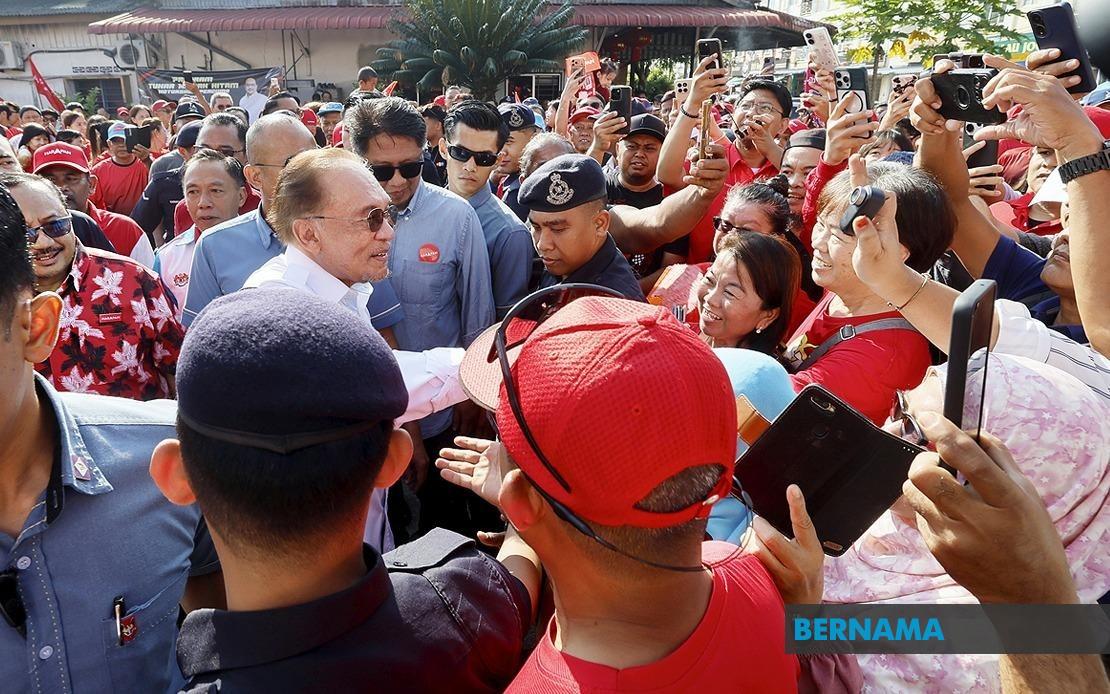
Prime Minister Datuk Seri Anwar Ibrahim has moved to counter perceptions that the Federal Government shows political bias in its allocation of development resources, asserting that his administration operates with fairness across all states irrespective of which coalition controls them. Speaking at a campaign event in Batu Pahat on July 9, Anwar underscored the government's track record of delivering assistance and implementing projects nationwide, rejecting suggestions that certain regions receive preferential treatment based on their political allegiances.
The timing of these remarks carries particular significance, delivered during campaigning for the 16th Johor state election. Anwar's emphasis on impartiality addresses a recurrent criticism levelled at federal governments in Malaysia—the allegation that resources flow preferentially to states governed by the ruling coalition while opposition-controlled territories receive diminished attention. This accusation has become increasingly prominent in Malaysian political discourse, particularly as coalition governments have shifted across electoral cycles and as voters become more attuned to comparing development outcomes across state lines.
Anwar, who chairs the Pakatan Harapan coalition, highlighted several major infrastructure and developmental undertakings as concrete evidence of the Federal Government's commitment to equitable distribution. The Johor-Singapore Special Economic Zone represents a significant cross-border initiative intended to enhance economic cooperation and generate investment opportunities in the southern region. This project exemplifies the type of strategic infrastructure development that the Prime Minister argues demonstrates federal commitment to all states regardless of political complexion.
Further supporting his argument, Anwar pointed to flood mitigation investments in Johor's Segamat and Muar districts, noting that the Federal Government has approved billions of ringgit for these critical projects. Flood management represents a pressing concern in several Malaysian states, and substantial federal funding for these initiatives signals governmental prioritization of public safety and disaster prevention across diverse constituencies. The allocation of such significant resources to Johor—currently under opposition governance in some districts—attempts to illustrate that development decisions follow need-based rather than partisan logic.
The Prime Minister's remarks also referenced development activities in Kelantan and Kedah, both states with varying political compositions. This broader geographical reference strengthens his argument that the Federal Government maintains a consistent approach to resource allocation across the country rather than tailoring its policies to suit coalition interests. For Malaysian voters weighing political choices in state elections, such assurances about federal impartiality hold considerable weight, as development funding represents one of the most tangible benefits of electoral outcomes.
Anwar sought to distinguish between campaign-era promises and substantive action, asserting that the Federal Government delivers assistance consistently rather than concentrating its efforts around electoral periods. This distinction carries importance in the Malaysian political context, where historical patterns have sometimes seen intensive government activity cluster around election campaigns before diminishing afterward. By emphasizing sustained development programmes rather than election-cycle largesse, Anwar attempts to present his administration as more institutionally committed to national development than previous governments.
The event in Senggarang drew attendance from several senior government figures, including Communications Minister Datuk Fahmi Fadzil, who holds the position of Pakatan Harapan communications director. The presence of coalition candidates for the Senggarang, Semerah, and Penggaram seats—Onn Abu Bakar, Mohd Khuzzan Abu Bakar, and Felicia Poh Rui Ling respectively—reinforced the dual messaging of the occasion, combining political campaigning with assertions of governmental evenhandedness.
The framing of equitable federal treatment carries implications extending beyond Johor's immediate political context. Concerns about resource distribution and regional development represent ongoing challenges across Southeast Asia, where governments frequently face accusations of partisan resource allocation. Malaysia's federal structure, combining national governance with state autonomy in certain domains, creates particular complexity in this regard. Federal funding decisions inevitably intersect with state-level politics, creating opportunities for either genuine equitable governance or perceived partisan advantage.
For opposition-governed states across Malaysia, Anwar's assertions about federal impartiality address longstanding anxieties about potential resource deprivation as punishment for political choice. These concerns have proven sufficiently salient historically that they influence voter behaviour and state-level political calculations. If voters perceive that choosing opposition state governments risks federal punishment through reduced development funding, such perceptions independently shape electoral outcomes regardless of underlying policy reality.
The emphasis on development projects as evidence of governmental fairness reflects an important aspect of Malaysian political culture, where infrastructure investment and visible development rank among voters' primary evaluation criteria for government performance. Major projects like the JS-SEZ or substantial flood mitigation funding generate tangible benefits and visible transformation of physical landscapes, making them particularly effective in political messaging.
Moving forward, the Federal Government's actual implementation of announced projects and its allocation of subsequent development funding will ultimately determine whether current assertions of impartiality withstand public scrutiny. The credibility of these claims rests less on rhetoric than on consistent performance across multiple electoral cycles and across states governed by different political coalitions. For Malaysian voters and political observers, tracking whether the Federal Government maintains announced commitments to equitable resource distribution will prove essential to evaluating both the truthfulness of current assertions and the viability of federal governance under the current administration.

