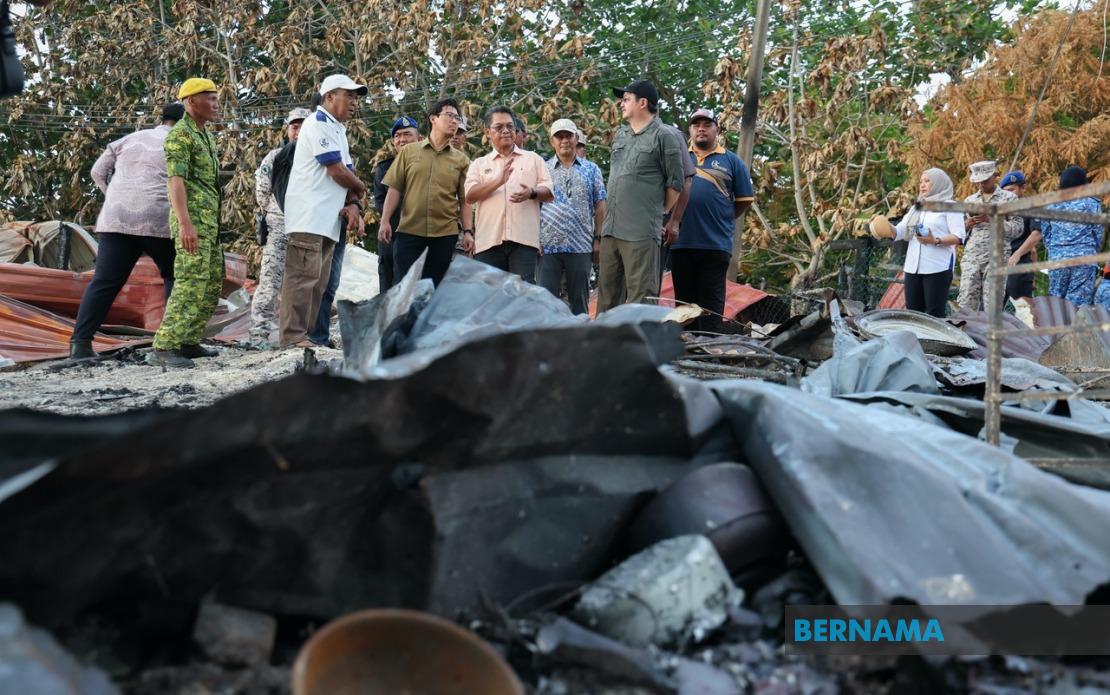
The Federal Government has swiftly mobilised assistance for residents of Pulau Nunuyan Laut in Sandakan following a destructive fire that razed 28 houses in the early morning hours and displaced more than 100 people from their homes. Initial aid has been distributed to 29 household heads affected by the disaster, with the Prime Minister's Department taking the lead in coordinating relief efforts and assessing longer-term support needs for the displaced community.
Datak Mustapha Sakmud, the Minister in the Prime Minister's Department responsible for Sabah and Sarawak affairs, announced that the Implementation Coordination Unit has already begun executing concrete measures to alleviate the immediate hardship faced by affected residents. The assistance extends beyond cash relief to include practical provisions such as wheelchairs for elderly community members who have lost their homes and possessions in the fire.
The minister's intervention reflects a broader strategy of preventing secondary disruptions to the community's daily life. Recognising that children from Pulau Nunuyan Laut depend on a jetty to commute to and from school, he has directed the Sandakan Municipal Council and related government bodies to prioritise repairs to this essential infrastructure. The immediate restoration of this transport link aims to ensure that the tragedy does not compound by further disrupting the educational schedules of young residents during their recovery period.
Coordination between multiple layers of government has proven crucial in the initial response. Datuk Walter Kenson, president of the Sandakan Municipal Council, accompanied the minister in assessing the fire site and confirmed that municipal authorities are collaborating with national-level agencies to comprehensively evaluate what each affected household requires going forward. This multi-agency approach recognises that fire victims often face diverse needs ranging from shelter and food to medical care and psychological support.
The relocation of displaced residents presents a more complex challenge that will require sustained coordination over weeks and months ahead. The Rural Development Department has been tasked with identifying suitable areas for permanent or semi-permanent resettlement, with village reserve land emerging as a possible option. However, the situation is complicated by the fact that many of the fire victims were already living on privately owned land when the disaster struck, occupying two separate plots held by different landowners.
This underlying issue of tenure and land rights adds a layer of complexity that authorities must carefully navigate. Resolving the relocation question will require open dialogue with both private landowners and the affected residents to reach an arrangement that addresses immediate housing needs while respecting property rights. The Rural Development Department's involvement signals a commitment to finding sustainable long-term solutions rather than temporary fixes.
Beyond shelter, the comprehensive relocation plan being developed encompasses fundamental utilities that define livable communities. Authorities are planning to ensure that any new settlement area for these residents will have reliable electricity supply, clean water access, and adequate transportation infrastructure including jetty facilities. These elements are essential for enabling the community to resume normal economic and social activities after losing their homes.
The scale of displacement is significant by the standards of a small coastal community. More than 100 people have become homeless in a single incident, straining local resources and requiring intervention from federal agencies. The loss of 28 houses represents substantial economic damage to a community that likely operates on modest incomes dependent on maritime activities and fishing.
The timing of government response has been relatively swift, with the minister and municipal president visiting the site within hours of the fire being extinguished. This rapid deployment of senior officials signals political recognition of the severity of the situation and demonstrates commitment to preventing the disaster from being forgotten or deprioritised in the face of competing government demands.
For Sabah's coastal communities and other rural areas prone to fire risks, this incident underscores the vulnerability of settlements often built from lightweight materials on marginal land. The concentration of multiple households in densely packed configurations, typical of fishing villages and settlements on islands, means that a single fire can quickly become a community-wide catastrophe. The government's response model here—immediate relief, infrastructure assessment, and medium-term relocation planning—may serve as a template for similar incidents elsewhere in the country.
The involvement of the Prime Minister's Department itself, rather than just state-level bureaucracies, elevates this disaster response beyond routine municipal administration. It signals that federal resources and high-level political attention are being focused on ensuring that Pulau Nunuyan Laut residents are not left to manage their recovery alone. As the relocation process unfolds over coming months, maintaining this level of coordinated support will be essential to helping the community rebuild.

