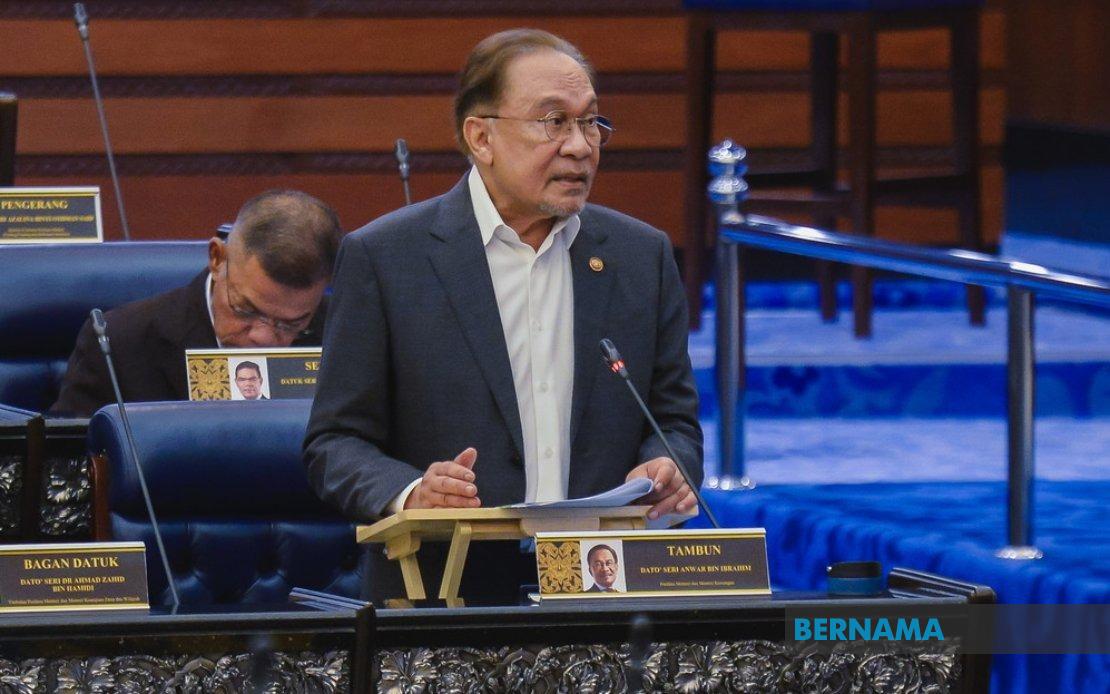
Prime Minister Datuk Seri Anwar Ibrahim has established a firm boundary on how the federal government will handle requests from state administrations for additional development funding, particularly when projects undergo cost escalations through Notices of Change. Speaking in Parliament on June 30, Anwar made clear that any such request cannot proceed without formal renegotiation between federal and state authorities, ensuring that cost increases are properly justified and scrutinised before public money is committed.
The clarification addresses a systemic issue in Malaysian project governance where cost overruns have become increasingly common across infrastructure and development initiatives. When a Notice of Change is issued—a contractual mechanism that formally documents alterations to a project's scope, timeline, or financial parameters—it triggers substantial fiscal consequences that extend beyond a state's individual budget considerations. The Prime Minister's pronouncement signals a shift towards more disciplined fiscal management at the federal level, one that refuses to rubber-stamp expenditure decisions made by state governments without proper evaluation.
Anwar outlined the critical factors that must be examined during renegotiation. The first involves establishing responsibility for cost increases, determining whether the contractor bears responsibility through mismanagement, underquoting, or poor planning. This distinction matters tremendously because it determines who should bear the financial burden of the overrun. Should the contractor have quoted accurately, they ought to absorb such costs. Conversely, if genuine unforeseen circumstances drove increases—such as significant commodity price volatility or genuine site discoveries—the analysis becomes more complex and may justify shared responsibility.
The second dimension emphasises federal sovereignty in fiscal matters. Once a state requests additional federal allocation or loan facility, the matter transcends state autonomy and becomes a federal budgetary decision. Anwar stressed that the federal government cannot be automatically bound by state decisions made in isolation, nor can it permit a culture where cost escalations trigger reflexive federal bailouts. This principle protects national fiscal discipline and prevents moral hazard where state officials might negotiate contracts carelessly, knowing the federal government will ultimately cover overruns.
The remarks emerged during parliamentary questioning about Kedah's request for supplementary funding for the Pulau Bunting Water Treatment Plant project, a critical infrastructure initiative that supplies water to the northern region. The project's cost increase evidently prompted the state to seek federal assistance, making it an instructive case study in how such matters should be processed. Rather than treating it as a discrete state problem, Anwar's framework positions it within broader federal fiscal governance and inter-governmental financial relations.
Water infrastructure projects carry particular weight in Malaysia's development narrative. The Pulau Bunting facility represents essential public utility expansion in Kedah, addressing population growth and industrial demand. However, this strategic importance does not exempt it from rigorous financial scrutiny. Indeed, the criticality of water supply strengthens the case for careful cost management, as taxpayers across the nation ultimately fund federal loans and allocations to support such projects.
Anwar delegated detailed explanations to Deputy Prime Minister and Energy Transition and Water Transformation Minister Datuk Seri Fadillah Yusof, reflecting the distributed nature of infrastructure governance across federal ministries. Fadillah's portfolio encompasses both energy and water, positioning him as the technical authority on project assessments and funding frameworks. This division of responsibility maintains operational clarity while Anwar stakes out the broad policy position.
The Prime Minister's insistence on renegotiation rather than automatic approval resonates with his administration's broader commitment to fiscal prudence. Malaysia's federal debt and fiscal constraints have repeatedly featured in policy discussions, with successive governments acknowledging the need for stricter expenditure controls. Renegotiation processes permit deeper examination of contract terms, alternative solutions, and whether the state and contractor have exhausted efficiency improvements before seeking federal funds.
For state governments accustomed to more flexible federal arrangements, this position may require adjustment in planning practices. States must now anticipate that cost increase requests will face substantive interrogation rather than sympathetic approval. This incentivises more rigorous initial contracting, better project management, and more realistic budgeting. While initially appearing burdensome, such discipline ultimately strengthens project delivery across the federation.
The renegotiation principle also protects federal funds from being stretched excessively across competing demands. With infrastructure development needs throughout Malaysia—from Peninsular Malaysia to East Malaysia—federal resources must be allocated strategically. Automatic approval of state requests would quickly exhaust available funds and potentially compromise other priority investments or essential services.
Southeast Asian neighbours observe Malaysia's approach to infrastructure financing and fiscal federalism with interest. Regional competitiveness depends partly on reliable, cost-effective infrastructure. By institutionalising rigorous assessment of cost escalations, Malaysia demonstrates commitment to project quality and financial responsibility, factors that increasingly matter to foreign investors evaluating operating environments.
The statement also clarifies accountability lines. States cannot deflect responsibility for project management failures upward to the federal government by simply requesting additional funds. Each administration bears responsibility for contractor selection, contract monitoring, and cost control within its purview. Only when genuine unforeseen circumstances warrant do states have legitimate claims on federal resources, and only after demonstrating that internal measures have been exhausted.
Moving forward, Kedah and other states will need to prepare comprehensive justifications for cost increase requests, detailing what triggered escalations and why additional funding represents the only viable solution. This process, though demanding, ultimately produces better outcomes for Malaysian taxpayers and infrastructure users alike.

