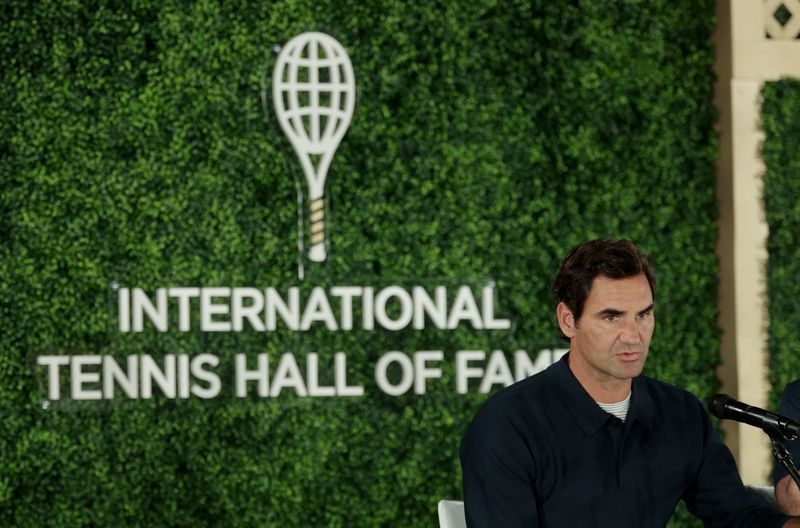
Roger Federer marked one of sport's most prestigious honours with contemplation rather than celebration when he entered the International Tennis Hall of Fame on Saturday in Newport. The 45-year-old Swiss champion, alongside renowned broadcaster and journalist Mary Carillo, took the occasion not merely as a capstone to his playing career but as an opportunity to assess what his presence in tennis ultimately meant beyond the gleaming trophy cabinet that defined his professional life.
Federer's achievements in competitive tennis remain staggering by any measure. His eight Wimbledon titles set a men's record that stood as the gold standard of sustained excellence at a single Grand Slam venue. To this he added six Australian Open crowns, five U.S. Open trophies, and a 2009 French Open triumph that completed an elusive career Grand Slam—a feat that demonstrated his technical mastery transcended the grass courts where he appeared most at home. These 20 Grand Slam championships, accumulated across nearly two decades of elite play, established him as one of the sport's most accomplished champions when he retired in 2022 after spending 310 weeks ranked first globally and claiming 103 ATP Tour titles.
Yet Federer's reflection on his Hall of Fame induction suggested a shift in perspective regarding how sporting legacies ought to be measured and understood. Speaking at a news conference moderated by Hall of Fame president Patrick McEnroe, he described the honour as qualitatively distinct from the rankings and trophies that had consumed his competitive focus. The recognition, he indicated, belonged to a different category of achievement—one that encompassed influence and stewardship of the sport itself rather than mere dominance of its playing surfaces.
This distinction proved particularly meaningful given Federer's extensive involvement in professional tennis governance throughout his career. He highlighted his collaborative efforts with ATP leadership, Grand Slam tournament directors, player unions, and various councils as instrumental in advancing the sport's infrastructure and economic opportunities. The tangible results of such engagement appeared evident in expanded prize purses that extended beyond tournament champions to reward early-round performances, creating more sustainable income pathways for professional players at all competitive levels.
For Malaysian and Southeast Asian tennis followers, Federer's emphasis on improving player conditions carries particular resonance. The region has produced several professional players seeking international careers, yet the economic realities of professional tennis—travel costs, coaching fees, and extended periods without prize money—create barriers to entry that Federer's advocacy has helped address. His contributions to enhancing prize distributions and stadium facilities, along with better support for medical staff and media personnel, have established higher standards that ripple through the professional circuit globally, including tournaments that attract or feature regional players.
Federer acknowledged the psychological intensity that accompanied his rise from gifted Swiss teenager to global sporting icon. Rather than portraying this trajectory as inevitable, he described a conscious embrace of competitive pressure and a deliberate preference for the grand stages—Centre Court at Wimbledon rather than peripheral competition courts. This mental orientation, he suggested, shaped his approach to professional tennis, enabling him to thrive in high-stakes environments where lesser players might wilt under external scrutiny and expectation.
However, his reflection also touched upon the darker dimensions of elite sport's intensity. The relentless scrutiny faced by top-ranked players, wherein success is measured exclusively through tournament victories, creates what Federer characterised as a cognitive maelstrom—a constant barrage of external commentary and judgment that can erode the fundamental enjoyment underlying athletic pursuit. His acknowledgment that players sometimes lose the essential pleasure within their sport despite reaching its pinnacle speaks to psychological costs often obscured by glamorous portrayals of professional tennis.
Despite his competitive retirement, Federer has remained selectively engaged with professional tennis. His recent exhibition match at Arthur Ashe Stadium ahead of the U.S. Open demonstrated continued vitality and connection to the sport, while his attendance at multiple tournaments annually maintains his presence within the professional ecosystem. This ongoing involvement, he explained, refreshes his mental engagement with tennis and clarifies potential future contributions.
Federer left deliberately open the possibility of future roles within professional tennis—potentially captaining the Laver Cup, mentoring emerging players, or working as a commentator. Such positions would represent a natural evolution for a player of his stature and insight, allowing him to channel competitive experience and institutional knowledge toward developing the next generation of international tennis talent. For the sport's broader development, particularly in markets like Malaysia where tennis infrastructure continues developing, such mentorship from tennis's most successful practitioners could elevate standards and expand the talent pipeline.
The Hall of Fame induction ultimately crystallised a distinctive legacy that extends beyond statistical excellence. While Federer's 20 Grand Slam titles, Olympic gold medal in doubles with Stan Wawrinka in 2008, and 2014 Davis Cup victory with Switzerland remain objectively remarkable achievements, his induction speech suggested he views these accomplishments as components of a larger narrative about professional tennis's institutional development and societal value. His advocacy for improved player compensation, better working conditions, and enhanced tournament infrastructure represents tangible contributions to sports governance that persist long after individual victories fade into historical record.
For tennis enthusiasts across Southeast Asia, Federer's Hall of Fame moment underscores how sporting legacies transcend individual glory to encompass broader industry stewardship. As emerging professional players from the region navigate international circuits, they benefit from institutional improvements Federer helped advance—improved prize money distributions, better medical support, and elevated stadium standards that make professional tennis careers more economically viable and personally sustainable than earlier eras permitted.

