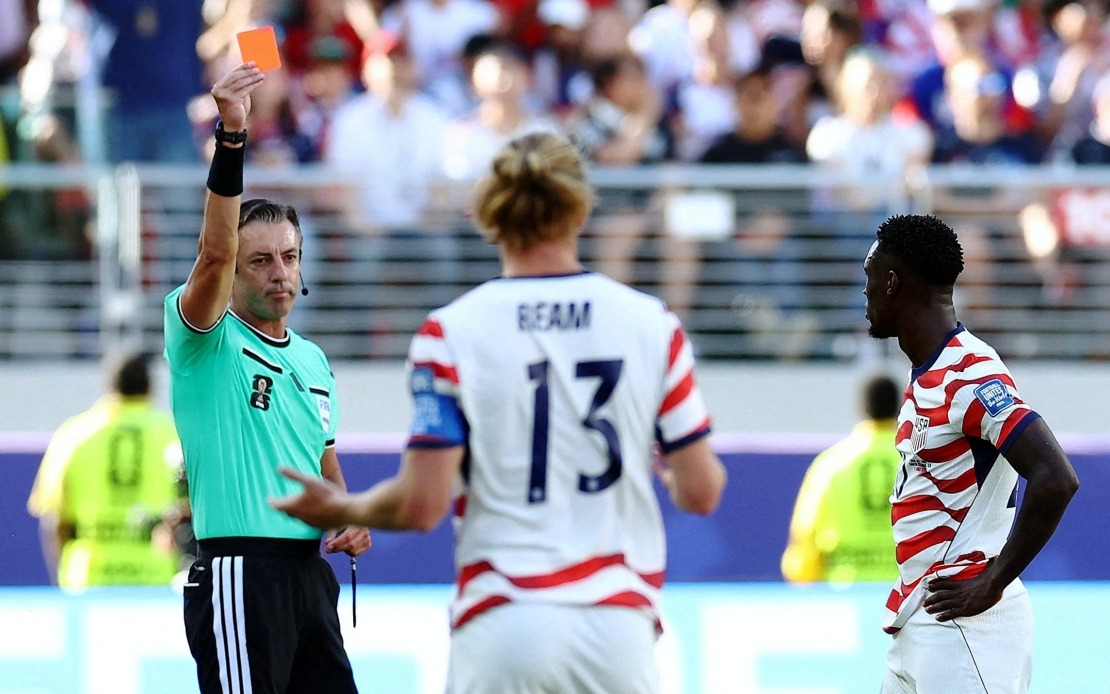
The international football governing body has rallied behind Brazilian match official Raphael Claus following pointed criticism from United States President Donald Trump, underscoring the tensions that can arise when political figures intervene in sporting decisions. Claus issued a red card to American striker Folarin Balogun during a last-32 encounter against Bosnia and Herzegovina after reviewing the incident using VAR technology, triggering Trump's public rebuke of the referee's judgment.
The dismissal proved consequential for the United States' tournament trajectory. Although Balogun's suspension was controversially lifted the following day, allowing him to participate in the last-16 fixture, the Americans fell to a heavy 4-1 defeat against Belgium in Seattle on Monday. Trump seized on the refereeing decision as a point of contention, labelling Claus as "suspect" and reportedly requesting FIFA to conduct a formal review of the red card incident. The former and current president's intervention highlighted how high-profile politicians can attempt to influence sporting outcomes when national teams are involved.
FIFA moved swiftly to shield its official from criticism. In an official statement, the organisation characterised Claus as "one of the world's leading professional referees and a valued member of Team One" — the designated name for the referees collective at this World Cup — while emphasising that throughout his career, the Brazilian has "consistently demonstrated the highest standards of professionalism and integrity." This formalized defence signalled FIFA's commitment to protecting its match officials from external pressure, particularly from government figures.
Pierluigi Collina, the FIFA official responsible for overseeing all refereeing matters at the tournament, provided additional reassurance regarding Claus's credentials and track record. Collina noted that the Brazilian referee was making his second World Cup appearance, having previously officiated matches at the 2022 edition in Qatar. He stressed that Claus is an "experienced and highly respected referee" in whom FIFA maintains "full confidence." By framing Claus as a seasoned professional with proven pedigree at football's premier tournament, Collina attempted to insulate the referee from doubts about his competence or judgment.
Claus's standing within FIFA may extend beyond the group stages, with organisers potentially considering him for advancement to the tournament's final stages. Notably, since Brazil exited the competition during the last-16 round, no conflict of interest would prevent Claus from officiating the championship match. This prospect underscores FIFA's apparent satisfaction with the referee's performance and its willingness to continue deploying him in high-stakes fixtures despite Trump's reservations.
FIFA President Gianni Infantino addressed the broader controversy in measured terms, although notably he avoided directly defending Claus by name. Instead, Infantino issued a general commendation of all match officials participating in the tournament, describing them as "the best in the world" selected through a stringent evaluation process emphasising "skills, consistency, and quality over a sustained period." His statement on Instagram appeared designed to defend the integrity of FIFA's refereeing apparatus without personalizing support for any individual official, perhaps reflecting sensitivity to Trump's political weight and influence.
Infantino's message carried an implicit but firm message about the sanctity of referees' authority within the sport. He reiterated that the football community "must respect the referees and respect the rules that govern our game," framing this principle as fundamental and non-negotiable. By arguing that "without referees, there is no football," Infantino articulated a principle that extends beyond this tournament: the notion that sporting integrity depends on shielding match officials from interference, whether from political leaders, team executives, or passionate supporters.
The incident illuminates broader tensions about political actors' involvement in sports governance. Trump's willingness to publicly challenge a refereeing decision and request FIFA's intervention reflects a pattern of prominent figures attempting to leverage their political authority to influence sporting outcomes. Such interventions risk compromising the independence that referees require to make impartial decisions, a principle that FIFA has sought to uphold through its defence of Claus.
For Malaysian and Southeast Asian observers, the episode offers instructive lessons about institutional autonomy. Regional sports bodies often face similar pressures from government officials or political figures seeking to influence outcomes of competitions involving national representatives. FIFA's stance — that referees must operate independently and that their decisions warrant respect even when controversial — establishes a precedent relevant to how other sporting organisations might resist political pressure whilst maintaining legitimacy and public confidence.
The controversy also highlights the growing influence of VAR technology in generating contentious moments at major tournaments. The technology itself remains neutral, but the interpretation of its output by match officials continues to spark debate. Claus's decision to issue a red card following VAR review suggests he applied established protocols, yet Trump's challenge indicates that transparency about how VAR decisions are reached remains important for maintaining public trust in the system.

