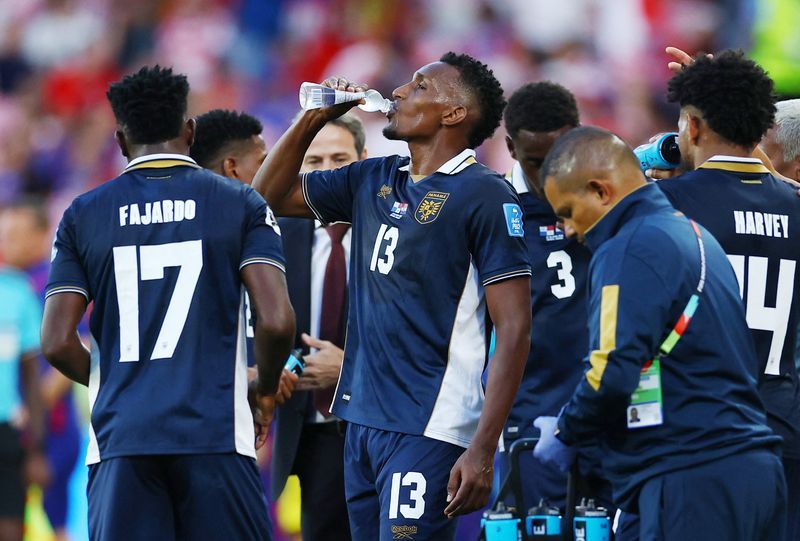
FIFA president Gianni Infantino has moved to quash mounting criticism of the mandatory hydration breaks implemented across World Cup matches, arguing forcefully that the measure reflects sporting prudence rather than commercial opportunism. The introduction of three-minute stoppages at fixed intervals—the 22nd and 67th minutes—has become one of the tournament's most contentious talking points, drawing sharp rebukes from established coaches and prominent players who contend the interruptions fundamentally compromise the rhythm and character of international football.
Infantino's defence hinges on a straightforward financial assertion: FIFA receives no additional revenue from these breaks since all broadcast and sponsorship agreements were negotiated and finalised well before the hydration policy took effect. This distinction matters because critics had seized upon the fact that broadcasters and networks have openly exploited the stoppages as natural advertising windows, creating the perception that FIFA had deliberately engineered extra commercial exposure for financial gain. By separating FIFA's interests from those of the media companies profiting from the breaks, Infantino attempts to reframe the measure as a welfare initiative untainted by mercenary considerations.
The underlying rationale for the stoppages remains rooted in environmental and physiological concerns. The North American venues hosting the tournament present challenging climatic conditions, and maintaining player hydration and core body temperature during intense exertion represents a legitimate health imperative. Infantino emphasised that ensuring all participating teams experience identical regulatory frameworks constitutes a fairness principle—a team cannot gain tactical advantage simply because their match occurred during a hotter period of the day or in a particularly humid location. This logic extends across the tournament's compressed schedule, with teams potentially playing eight matches across 39 days, creating cumulative physical demands that shorter rest intervals would intensify.
Yet the controversy extends beyond health considerations into the structural integrity of the sport itself. Thomas Tuchel, managing England, articulated a widely shared concern that the mandatory pauses fundamentally alter the match's identity by fragmenting what should be continuous athletic narrative into segmented episodes. Uruguay's Marcelo Bielsa voiced similar reservations, arguing that dividing play into truncated sections strips football of an essential characteristic—the continuous, uninterrupted flow that distinguishes the sport from activities with scheduled stoppages. Both coaches raise a philosophical point about the sport's essence that transcends mere convenience or comfort.
Interestingly, some prominent figures have acknowledged the humidity rationale while questioning its universal application. Spain's Luis de la Fuente and Netherlands captain Virgil van Dijk expressed openness to the concept in genuinely extreme conditions but queried whether indoor stadiums or cooler climates genuinely necessitated the same intervention. This nuanced position suggests that even critics recognise a distinction between principled opposition and acknowledgment that targeted measures might serve legitimate purposes in specific circumstances.
Infantino addressed the tactical dimension of the breaks directly, noting that coaching staffs can utilise the stoppages to adjust strategy and communicate revised instructions to their squads. Rather than treating this as merely an unfortunate side effect, he positioned it as an asset within a lengthy tournament structure where personnel fatigue and in-game injuries create evolving tactical scenarios. A manager might need to reorganise defensive assignments or pivot attacking patterns mid-match; the hydration break provides designated opportunity for such communication without requiring a formal timeout request.
The FIFA president further contended that empirical evidence from matches played under these conditions demonstrates no diminution of playing intensity or athletic performance. Players have sustained high-speed running, aggressive pressing, and creative play throughout complete matches, suggesting that the breaks neither undermine match quality nor compromise the spectacle fans expect from world-class competition. This assertion invites scrutiny—whether three-minute interruptions genuinely fail to disrupt momentum remains subject to legitimate debate—but Infantino presents it as observable fact derived from tournament experience.
The standardisation argument carries particular weight in international competition where consistency and perceived fairness shape how participating nations and their supporters evaluate tournament legitimacy. If some matches received hydration breaks while others did not based on ambient temperature readings, accusations of arbitrary application would inevitably emerge. By implementing the rule universally, FIFA ensures no team can credibly claim that opposition benefited from advantages unavailable to them. This principle of uniform regulation, while possibly imperfect in execution, reflects a governance philosophy prioritising procedural transparency.
For Malaysian and Southeast Asian perspectives, the debate resonates beyond FIFA's specific situation. Regional football administrators and coaches wrestling with tropical climates face similar hydration and heat-stress challenges, making Infantino's reasoning potentially relevant to domestic and regional competitions. The tension between player welfare and competitive integrity—between protecting athletes from medical risks and preserving the sport's traditional character—reflects a broader global conversation about how football evolves while maintaining its fundamental appeal.
The controversy also illustrates how modern football increasingly intersects with commercial broadcasting interests in ways that blur decision-making motivations. Even when governance bodies like FIFA insist their motives remain purely sporting, the simultaneous commercial benefit creates justified scepticism among observers. Infantino's transparent acknowledgement that he derives no direct financial advantage from the breaks represents a significant rhetorical strategy, yet ultimately the policy's legitimacy rests on whether players, coaches, and fans accept the scientific basis for intervention and the procedural fairness of universal implementation across all World Cup matches.