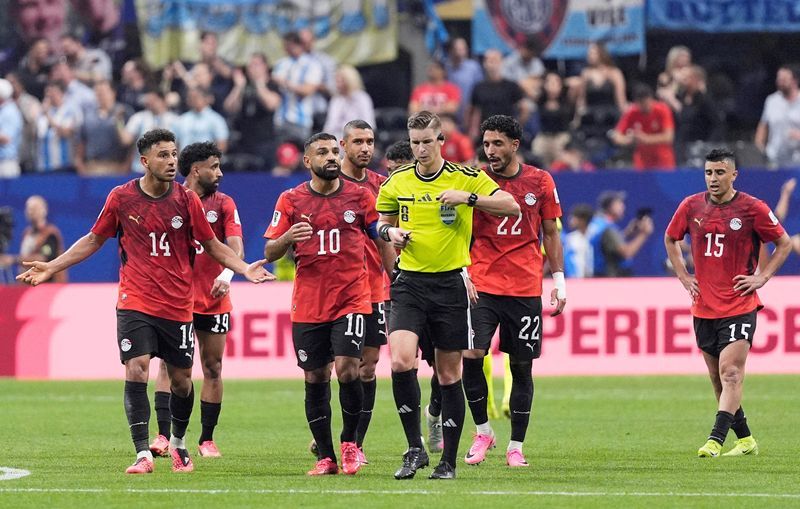
FIFA's head of refereeing has moved swiftly to defend the officials who oversaw Argentina's contentious 3-2 victory against Egypt in the World Cup round of 16, firmly rejecting allegations that bias influenced the match's outcome. Pierluigi Collina issued his statement through FIFA's official channels, emphasising that match officials at world football's premier tournament operate with complete autonomy and cannot be compromised by external pressures or political considerations.
The dispute centres on several pivotal moments that altered the course of the encounter. Egypt entered the closing stages holding a 2-0 advantage but conceded three goals, including a stoppage-time winner from Enzo Fernandez that sent Argentina through at Egypt's expense. The dramatic turnaround prompted immediate objections from the Egyptian Football Association and coach Hossam Hassan, who suggested that referee decision-making might have been influenced by institutional pressure to retain Argentina—a powerhouse in world football—in the tournament.
Egypt's primary complaint involved the disallowed goal scored by Mostafa Zico in the second half. The Egyptian camp characterised the foul deemed to have preceded the strike as non-existent, arguing that defender Marwan Attia made no improper contact with Argentina's Lisandro Martinez during the build-up play. According to Egypt's formal statement, this decision and others raised fundamental questions about consistency and fairness, with the association claiming these rulings directly altered the match's trajectory. Beyond Zico's disallowed goal, Egypt protested that no penalty was awarded when Mohamed Salah appeared to be fouled moments before Argentina orchestrated the attacking sequence culminating in their winning goal.
Collina's response addressed each controversy with technical precision. Regarding the overturned Zico goal, he explained that VAR had correctly identified and recommended overturning the original decision after detecting the foul by Attia. The FIFA official emphasised that referees and VAR operators apply a consistent standard: infractions must be penalised regardless of their perceived obviousness, provided video review can detect them when the on-field official missed the incident. This interpretation, Collina contended, reflects proper application of VAR protocol rather than any predetermined outcome.
On the contentious incident involving Salah, Collina clarified that both the referee and VAR determined the contact between Salah and Argentina's Julian Alvarez constituted normal football contact rather than a punishable offence. He drew a technical distinction between deliberately stepping on an opponent's foot, which constitutes a foul, and situations where a defender makes lawful contact with the ball first before incidental contact occurs during normal play. By this standard, no penalty was warranted, though this interpretation immediately became a flashpoint for disagreement given the match's decisive consequences.
The FIFA refereeing chief took a broader stance against what he characterised as unfounded allegations questioning the integrity of World Cup officials. Collina warned that such claims, while critical discussion remains part of football culture, could endanger referees and their families through threats and harassment. His remarks reflected growing sensitivity within FIFA to public criticism, particularly from losing teams whose coaches and federations challenge officiating decisions. The organisation appears concerned that permitting unchecked allegations of bias could undermine institutional credibility and referee safety.
Collina acknowledged that football matches inevitably contain subjective elements requiring human judgment, but he asserted that FIFA remained confident VAR principles had been correctly applied throughout the tournament. This confidence statement served to reassure stakeholders that technological assistance, rather than corrupting the sport, enhances decision-making accuracy when properly implemented. The statement implicitly suggested that Egypt's grievances reflected a team's natural disappointment at elimination rather than evidence of systematic unfairness.
The clash between FIFA's defence and Egypt's allegations highlights broader tensions within international football. As tournaments grow in commercial significance and geopolitical importance, teams and nations increasingly scrutinise refereeing decisions through lenses of fairness and potential bias. Egypt's status as one of Africa's most successful football nations lends weight to its complaints within the continental confederation, potentially influencing how African football bodies engage with FIFA on governance questions. For the Malaysia region, the incident underscores how major World Cup decisions cascade through global football governance and can affect regional confederations' leverage in FIFA councils.
The Salah incident particularly resonates across Asia and the Middle East, where Salah's profile extends far beyond Egypt. His involvement in a disputed non-penalty decision elevates the controversy beyond typical refereeing disagreements. Many observers in Southeast Asia and the broader Asian football sphere view such incidents through the lens of smaller nations' treatment in FIFA's hierarchy, questioning whether superpower teams like Argentina receive more favourable interpretations of VAR protocol. Collina's technical explanations, while internally consistent, cannot fully address the perception that major tournaments may feature variable standards applied to different teams.
Moving forward, Egypt's formal protest likely represents a marker that this controversy will not fade quietly from institutional memory. The Egyptian Football Association's detailed statement about fairness and consistency suggests the matter could be raised in future FIFA governance discussions, particularly within African football's representative bodies. For regional football administrators, the case demonstrates that World Cup decisions, however technical their justifications, inevitably acquire political and cultural dimensions that transcend sport itself.
The broader implications for international football governance appear significant. FIFA's robust defence of its officials suggests the organisation intends to resist what it perceives as erosion of referee authority through unsubstantiated bias claims. However, the frequency with which losing teams now challenge major decisions—increasingly through formal confederation channels—indicates that public trust in refereeing remains fragile despite VAR technology. For Southeast Asian football, which includes nations with limited historical leverage at FIFA, this dynamic raises questions about whether technological solutions can genuinely solve perceptions of unequal treatment, or whether such concerns fundamentally reflect structural imbalances in world football's governance and resources.

