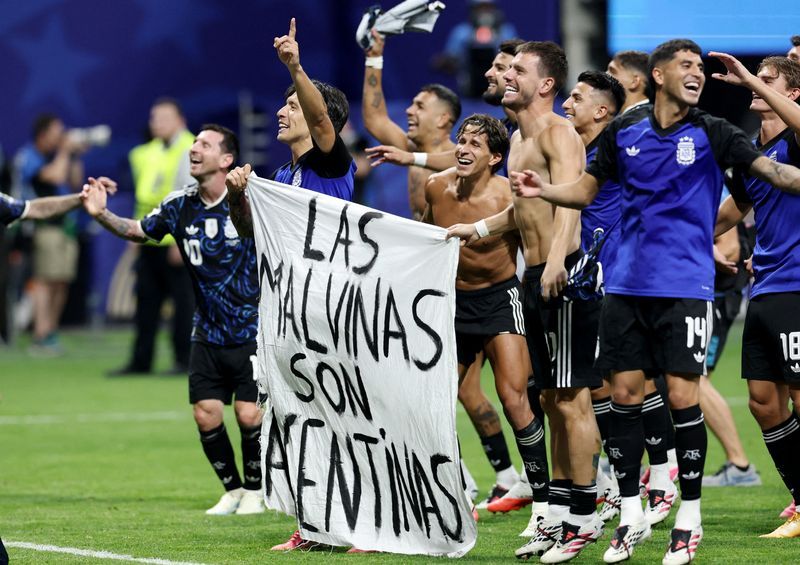
FIFA has initiated formal disciplinary proceedings against Argentina's football association and its squad members for multiple alleged violations committed during the recently concluded World Cup tournament, with a particularly contentious incident involving a political statement about territorial sovereignty taking centre stage in the investigation.
The most prominent allegation concerns a banner reading "Las Malvinas Son Argentinas" ("The Falklands are Argentine") that several Argentina players unfurled following their semi-final victory over England in Atlanta. This gesture has drawn FIFA's attention because the international football body maintains strict regulations prohibiting the use of World Cup matches and related sporting platforms for advancing political causes or territorial claims, regardless of historical or legal merit. The display represents a deliberate attempt to leverage global media exposure during a major sporting event to promote a nationalist position, a practice FIFA considers incompatible with its stated apolitical mission.
This is not Argentina's first encounter with FIFA sanctions over such displays. In 2014, the Argentine Football Association faced a monetary penalty of 20,000 pounds (approximately $26,560) after players similarly brandished a Falklands banner before a friendly international match against Slovenia. The recurrence suggests either insufficient institutional awareness of FIFA regulations or a deliberate calculation that the diplomatic and symbolic value of the gesture outweighs potential sporting consequences. For Argentine football officials and the government, the Falklands question remains emotionally charged and politically significant, complicating their ability to restrict players from making such statements.
Beyond the Falklands incident, FIFA's investigation encompasses a broader range of alleged misconduct throughout the tournament. These additional charges include discriminatory chanting and gestures directed at opponents or spectators, violations of match scheduling protocols involving untimely kickoffs, security breaches that may have compromised player or official safety, inappropriate messaging from team delegations or supporters, and instances of projectiles thrown by fans during various matches. This comprehensive approach suggests FIFA is using the disciplinary process not merely to address individual incidents but to establish clear standards for future tournaments.
The final match between Argentina and Spain in New Jersey has generated separate disciplinary action following an altercation that erupted when the final whistle sounded. Spain's victory in extra time, achieved with a 1-0 scoreline, was immediately marred when Argentina midfielder Leandro Paredes shoved Spain's young player Gavi to the ground as Spanish substitutes rushed the pitch in celebration. The physical contact, though brief, violated FIFA's expectations regarding player conduct during emotionally charged moments in high-stakes matches.
Paredes faces three assault charges arising from this incident, making him the most seriously accused player in connection with the final's disturbance. Nahuel Molina, his teammate, has been charged with two counts of assault, while three other individuals—Molina again, midfielder Thiago Almada, and Argentine official Roberto Ayala—alongside Spain's Gavi face single counts of unsporting behaviour. The tiered charging structure indicates FIFA's assessment that some individuals bore greater responsibility than others for the post-match fracas, though all violated behavioural standards.
The involvement of Roberto Ayala, identified as an Argentine official rather than a player, introduces an institutional dimension to the disciplinary process. Officials' conduct during matches and immediately thereafter carries particular significance because they are expected to maintain composure and exemplify professional standards. Ayala's inclusion in the charges suggests his behaviour during or after the final crossed thresholds that FIFA considers unacceptable for someone in an official capacity.
FIFA's procedural approach provides accused parties with opportunity to respond to allegations before final determinations are rendered. According to a statement from the global football governing body, all respondents have been formally notified of the charges and given the chance to submit their defence, position statements, or contextual information that might influence the investigation's outcome. This procedural fairness is standard under FIFA's Disciplinary Code, though it does not prevent eventual sanctions if evidence supports the violations.
The timing and nature of these charges carry implications for Argentine football's international standing and future tournament participation. While individual players may face suspension from upcoming matches, the broader questions about whether Argentina's football culture adequately emphasises compliance with FIFA regulations—or whether political and diplomatic considerations consistently override sporting obligations—remain unresolved. For Malaysia and Southeast Asian football administrators, these proceedings illustrate FIFA's willingness to enforce its rules even against prestigious football nations, establishing precedent that no association, regardless of global stature, operates beyond the disciplinary framework.
The disciplinary process will ultimately demonstrate whether FIFA prioritises consistency in enforcing its apolitical mandate or whether pragmatic considerations regarding prominent footballing nations influence outcomes. The FIFA Disciplinary Committee's forthcoming decision will determine specific penalties, whether financial fines, player suspensions, or institutional sanctions, and signal the organization's commitment to maintaining regulatory standards across all member associations. For Argentina specifically, the outcome will influence how the nation's football authorities balance domestic political pressures with international competitive obligations in future tournaments.

