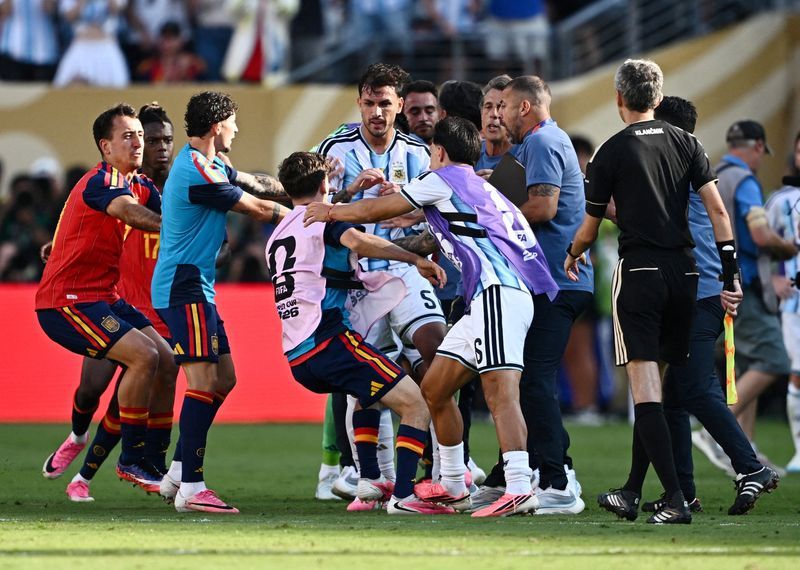
FIFA has launched a formal disciplinary inquiry into a heated altercation that broke out at the conclusion of the World Cup final, appointing specialized prosecutors from its disciplinary and ethics division to examine the circumstances surrounding the confrontation between Spain and Argentina. The decision to investigate reflects football's governing body's commitment to maintaining standards of conduct during its flagship tournament, even at the highest levels of competition.
Spain secured their second World Cup title through an extra-time goal by winger Ferran Torres in a match marked by escalating tension and multiple flashpoints. The trajectory toward the eventual brawl had been set earlier when Argentina's midfielder Enzo Fernandez received a second yellow card in the 93rd minute of regular play, reducing his side to ten men during a critical phase of the contest. This dismissal fundamentally altered the match dynamics, intensifying the pressure on Argentina's depleted squad during the additional thirty minutes required to determine a winner.
The physical confrontation that defined the match's conclusion began when Argentina midfielder Leandro Paredes initiated contact with multiple Spanish players in the immediate aftermath of the final whistle. The clash involved defender Eric Garcia and midfielder Gavi among others, with the initial exchange quickly spiralling into a wider melee involving numerous players from both teams. What started as isolated incidents between individuals rapidly transformed into a broader breakdown of discipline, with players from both benches drawn into the conflict.
The scene that followed the final whistle presented a stark contrast to the typically cordial post-match interactions expected at football's pinnacle. Players engaged in sustained pushing and shoving, requiring officials and security personnel to physically separate the antagonists to restore order. Argentina's head coach Lionel Scaloni found himself in the difficult position of attempting to restrain his own players and defuse the volatile situation as the match descended into what observers characterized as an ill-tempered conclusion.
The appointment of FIFA prosecutors signals that the organization views the incident as sufficiently serious to warrant detailed examination and potential disciplinary sanctions. Formal investigations of this nature typically involve reviewing match footage, gathering statements from officials who were present, and examining the conduct of individual players implicated in the altercation. The scope of such inquiries extends beyond identifying who initiated physical contact, extending to assessing the degree of culpability and any aggravating factors that might influence eventual penalties.
For Malaysian and Southeast Asian readers, the investigation underscores the evolving standards FIFA applies to match conduct across all competitions and at every level of competitive football. The organization's willingness to scrutinize even World Cup final participants demonstrates an institutional commitment to uniformly enforcing behavioral expectations. This approach has implications for regional football bodies and national associations that increasingly model their disciplinary procedures on FIFA's frameworks and precedents.
The absence of a specified timeline for concluding the investigation suggests FIFA intends to conduct a thorough examination rather than rush toward predetermined conclusions. Such methodical approaches typically require several weeks, potentially extending well into the post-tournament period. This deliberate pace allows for comprehensive gathering of evidence and careful analysis of all contributing factors, though it also means uncertainty for players who might face sanctions will persist during the off-season.
The incident itself reflects broader trends in international football where competitive intensity and emotional investment in high-stakes matches occasionally override commitments to sportsmanship. The World Cup final represents the culmination of years of preparation and national aspirations for participating teams, creating pressure environments where emotional control becomes challenging. Argentina's reduction to ten men during crucial minutes likely amplified frustration within their camp, providing context, though not justification, for the post-match conduct.
The Spain-Argentina final distinguished itself not merely for its sporting quality but for the disciplinary challenges it presented. The match served as a reminder that even carefully organized, heavily regulated competitions struggle to prevent moments where athletes lose composure. For football administrators in Malaysia and throughout the region, the investigation offers instructive examples of how governing bodies address serious conduct violations and the mechanisms through which accountability is maintained at the sport's highest levels.

