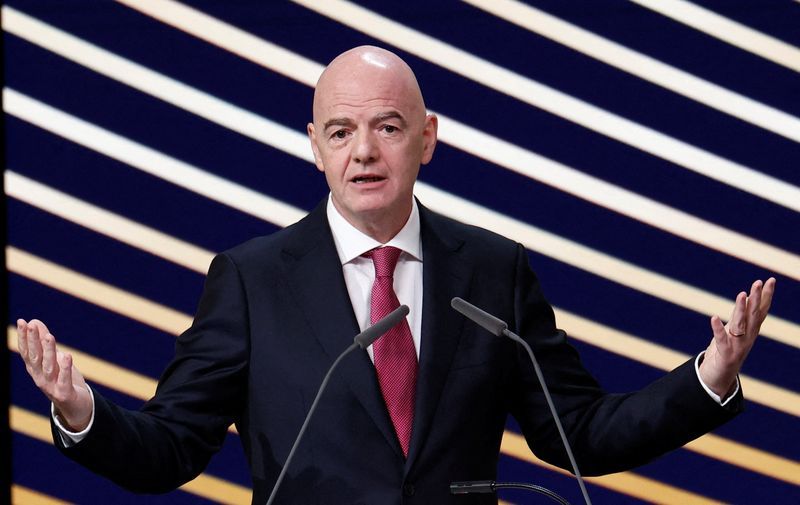
Gianni Infantino, once considered virtually unassailable as FIFA president, suffered a dramatic reversal of fortune on Friday when his aggressive push to commercialise global football through private equity partnerships came to an abrupt end. The 56-year-old Swiss administrator abandoned the scheme after it triggered an unprecedented coordinated backlash from regional confederations, most notably Europe's UEFA, which threatened to boycott all FIFA events unless the proposal was shelved. The proposal, which would have created a commercial entity to operate the World Cup and other tournaments with 20% ownership transferred to private investors, represented Infantino's most ambitious initiative since assuming control of world football's governing body in 2016.
The collapse of what Infantino positioned as a transformative revenue-generation scheme marks a turning point in his leadership. Just days before the announcement of the private equity plan, his re-election for a fourth consecutive term appeared inevitable when the FIFA Congress reconvenes in Morocco this March. The financial success of the 2022 World Cup in Qatar had bolstered his standing with national federations and appeared to guarantee his continuation in office through 2031. However, the dramatic unravelling of the investment strategy has fundamentally altered the political landscape, with competing candidates now almost certain to declare their intention to challenge him at the upcoming election.
The process by which Infantino pursued this initiative revealed significant gaps in his leadership approach and institutional judgement. Rather than consulting with key stakeholders in advance, FIFA announced the proposal on Tuesday only after details had already leaked to media outlets. Regional confederations, including the 47-member Asian Football Confederation, learnt of the plan simultaneously with the global football community, generating immediate resentment over what many viewed as contempt for established governance protocols. The AFC issued a formal statement describing the initiative as "totally unacceptable" and called for comprehensive institutional reform at FIFA to restore proper decision-making structures and stakeholder engagement.
The selection of Thrive Capital, a private investment firm founded by Joshua Kushner, to lead the investor consortium triggered additional complications beyond the core policy disagreement. Questions about the proximity between Infantino and U.S. President Donald Trump intensified when observers noted the Kushner family's well-documented political connections. These concerns gained credibility after Trump publicly claimed he had telephoned Infantino during the Qatar World Cup requesting the suspension of American player Folarin Balogun be overturned. Although FIFA's independent disciplinary body ultimately allowed Balogun to participate, the episode created perceptions of improper political influence over football administration. Infantino's acceptance of FIFA's inaugural Peace Prize from Trump last December had already aroused scrutiny about the appropriate boundaries between sports governance and political alignment.
Former FIFA vice-president Jim Boyce, who worked alongside Infantino during the latter's tenure at UEFA, attributed the proposal's failure partly to personality factors. Speaking to the BBC, Boyce suggested that proximity to political power and high-profile associations may have clouded Infantino's judgement. The Northern Irish football administrator expressed astonishment at the scope of Trump's involvement in World Cup matters, describing it as genuinely shocking. Sports marketing analyst Bob Dorfman echoed these concerns, noting that the involvement of a Kushner family member made an already controversial proposal significantly worse given the pre-existing perception of inappropriate Trump administration interference in football decisions during the tournament.
Infantino's previous capacity to weather controversies and maintain his authority depended substantially on his demonstrated ability to expand FIFA's commercial revenues. He had previously retreated from a 25 billion dollar Club World Cup investment scheme in 2018 when UEFA mounted strong opposition, recovering his standing through continued financial success. He survived intense criticism over Qatar's selection as World Cup host, including backlash against his bizarre pre-tournament speech in which he declared identification with various marginalised groups. However, each of these previous setbacks involved external decisions or personal statements rather than a core policy proposal central to his presidential agenda. The current collapse represents something fundamentally different: a rejection of Infantino's strategic vision for football's future delivered by the confederations whose support remains essential for his political survival.
Key advisers and senior FIFA officials distanced themselves from the initiative as the political backlash intensified, signalling deepening institutional fractures. Carlos Cordeiro, a senior adviser working closely with Infantino, resigned in protest and publicly characterised the proposal as "a bad deal for football." Kevin Lamour, FIFA's Chief Operating Officer, made the startling allegation that staff members had been "deceived" by Infantino regarding the proposal's scope and implications. Such internal dissent from individuals in close proximity to the president reflects extraordinary damage to his standing within FIFA's administrative structure. The accusations of deception proved particularly damaging to Infantino's credibility, suggesting his leadership style had shifted from collaborative to autocratic in ways that alienated even loyal subordinates.
The timing of the fiasco compounds its political significance. Coming barely two weeks after the commercially triumphant Qatar World Cup, the proposal appeared positioned to capitalise on Infantino's peak authority and goodwill among football's stakeholders. The dramatic pivot from apparent strength to visible weakness occurred with stunning rapidity, collapsing within three days of initial announcement. This compressed timeline prevented Infantino from mounting an effective counter-narrative or building coalitions to defend the initiative. The speed of the reversal also emphasised the absence of prior consensus-building, suggesting the proposal had been developed within an extremely narrow circle without adequate sounding-out of key constituencies.
For Malaysian football specifically and Southeast Asian football more broadly, Infantino's political difficulties carry important implications. The Asian Football Confederation's formal intervention in the controversy, treating it as a matter of institutional principle rather than mere policy disagreement, demonstrates that regional confederations now perceive themselves as capable of imposing constraints on FIFA presidential authority. Malaysia, along with other AFC members, participated in this collective assertion of regional interests. The strength of unified AFC opposition to Infantino's approach suggests that any future FIFA initiative affecting Asian football interests will encounter heightened scrutiny and coordination among regional members. This shift represents a meaningful recalibration of power relationships within world football governance.
Despite the severity of his current predicament, observers remain cautious about writing off Infantino's prospects entirely. Although rival candidates will almost certainly emerge to challenge his re-election, Infantino retains significant structural advantages if he chooses to contest the March vote. The 211 national football federations that comprise FIFA's voting membership include numerous bodies that have benefited substantially from FIFA funding during his presidency. Many smaller federations lack alternative sources of revenue and have grown dependent on the distribution mechanisms Infantino established. These financial dependencies may incline significant numbers of delegates to support his continued leadership despite the private equity debacle, particularly if he demonstrates appropriate contrition and commits to reformed decision-making processes.
The mathematics of FIFA's electoral system also favour an incumbent president or candidate able to mobilise substantial voting blocks. A two-thirds supermajority is required to secure election in the first ballot, but subsequent rounds require only a simple majority. This structure means that even a wounded Infantino could potentially prevail if opposition to his candidacy fragments among multiple rivals. Sports analysts have suggested that a genuine expression of regret for the consultation failures and a commitment to reshaped governance procedures might sufficiently mollify concerns among fence-sitting federations. However, such a recovery would require Infantino to demonstrate genuine transformation in his leadership approach rather than merely allowing public anger to dissipate through time.
The episode exposes fundamental tensions within FIFA's governance between the president's executive discretion and the confederations' legitimate expectations of consultation and institutional respect. Infantino's independent leadership style, which had previously generated exasperation among those working directly with him, ultimately proved incompatible with the distributed authority structure that characterises international football governance. The private equity proposal collapsed not primarily because of substantive disagreement about revenue generation, but because of the process through which it was pursued and the perception that Infantino had acted unilaterally rather than collaboratively. Any candidate emerging to challenge him, whether Infantino himself in reformed circumstances or a new challenger, will need to address directly the governance and consultation deficits that the current crisis has exposed.

