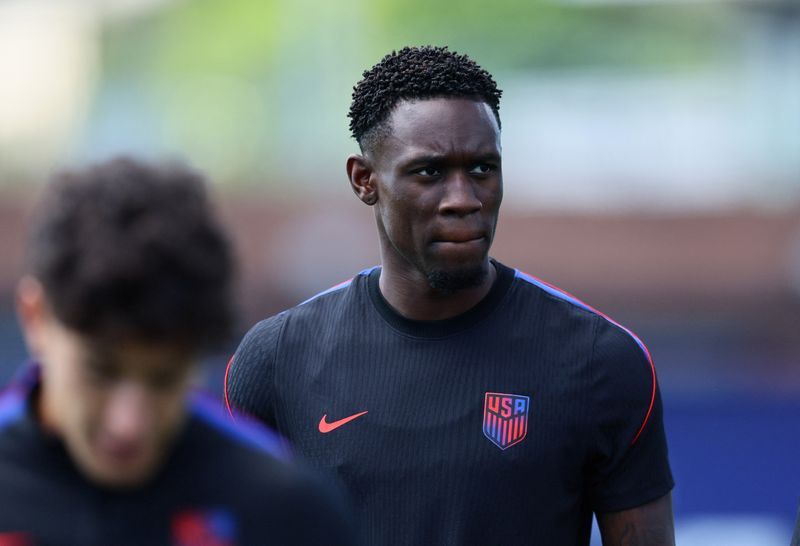
FIFA's decision to suspend United States striker Folarin Balogun's one-match automatic suspension has ignited a firestorm of criticism across European football, with multiple national associations raising alarm bells about political interference in the sport's governance. The ruling, announced on Sunday, came after U.S. President Donald Trump telephoned FIFA President Gianni Infantino requesting a review of the decision that would have benched Balogun for Monday's World Cup last-16 encounter against Belgium. The move represents an unprecedented intervention in tournament rules by a sitting head of state, raising fundamental questions about the independence of football's governing body and the sanctity of competition regulations.
The Belgian football federation was among the first to formally protest, arguing that FIFA's action directly contradicted its own disciplinary code. According to the Royal Belgian Football Association's statement, while Article 27 of the FIFA Disciplinary Code does provide discretion to suspend enforcement of sanctions, this provision cannot override Article 66.4, which mandates that a red card automatically triggers suspension for the next match. The federation emphasized that this principle has applied consistently to every other player sent off during the World Cup, making the exception for Balogun not merely irregular but fundamentally inconsistent with how the tournament has operated until that moment.
German Football Association President Bernd Neuendorf delivered perhaps the most pointed criticism, calling for FIFA to issue a swift clarification regarding the circumstances surrounding the decision. Neuendorf's intervention reflected broader European concerns that the reversal set a dangerous precedent. His statement underscored that permitting political pressure to influence match eligibility decisions undermines both the credibility of FIFA as an institution and the integrity of the competition itself. The DFB president's emphasis on the need to "dispel the impression" of political interference suggested deep skepticism about FIFA's claims that the decision was made on purely sporting grounds.
The practical implications of FIFA's ruling extend beyond the immediate match involving Belgium and the United States. Coaches and players who had previously accepted red card suspensions now faced an uncomfortable reality: the rules that governed their punishment could be selectively suspended depending on political circumstances. One analyst noted the peculiar position of other footballers who had already served their one-match bans during the tournament, effectively punished under a standard that no longer applied universally. This retroactive change to the competition's regulatory framework raised questions about fairness that transcended the particular case of Balogun.
The episode also highlighted the vulnerability of international sporting bodies to external political pressure, particularly when dealing with powerful nations. FIFA's willingness to accommodate a direct call from a sitting president sent a message about the hierarchy of influence within global football governance. For smaller nations and their associations, the incident demonstrated that access to political leadership might determine how rules were applied, rather than the rules themselves serving as neutral arbiters of conduct. This dynamic fundamentally altered the competitive landscape in ways that statistics and tactics could not fully capture.
Further complicating matters was the philosophical question about what constitutes a red card offense in the first place. Some commentators suggested that if serious doubt existed about whether Balogun's action warranted a red card, the appropriate remedy was overturning the card itself through proper VAR review procedures, not suspending the automatic consequences of a red card that had been collectively validated by the referee and VAR officials. By choosing suspension rather than reversal, FIFA created the impression of wanting to satisfy both the original decision-makers and external political pressure simultaneously, satisfying neither and damaging its own authority.
The situation also raised uncomfortable questions for the United States team itself. Even if American officials welcomed the reprieve allowing Balogun to face Belgium, any subsequent World Cup success would carry the asterisk of this controversy. Sports historians and analysts would forever reference the role of presidential intervention in the team's progression, a distinction that typically reflects poorly on the beneficiary rather than enhancing its reputation. The irony was not lost on observers: protecting Balogun's availability to play may have permanently tainted any achievement the U.S. team subsequently accomplished.
From a Southeast Asian perspective, the Balogun incident demonstrated how international sporting governance remains subject to geopolitical influence. Nations in this region, with significantly less political leverage than the United States, could expect little mercy if their players faced similar circumstances. The ruling exposed a structural inequality within FIFA's decision-making apparatus, where formal regulations ostensibly applied universally but could be negotiated away through high-level political channels. This asymmetry should concern football administrators across Asia, who operate within systems where their disciplinary decisions could theoretically be overridden through comparable interventions.
The broader implications for FIFA's credibility extended beyond this single tournament. The organization already faced scrutiny regarding corruption allegations, host nation selection processes, and labor standards at World Cup venues. By allowing a sitting president to influence match eligibility determinations, FIFA added another dimension to the question of whether it functioned as an independent institution capable of governing the sport fairly. The Belgian, German, and other European associations' protests represented not merely objections to a specific ruling but fundamental challenges to FIFA's legitimacy as a regulatory body.
Looking forward, FIFA faced pressure to establish clearer protocols distinguishing between legitimate discretionary review and improper external influence. Without such clarification, every future red card suspension during international tournaments could potentially invite similar interventions from interested parties. The organization's next statement addressing these concerns would likely determine whether this incident marked an anomalous lapse or the beginning of a pattern that fundamentally restructures how international football governance operates. For now, the Balogun case stands as a stark reminder that even the world's most popular sport remains vulnerable to the exercise of political power, regardless of stated regulatory frameworks designed to prevent exactly such interference.

