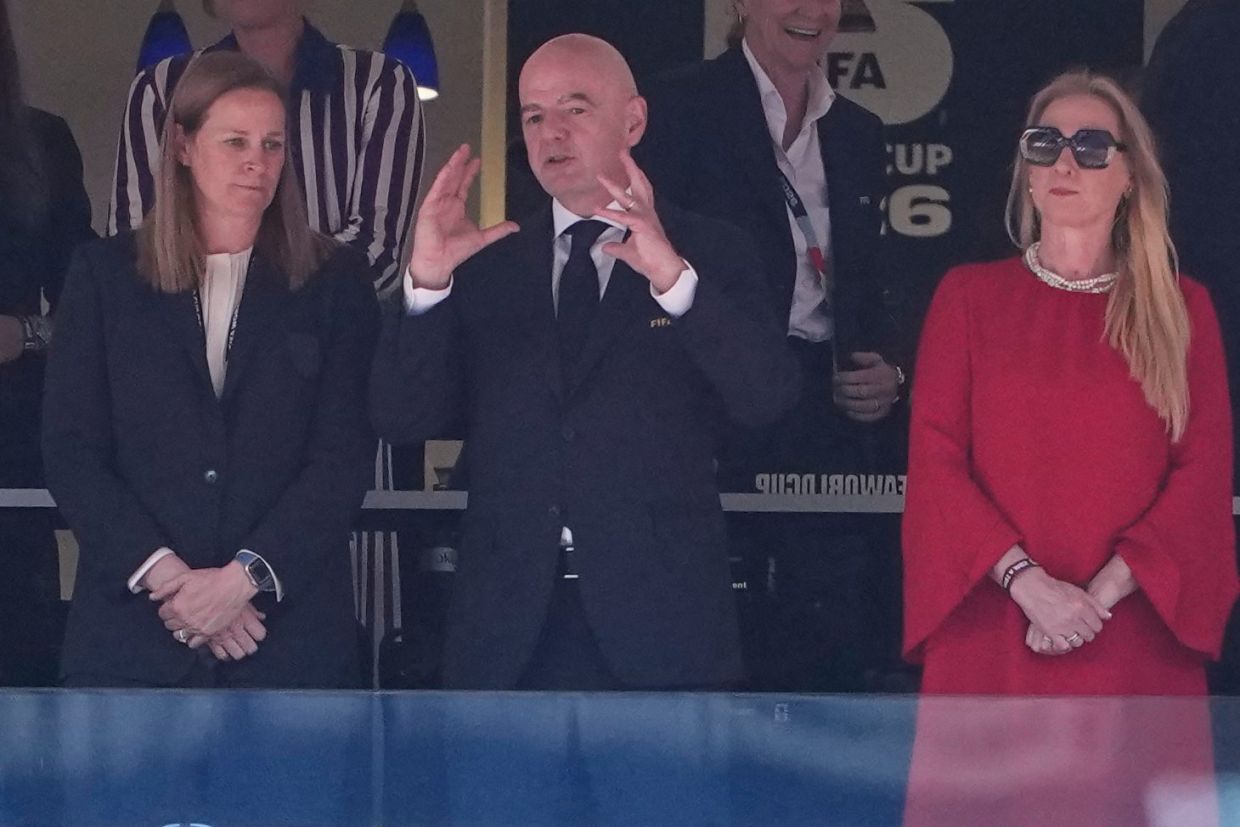
Amid swirling criticism over governance, fairness and the apparent politicisation of football's biggest stage, FIFA emerges from the 2026 World Cup substantially richer and operationally unscathed. Organisation chief Gianni Infantino has consolidated his authority over the global game despite controversies ranging from ticket pricing and refereeing decisions to the controversial award of a peace prize to Donald Trump and pressure to reinstate a suspended American player. The accumulated grievances have done little to dent FIFA's financial performance or membership support for Infantino's continued leadership.
The 2026 tournament has attracted criticism from multiple quarters. Ticket prices have deterred ordinary supporters, whilst the Iranian squad faced international isolation, and FIFA's decision to bar a Somali referee drew additional scrutiny. Most contentiously, the governing body reversed a red card decision involving a United States player following reported pressure from Trump, provoking condemnation from nations outside America and raising fundamental questions about FIFA's commitment to regulatory consistency. Sports lawyer Nick De Marco articulated the deeper concern: the incident suggested FIFA had compromised not merely the application of a particular rule, but the foundational integrity of the World Cup itself and FIFA's credibility as football's global regulator.
Yet the intensity of these disputes dissipated rapidly once tournament momentum shifted. Following Belgium's decisive 4-1 victory over the United States, the firestorm over the American player's reinstatement lost political oxygen. Infantino's strategic focus has remained unwavering—maximising revenue generation from the world's most commercially valuable sporting event. The 56-year-old administrator has proven adept at separating FIFA's governance failings from its profit-generation machinery, insulating the latter from the reputational damage of the former.
Financially, FIFA stands to collect approximately $9 billion directly from the 2026 tournament, representing a $2 billion increase over the 2022 Qatar edition. This expansion reflects Infantino's deliberate commercial strategy: expanding tournament scale and integrating American-style monetisation across every venue touchpoint. The multiplication of revenue streams extends beyond FIFA itself. Stadium concessionaires are capturing unprecedented margins, with some locations recording per-capita spending reaching $100 per spectator—nearly double typical National Football League game expenditure. Corporate advertisers have benefited substantially from mandated hydration breaks that effectively restructured football's traditional two-half format into an American-style four-quarter format, creating additional advertising inventory and interruptions.
Host cities, many of which voiced apprehension about upfront expenditure before the tournament commenced, are experiencing tangible economic gains. Bank of America financial data covering mid-June demonstrates that credit and debit card spending in World Cup host cities surged 6.3 percent year-on-year, with non-resident spending climbing 16.7 percent. These figures suggest meaningful tourism-driven economic activity is materialising, partially validating the financial case local administrators presented to sceptical communities.
The tournament structure itself has been expanded to distribute FIFA largesse more broadly. The format increased from 32 to 48 participating nations, doubling the overall prize distribution to a record $871 million. Every participating federation receives a baseline payment of $12.5 million simply for attendance, fundamentally reshaping football economics across smaller nations. Cape Verde's historic knockout-stage progression earned the island nation over $21 million—approximately 0.75 percent of its entire national GDP. For numerous football associations, particularly those from developing regions, FIFA disbursements constitute a majority of annual operational funding, creating structural dependency that translates into organisational loyalty to Infantino's continued leadership.
Infantino faces re-election in early 2027 at the 77th FIFA Congress in Rabat, Morocco—itself a host nation for the next World Cup. The 211 member federations each wield one vote, yet the election represents a procedural formality rather than genuine competition. Infantino is running unopposed, with federations representing Asia, South America and Africa having already pledged support. His third term would extend the tenure he began following Sepp Blatter's 2015 resignation amid the corruption scandal that had rendered FIFA synonymous with institutional decay. Infantino's rehabilitation of the organisation's public image, coupled with his amplification of member-state payouts, has neutralised potential challengers.
Criticisms from prominent football figures and politicians have proven ineffectual in denting his political position. Former Liverpool manager Jurgen Klopp denounced the Trump-Infantino conversation regarding the red card as madness that undermined everything FIFA ostensibly represents, arguing football belongs to players and fans rather than political figures. Politicians from the United Kingdom and Belgium have formally called for Infantino's resignation. Yet these principled objections reflect the priorities of wealthy European football cultures accustomed to FIFA deference. For the vast majority of FIFA's member states, Infantino's tenure has materially improved their revenue circumstances and international football development capacities.
African, Middle Eastern and Asian football confederations have publicly reinforced their backing. Asian Football Confederation president Sheikh Salman has characterised FIFA as occupying "its best position ever," a testament to Infantino's success in reorienting the organisation toward broad-based member benefit rather than elite European club interests. The Royal Moroccan Football Federation has highlighted "the great work carried out by Mr. Gianni Infantino and his team to develop African and world football." From Kuwait to South Africa, federation leadership remains resolute in backing the FIFA chief.
Infantino's governance model reveals a fundamental tension embedded within modern FIFA. The organisation serves simultaneously as sport's supreme regulator and as a revenue-maximising commercial enterprise. These missions conflict when commercial pressures—whether from host nations, sponsors, or political figures—collide with rules enforcement and competitive integrity. Infantino has navigated this tension by privileging revenue generation and member-state appeasement whilst tolerating periodic governance compromises that attract international criticism but inflict minimal practical damage upon FIFA's institutional coherence or commercial momentum.
The paradox underpinning FIFA's current position merits consideration beyond football circles. Across major international sports and governing bodies, the template Infantino has pioneered—substantial dispersal of revenues to member organisations, expansion of commercial opportunities, and maintenance of structural support through financial incentivisation—has proven remarkably effective at neutralising institutional critique. This model relocates governance accountability from principle-based standards to transactional relationships, fundamentally altering how global sports institutions negotiate legitimacy and compliance. For emerging football nations and smaller federations, this architecture delivers tangible resources; for supporters worldwide invested in competitive fairness and organisational integrity, it represents an uncomfortable compromise with the commodification imperative.

