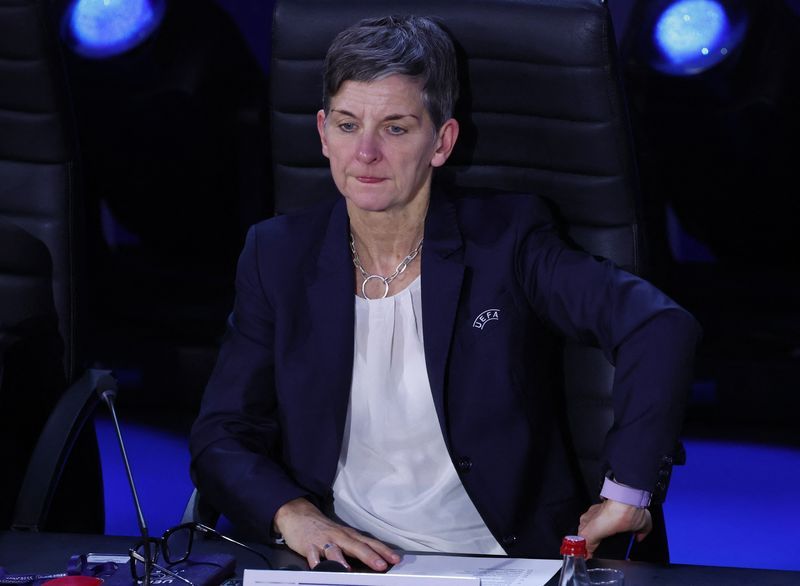
The hunt for FIFA's next president will demand far more than administrative competence or strategic vision. According to UEFA Vice-President Laura McAllister, the football world's governing body needs a leader who can genuinely unite the sport across all continents and serve as a true custodian of the game's fundamental values, not merely its institutional machinery. Her comments come at a moment when Gianni Infantino's presidency faces its most significant test following the dramatic collapse of his ambitious World Cup investment scheme, which would have created a commercial subsidiary to monetise future tournament revenues through external investor stakes.
Infantino's troubled plan sparked an unprecedented backlash from national football associations and other stakeholders, forcing FIFA to retreat and apologise for the process that produced the initiative. Though FIFA's leadership convened in Rabat on Wednesday and reaffirmed collective support for the current chief, the damage to institutional trust appears substantial. The episode has inevitably redirected attention to the 2027 presidential election, with McAllister and other influential voices now openly discussing what qualities FIFA's next leader must possess to restore credibility and address the governing body's chronic governance challenges.
McAllister emphasised in interviews with both Reuters and Deutsche Welle that identifying a credible successor will prove extraordinarily difficult. The obstacle extends beyond personality or qualifications; it fundamentally concerns political alignment and geographical representation. Any candidate seeking the presidency must secure backing from FIFA's 211 member associations, spanning Africa, Asia, Europe, South America, Oceania, and North America. This requirement means European candidates, no matter how popular in their own confederation, cannot rely solely on UEFA support and must build genuinely global coalitions. The mathematics of FIFA's electoral landscape considerably favour candidates who can demonstrate support across the football world's diverse regions and competing interests.
The former Wales women's national team captain stressed that the political complexities surrounding FIFA elections cannot be underestimated or oversimplified. She argued that identifying someone with both the temperament and political capital to lead world football requires looking beyond traditional power bases. McAllister's observation reflects a broader reality: FIFA has historically been dominated by power brokers from specific regions, yet the institution's legitimacy increasingly depends on demonstrating inclusive governance that genuinely represents all constituencies within the global game. This tension between historical power structures and modern expectations for representative leadership will define the search for Infantino's successor.
Beyond the immediate question of personality and electability, McAllister articulated a more fundamental challenge facing FIFA: the need for sweeping institutional reform that would transform how football's leadership operates at every level. She called for moving beyond what she characterised as governance by "fiefdoms or by individuals," advocating instead for genuinely democratic structures that distribute power and decision-making authority more broadly. This vision directly critiques not just Infantino's specific decisions but the concentrated power structures that enabled them. McAllister's case for modernisation suggests that merely replacing one leader with another, without accompanying structural reform, would merely perpetuate the systemic problems that generated the World Cup investment controversy.
The governance agenda McAllister outlined extends to how football's leadership approaches commercial opportunities and strategic direction. She indicated that any future FIFA administration must centre the sport's core values rather than pursuing growth for growth's sake or optimising revenue streams at the expense of football's fundamental mission. This represents a direct philosophical challenge to the commercial logic that animated Infantino's investment plan. Where that proposal treated World Cup revenues as an asset to be monetised and extracted, McAllister's vision treats the World Cup as a global institution whose primary purpose remains serving the sport and its constituencies.
McAllister's vision encompasses football's role across all levels and geographies. She stressed that the game belongs equally to grassroots players and professional elites, to female and male athletes, and to footballing nations whether wealthy or developing. This inclusive conception challenges FIFA to reconsider how its decisions affect communities far removed from the professional game's commercial centre. When FIFA pursues policies that prioritise revenue maximisation or serve narrow political interests, it inevitably advantages certain constituencies while marginalising others. A custodian model, by contrast, would evaluate every major decision through the lens of whose interests it serves and whether it advances football's universality.
The timeline matters significantly for this discussion. The 2027 election lies roughly three years away, sufficient time for potential candidates to build the necessary global support networks but not so distant that serious political positioning can be deferred. During this period, FIFA must simultaneously rebuild institutional trust damaged by the World Cup investment debacle while undertaking the governance reforms McAllister advocates. This dual agenda will test whether FIFA's leadership can demonstrate genuine commitment to change or whether it will revert to protecting existing power structures once the immediate controversy subsides.
For football nations across Southeast Asia and beyond, these governance questions have tangible implications. FIFA's policies shape how national associations operate, how tournaments are allocated, how development resources are distributed, and which voices gain meaningful influence in global football administration. A FIFA leadership that prioritises democratic governance and universal inclusion would likely create more space for smaller footballing nations to influence decisions affecting them. Conversely, a FIFA that continues concentrating power among traditional powerbrokers would perpetuate the marginalisation of nations whose football communities lack comparable economic or political leverage.
McAllister's framing of the ideal FIFA president as a "custodian" rather than an executive or entrepreneur represents a subtle but significant philosophical reorientation. A custodian mindset emphasises stewardship, preservation of institutional integrity, and service to constituencies beyond oneself. This contrasts sharply with the entrepreneurial approach that characterised much of Infantino's tenure, which sought to reimagine FIFA's business model and revenue streams. Whether the football world's leadership structures prove capable of embracing custodian-style governance—or whether they will again gravitate toward figures promising growth and commercial innovation—will ultimately determine FIFA's trajectory in the years ahead and its capacity to serve global football equitably.

