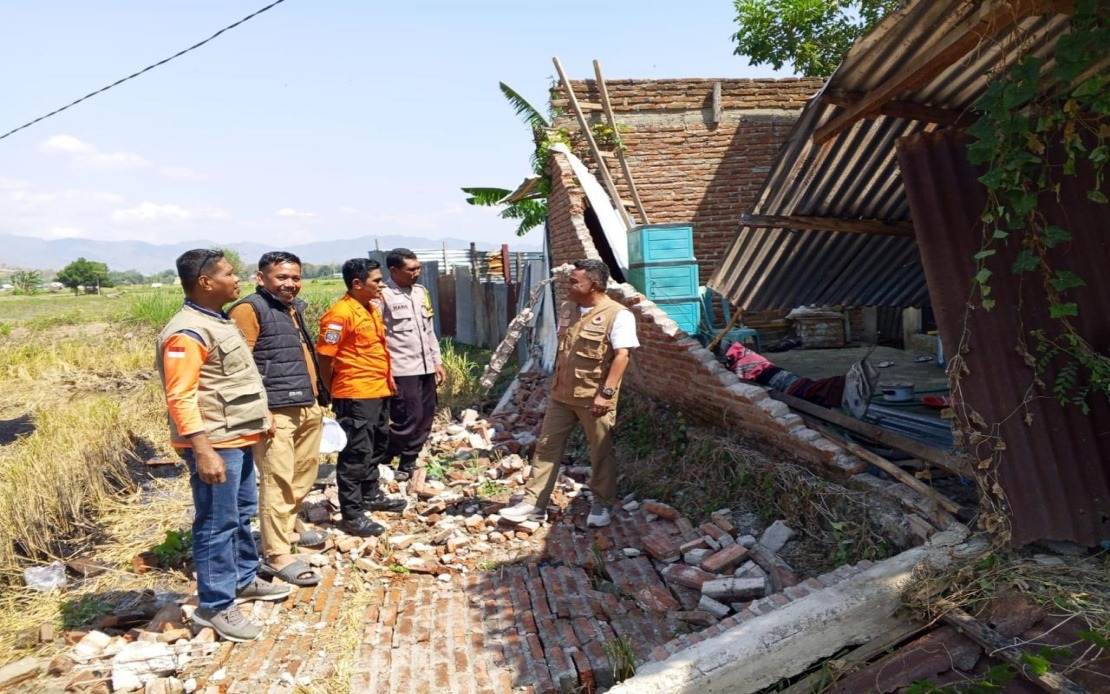
A powerful magnitude 7.7 earthquake struck Indonesia's Flores Island in the early hours of Saturday morning, triggering a rapid evacuation that saw approximately 2,000 residents moved to safety by authorities or seeking refuge independently. The tremor, which hit at 4.58 am local time with its epicentre located around 30 kilometres offshore from Mbay at a depth of 15 kilometres, sent shockwaves through the East Nusa Tenggara province and prompted immediate emergency protocols across the region. The seismic event unleashed considerable concern among residents already grappling with the trauma of the initial quake, as the Meteorology, Climatology and Geophysics Agency (BMKG) issued a tsunami warning that would remain in effect for nearly three hours before being lifted at 7.31 am following sea-level observations.
Indonesia's National Disaster Management Agency (BNPB) has been marshalling resources to assess the full scope of damage across affected districts, with officials acknowledging that impact evaluations remain ongoing. According to Berton Suar Pelita Panjaitan, the acting chief of the BNPB's Disaster Data, Information and Communication Centre, preliminary surveys identified significant structural damage across residential and institutional facilities. The initial assessment documented 54 houses suffering severe damage, with an additional nine experiencing moderate destruction and 11 sustaining minor harm. Beyond residential areas, the earthquake's reach extended to critical infrastructure, damaging five health facilities, one educational institution, three religious sites, a warehouse operated by the state food logistics agency Bulog, and six government office buildings.
The Manggarai district emerged as particularly hard-hit, with authorities recording 29 severely damaged houses alongside nine moderately and nine slightly damaged structures. The adjacent East Manggarai district reported comparable devastation, with 23 houses classified as severely damaged. These figures underscore the concentrated nature of the earthquake's destructive force across specific population centres, though Panjaitan cautioned that verification and validation of damage data continued as teams worked through affected communities. The complexity of accurately determining casualties and infrastructure losses has prompted coordination among regional disaster agencies, military and police forces, local government bodies, and other institutions engaged in comprehensive assessment activities.
The succession of aftershocks following the main earthquake has compounded challenges facing rescue and relief operations. The recorded 111 aftershocks represent a concerning pattern that typically follows major seismic events in Indonesia's tectonically active regions, each tremor potentially causing further structural compromise to already weakened buildings and generating renewed panic among affected populations. For residents contemplating whether to remain in damaged homes or seek temporary shelter, this aftershock sequence has reinforced the necessity of evacuation, complicating efforts to establish normal life and assess property damage accurately.
Casualty figures, while still being consolidated, have reached at least 20 deaths according to reports from the Maumere Search and Rescue Office, with six additional people injured and two others reported trapped in debris. These numbers, however preliminary, reflect the immediate human toll of the earthquake and underscore the urgency with which rescue teams have mobilised across the affected region. The trapped individuals represent ongoing search operations that may yet yield additional casualties or survivors depending on rescue progress.
Beyond physical destruction, the earthquake has compromised critical communication infrastructure across the province. The Ministry of Communication and Digital Affairs identified 200 base transceiver station (BTS) sites experiencing service disruptions across 10 districts and cities in East Nusa Tenggara, representing approximately 16.35 per cent of all BTS facilities in the affected areas. Digital Infrastructure director-general Wayan Toni Supriyanto noted that restoration efforts were underway through coordination with mobile telecommunications operators, highlighting how earthquake damage extends beyond visible structural destruction into the less obvious but equally vital realm of digital connectivity essential for emergency response coordination and public information dissemination.
For regional observers and policymakers, the Flores earthquake underscores Southeast Asia's persistent vulnerability to seismic hazards. Indonesia sits along the Pacific Ring of Fire and constitutes one of the world's most tectonically active zones, where earthquakes of this magnitude occur with relative frequency relative to other regions. The rapid mobilisation of evacuation efforts and the established protocols for tsunami warnings suggest that institutional preparedness has improved considerably since previous major events, yet the scale of displacement and infrastructure damage demonstrates that no level of preparation fully mitigates the destructive potential of such powerful natural phenomena.
The earthquake also highlights interdependencies between Indonesia and its regional neighbours, particularly Malaysia and other Southeast Asian nations that maintain substantial economic, diplomatic, and humanitarian relationships with Indonesian provinces. While the immediate crisis remains localised to Flores and East Nusa Tenggara, the broader implications resonate across a region where similar seismic risks threaten population centres in the Philippines, Brunei, and other areas along tectonic boundaries.
Looking forward, Indonesian authorities face the dual challenge of managing immediate humanitarian response while initiating reconstruction and building resilience initiatives. The damage assessment process, though ongoing and incomplete, will inform resource allocation for rebuilding efforts and inform updated building codes and disaster preparedness protocols. International support mechanisms, including potential assistance from regional organisations and bilateral partners, may complement domestic Indonesian resources as communities transition from emergency response to recovery and long-term reconstruction phases.

