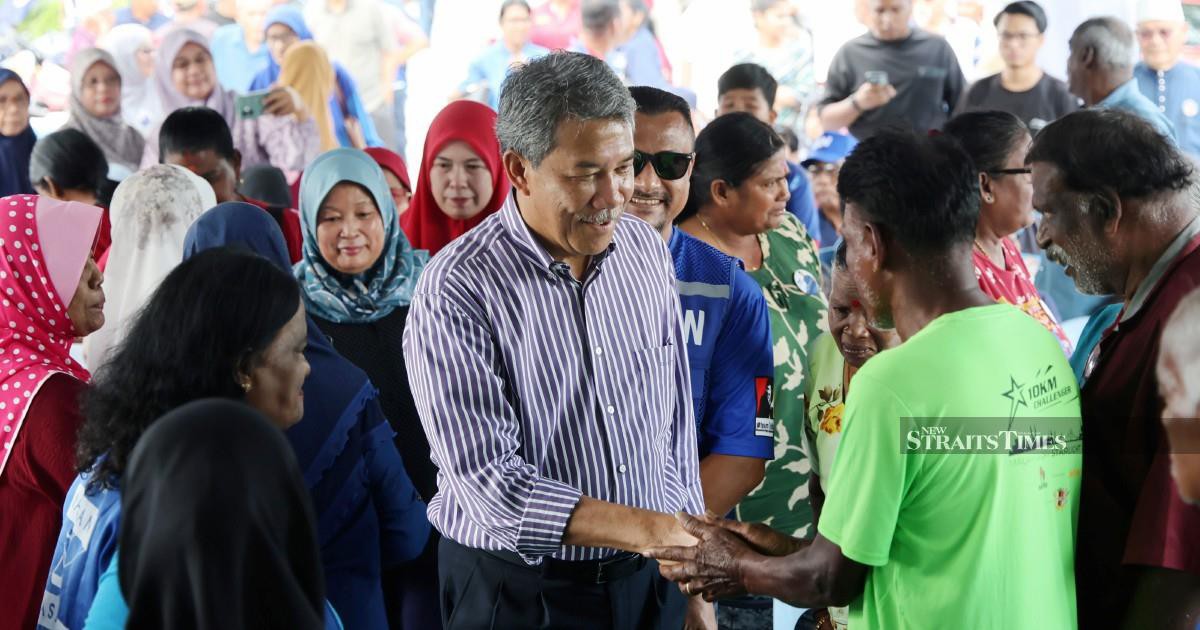
In remarks made in Rembau on Wednesday, Foreign Minister Datuk Seri Mohamad Hasan publicly declared his preparedness to relinquish his ministerial post should Prime Minister Datuk Seri Anwar Ibrahim determine it necessary. The candid statement underscores the delicate balance of power within Malaysia's coalition government and the subordinate position of senior cabinet figures relative to the prime minister's authority.
The foreign minister's willingness to step aside on command reflects the hierarchical structure embedded within Malaysian cabinet governance. While such declarations are ostensibly routine affirmations of the PM's supreme authority, Mohamad Hasan's explicit articulation of this readiness comes against a backdrop of periodic cabinet reshuffles and ministerial reassignments that have characterised recent administrations. His statement essentially signals deference to the prime minister's prerogative to restructure the cabinet whenever political exigencies demand.
The timing of such a pronouncement carries significance in the context of Malaysia's political landscape. The country's coalition government has faced recurring pressures from intra-party tensions and the need to balance representation among its constituent parties. Cabinet positions represent crucial power-sharing mechanisms that distribute influence and patronage among different political factions. A minister's willingness to step down readily can be interpreted as either genuine loyalty to the party leadership or a calculated political manoeuvre to demonstrate party discipline and cohesion to their own faction.
Mohamad Hasan's position as Foreign Minister places him at the intersection of Malaysia's diplomatic initiatives and domestic political requirements. The portfolio handles bilateral and multilateral relations with neighbouring ASEAN nations, major powers including China and the United States, and multilateral organisations. Any transition in this role would necessitate careful coordination to ensure continuity in Malaysia's foreign policy positions, particularly given ongoing regional developments including the Myanmar situation, South China Sea tensions, and Malaysia's engagement with the Quad countries.
The foreign minister's background brings particular experience to diplomatic functions. His prior tenure in various state and federal positions has shaped his approach to international engagement. The notion that he could be replaced suggests that the prime minister retains flexibility in managing the cabinet according to changing political circumstances, whether driven by coalition politics, electoral considerations, or broader strategic assessments of government performance.
For Malaysia's regional standing, ministerial stability in the foreign affairs portfolio carries practical implications. Diplomatic relationships depend on continuity, institutional memory, and established channels of communication with counterparts in other nations. A sudden change in foreign minister requires rebuilding rapport with international partners and recalibrating negotiating positions. ASEAN colleagues, multilateral organisation officials, and bilateral partners would need to establish working relationships with any successor, potentially creating transitional inefficiencies.
The statement also reveals conventional thinking within Malaysia's political system regarding ministerial accountability and prime ministerial authority. Unlike in some parliamentary democracies where cabinet ministers possess greater autonomy and resistance to removal, the Malaysian system grants the prime minister substantial discretion in constructing and reconstructing their cabinet. Ministers typically serve at the PM's pleasure, and their public affirmations of this principle reinforce the centrality of the prime minister's position within the executive structure.
Within the ruling coalition framework, such declarations by senior ministers serve multiple audiences. They communicate commitment to party leadership, demonstrate understanding of party discipline, and signal to faction colleagues that political survival depends on loyalty to the supreme leadership. For the prime minister, accepting such statements affirms the hierarchy and consolidates executive authority. The exchange between minister and PM becomes a public reaffirmation of the proper functioning of cabinet governance.
The broader political environment in Malaysia has witnessed ongoing discussions about government composition and ministerial effectiveness. Public discontent with inflation, cost-of-living pressures, and corruption perceptions periodically drive debates about whether the current cabinet configuration optimally serves national interests. A foreign minister's readiness to step down if needed suggests flexibility in addressing such concerns, though it remains unclear whether the government faces pressure specifically regarding foreign affairs management or whether this statement reflects routine assertions of cabinet discipline.
International observers monitoring Malaysia's political stability would note such statements as indicators of governmental continuity. While ministerial changes occur in functioning democracies, transparent assertions by cabinet members of their subordination to the prime minister's authority provide predictability in how power transitions would occur. This contrasts with scenarios of ministerial rebellion or public conflict over government direction, which would suggest deeper institutional dysfunction.
Looking forward, Mohamad Hasan's position remains secure unless Prime Minister Anwar Ibrahim determines otherwise. The foreign minister's explicit readiness to comply with potential removal orders essentially removes speculation about whether he would resist such a decision. This proactive declaration of compliance paradoxically may strengthen his position by demonstrating reliability and eliminating any perceived threat to executive unity.
The statement encapsulates an important dimension of Malaysian governance: the concentration of executive power in the prime minister's hands and the expectation that senior ministers operate within clear parameters of subordination. Whether this arrangement produces optimal governance outcomes remains a subject of ongoing political and public debate, but the system's continuity depends on ministers like Mohamad Hasan accepting these structural realities.

