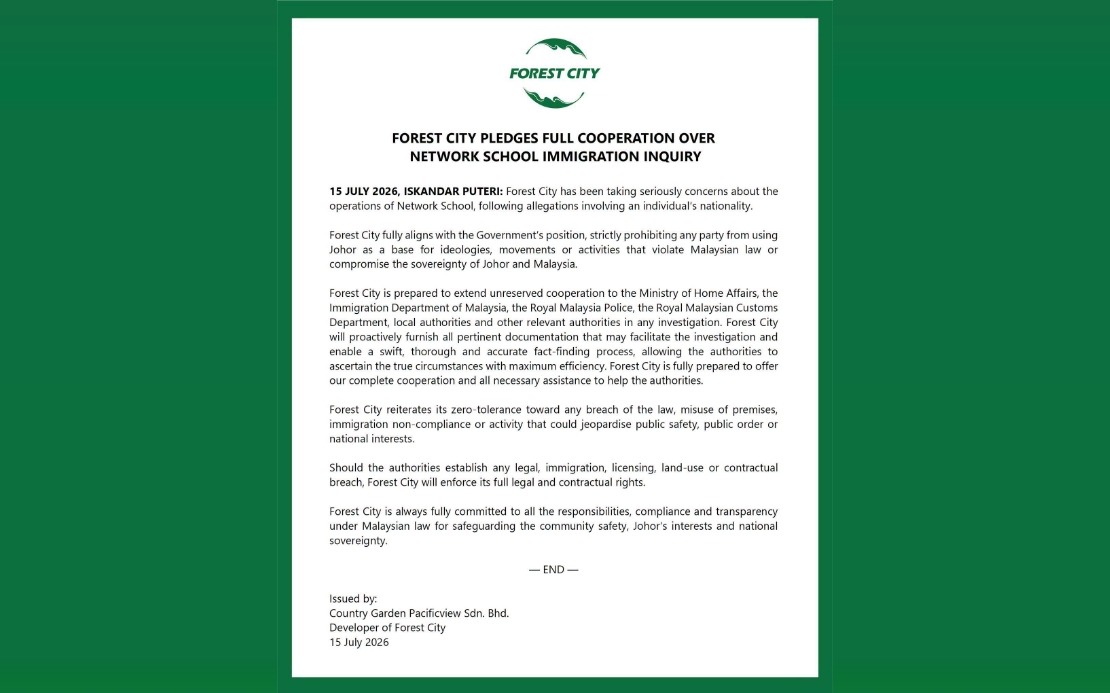
Country Garden Pacificview Sdn Bhd, the developer behind Johor's Forest City mega-project, has signalled its willingness to assist government agencies in examining allegations surrounding the Network School operation, which reportedly involved Israeli nationals. The statement comes as authorities intensify scrutiny into how the purported educational initiative operated within the sprawling waterfront development and what regulatory oversight may have been inadequate.
The developer's public commitment to cooperate reflects broader sensitivities around Johor's status as a major international investment hub and the need to maintain tight control over who enters the state and what activities they undertake. Forest City, which has attracted significant Chinese and regional interest, occupies an increasingly important position in both Johor's economic trajectory and Malaysia's relationship with international partners. Any suggestion that the development could serve as a platform for activities deemed problematic by the government poses reputational risks that the developer appears eager to contain through transparent engagement with authorities.
Country Garden Pacificview's position statement underscores its commitment to upholding Malaysian law and supporting government objectives regarding national sovereignty and security. The developer has explicitly endorsed the stance taken by Johor's leadership, signalling alignment with state authorities rather than attempting to distance itself from the controversy. This cooperative posture may help mitigate potential regulatory consequences, though it also suggests the scope of the investigation could be broader than initially apparent.
The investigation itself was catalysed by Johor Menteri Besar Datuk Onn Hafiz Ghazi's directive to the Home Ministry and related agencies to examine the Network School programme. Onn Hafiz raised concerns that participants had allegedly utilised second country passports to gain entry to Malaysia, circumventing standard immigration protocols. This detail is particularly significant in the Malaysian context, where immigration integrity is treated as a matter of national security and border control effectiveness directly reflects on governmental credibility.
Immigration Department officers conducted spot checks on 266 foreign nationals representing 40 different countries within Forest City, discovering that all possessed valid immigration documentation at the time of inspection. However, the fact that further investigations remain ongoing suggests authorities are pursuing deeper questions about whether documentation was authentic, whether visa conditions were properly observed, or whether the purposes declared upon entry aligned with actual activities undertaken. The distinction between holding valid papers and using them appropriately is crucial to understanding the full scope of potential violations.
Forest City's developer has committed to providing all documentation necessary to expedite the investigative process, a move that demonstrates confidence in the legitimacy of the development's operations while simultaneously positioning the company as a responsible corporate citizen. This approach reflects lessons learned from similar controversies elsewhere in Southeast Asia, where failure to cooperate transparently with authorities can result in prolonged investigations, reputational damage, and increased regulatory burdens.
The zero-tolerance policy articulated by Country Garden Pacificview explicitly addresses multiple categories of concern: legal violations, misuse of premises, immigration regulation breaches, and activities threatening public safety and order. By enumerating these specific areas, the developer signals that it has reviewed its own compliance mechanisms and identified potential weaknesses. This self-reflective posture suggests the company may implement enhanced vetting procedures for tenants, visitors, and programmes operating within Forest City boundaries.
The broader context involves Malaysia's evolving approach to managing large-scale international developments and ensuring they do not become vehicles for activities that contravene government policy. Forest City, as a high-profile Chinese-backed project, has already attracted scrutiny from various quarters regarding its ownership structure, environmental impact, and integration with Johor's existing communities. The Network School controversy adds another dimension to this ongoing public conversation about the appropriate boundaries of activity within such developments.
For Malaysian readers, this incident illustrates the delicate balance authorities must maintain between attracting international investment and safeguarding national interests. Johor's economic model increasingly depends on drawing foreign capital and talent, yet the state remains vigilant about ensuring that openness does not create security vulnerabilities or policy contradictions. The Network School investigation will likely influence how future educational and professional development programmes operate within Forest City and similar developments across Malaysia.
The involvement of multiple agencies—the Home Ministry, Immigration Department, Royal Malaysia Police, Royal Malaysian Customs Department, and local authorities—indicates this is being treated with appropriate seriousness rather than dismissed as a minor compliance matter. This multi-agency approach reflects the interconnected nature of modern border security, where educational programmes, visa statuses, passport validity, and local authority oversight all require coordinated examination.
As investigations proceed, the outcomes will probably shape how international programmes and educational initiatives are structured and monitored within Malaysia's private developments. Companies operating in the real estate sector are likely to become more cautious about what activities they permit on their premises and may implement more rigorous screening of tenant operations. This represents a recalibration of risk management practices across the industry.
The case also underscores Malaysia's position on matters relating to Israel and Israeli citizens, where the government maintains clear policies reflected in various legislative frameworks and diplomatic stances. Any activity involving Israeli nationals must navigate this complex legal and political landscape, and the fact that concerns were raised suggests that proper protocols may not have been followed when the Network School began operating.

