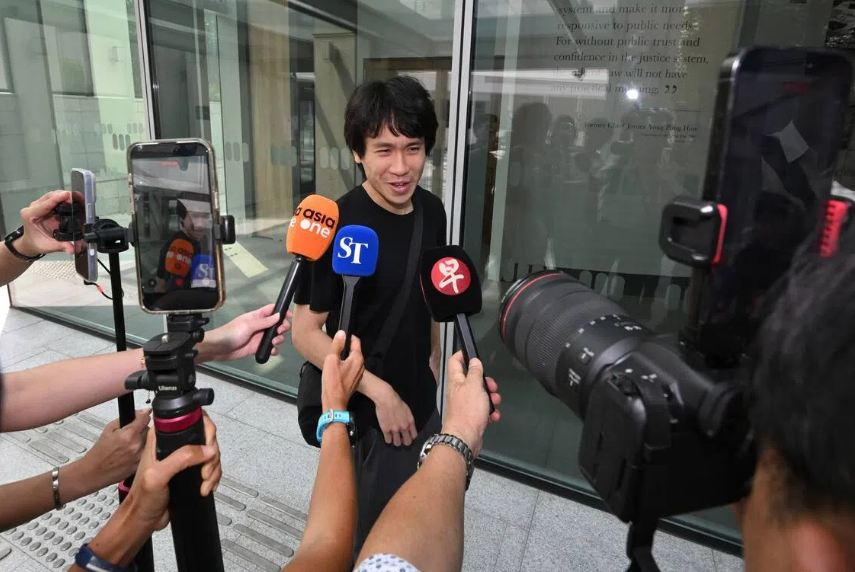
Former child actor Amos Yee made a return appearance at Singapore's District Court on August 26, where he was slapped with four additional charges that bring his total legal exposure to seven separate accusations spanning disparate areas of criminal law. The 27-year-old now faces multiple allegations ranging from deliberately stoking communal tensions to making statements supportive of child sexual abuse, alongside pre-existing charges related to mandatory military service violations.
Among the newly filed charges, Yee is accused of deliberately attempting to incite racial disharmony through a series of blog posts published in April. According to court documents, the posts claimed that Malay and Indian communities faced systematic discrimination at the hands of Singapore's Chinese majority, and allegedly encouraged members of these groups to launch coordinated protests against the Government. This line of accusation carries particularly serious implications in Singapore's multicultural context, where legislation strictly criminalises speech deliberately calculated to inflame communal tensions.
A second charge relates to video content uploaded in May in which Yee allegedly made statements characterising the Malay and Muslim communities as suffering heavy discrimination from the Chinese population in Singapore. The posting of such inflammatory material represents a notable escalation in the nature of his alleged conduct and demonstrates a pattern across multiple platforms and formats.
Two additional charges under Singapore's Protection from Harassment Act concern material that Yee purportedly created in 2021. In these videos, he allegedly articulated positions supporting freedom of speech for paedophiles and made claims that children could consent to sexual activity. Such advocacy strikes at the core protections that Singapore's legal framework extends to vulnerable minors. Yee further allegedly called for the repeal of legislation prohibiting the creation and retention of child sexual abuse material, positions that directly contradict international child protection standards and Singapore's own statutory scheme.
In a parallel set of allegations, Yee is said to have published a blog post on June 30 containing similar contentions regarding child exploitation and the decriminalisation of child sexual abuse material. The pattern of repeatedly articulating these positions across different platforms and extending over months suggests deliberate and sustained conduct rather than isolated incidents of poor judgment.
The legal consequences Yee faces are substantial. If convicted of deliberately promoting racial disharmony, he may be imprisoned for up to three years, fined, or subject to both penalties simultaneously. Each violation of the Protection from Harassment Act carries potential fines reaching S$5,000, a penalty structure designed to deter repeat offenders from persisting in harassing conduct.
Three additional charges under Singapore's Enlistment Act address long-standing allegations concerning national service obligations. Yee allegedly departed Singapore without proper authorisation on two separate occasions spanning December 2015 to April 2016, and again from December 2016 through March 2026, remaining absent without valid exit documentation. Furthermore, he is accused of failing to report for mandatory military service medical screening throughout an extended period from April 2016 onwards. These charges reflect systematic non-compliance with Singapore's conscription requirements, which the Government views as fundamental to national security and civic obligation.
Singapore's enforcement authorities moved swiftly to contain the spread of Yee's alleged harmful content. The platform X received a disabling direction from police on August 18 under the Online Criminal Harms Act, resulting in removal of his video material. Separately, Yee was issued a stop communication direction requiring deletion of the contested blog posts. These interventions illustrate Singapore's increasingly proactive stance toward regulating online speech deemed to threaten communal harmony or public safety.
The court released Yee on bail of S$15,000 on August 26, conditional upon strict limitations on his online activity. Crucially, he is forbidden from posting any content expressing views on paedophilia or material calculated to stir communal ill-feeling between racial and religious groups. These conditions attempt to prevent further dissemination of the alleged harmful speech while the case proceeds through the courts.
For Malaysian observers, Yee's case offers pertinent reminders regarding the regulatory frameworks governing speech in the region. While Malaysia's approach to balancing free expression with communal harmony differs in particulars from Singapore's more enforcement-intensive model, both jurisdictions maintain legislation targeting racial and religious incitement. The Yee prosecution underscores how Southeast Asian governments prioritise social cohesion in multicultural societies, and how online platforms have become focal points for enforcement action.
The convergence of charges—from racial disharmony to child exploitation advocacy to enlistment violations—presents a complex legal panorama that will likely extend through multiple court hearings. Yee is scheduled to return for a pre-trial conference on September 18, at which point the defence and prosecution will likely narrow contested issues and potentially begin plea negotiations. The case demonstrates how individual conduct online can trigger coordinated enforcement across multiple statutory regimes and how regulatory agencies view interconnected violations as requiring comprehensive legal response.

