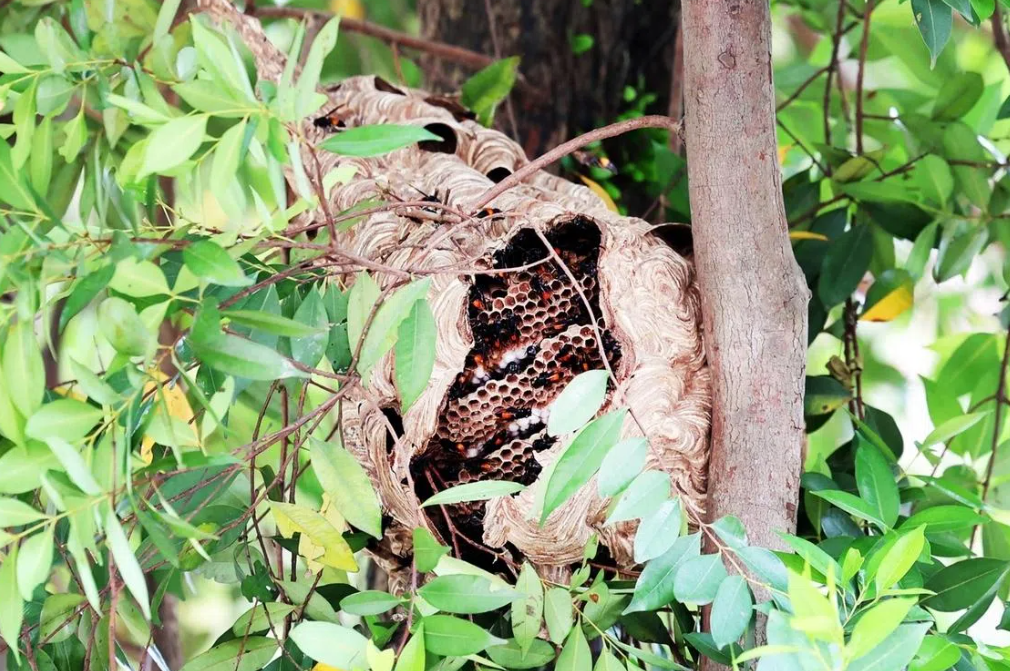
Four individuals were admitted to Singapore General Hospital after being attacked by a swarm of hornets near Redhill Market during the afternoon of July 10, prompting a swift response from local authorities who secured the area and safely extracted the offending nest from a residential zone.
The Singapore Civil Defence Force and Tanjong Pagar Town Council were notified around 1pm when residents reported the incident in Redhill Lane, where a large hornet nest had become established on a tree situated on the public footpath positioned between Block 78 Redhill Lane and a Shell petrol station. The town council's rapid intervention included immediate cordoning of the zone and activation of its contracted pest control operators, who successfully removed the nest and restored public safety to the area within hours.
Eyewitness accounts painted a harrowing picture of the encounter. Chen, who was enjoying coffee at the market when the incident unfolded, recounted hearing someone alert other patrons to the hornet presence and watched as an older man became the focus of the insects' aggression, with multiple stings sustained during the attack. Another witness, Mei Zhen, provided particularly vivid details after discovering an elderly woman in her 70s in a distressed state inside a nearby toilet facility.
The woman's injuries were visibly severe, with her ears displaying pronounced swelling, redness, and bleeding consistent with multiple stings concentrated on her head and face area. Zhen observed that more than ten hornets had surrounded the victim's head during the assault, with some insects becoming tangled in her hair while others scattered across the floor and door surfaces. Beyond the physical trauma, the victim reported experiencing debilitating symptoms including severe headaches and vertigo, suggesting systemic reactions to the venom exposure.
The medical consequences of hornet stings carry particular gravity for victims and healthcare providers. According to clinical information from the National University Hospital, hornets possess anatomical and biochemical characteristics that distinguish them from smaller stinging insects such as bees or common wasps. Each hornet delivers considerably more venom during a sting event, multiplying the danger during encounters involving multiple insects as occurred near Redhill Market.
The hornet venom composition explains why victims experience such pronounced symptoms. Histamine present in the venom triggers acute allergic responses that cascade through the body, while melittin, another key component, produces intense localized pain at sting sites. Additional proteinaceous substances including phospholipase and hyaluronidase add further toxicity, as these enzymes can damage human cellular structures and exacerbate inflammatory reactions throughout affected tissues.
In worst-case scenarios, hornet venom exposure can trigger life-threatening systemic responses. These include dangerous drops in blood pressure, reduced circulation to critical organs, and oedema affecting the airway passages, potentially causing fatal asphyxiation if medical intervention proves delayed. The severity spectrum means that seemingly numerous stings, particularly concentrated on vulnerable regions like the head and neck, demand rapid professional medical evaluation and treatment.
Local authorities issued public guidance emphasizing that residents encountering hornets or suspicious nests should prioritise personal safety above all other considerations. Tanjong Pagar Town Council specifically advised maintaining composure and immediately vacating the vicinity, moving toward the nearest building for shelter rather than attempting confrontation with aggressive insects. Residents should never try to disturb or independently remove nests, as such actions invariably provoke the colonies and escalate attack severity.
For those already stung, the protocols are straightforward: exit the area without delay and immediately telephone 995 if symptoms become severe or if the victim feels unable to cope with the injury alone. This emergency response system has proven essential in hornet incidents, given the potential for rapid medical deterioration following multiple envenomations.
Singapore's hornet problem extends beyond this isolated incident, reflecting a broader public health pattern. In 2024 alone, authorities responded to at least two significant hornet attack incidents, including an episode at Sungei Buloh that hospitalised five people, and a fatal attack along the Sembawang Park Connector that resulted in a cyclist's death. These recurring events underscore the need for enhanced public awareness, prompt nest identification and removal protocols, and accessible emergency medical response.
The incidents also carry implications for Southeast Asia more broadly, as Singapore's high population density in confined urban spaces creates unusual concentrations of human-hornet interaction compared with regional norms. Malaysian readers should note that while hornet populations and attack frequencies vary across the region, the medical management principles remain identical, and awareness of proper response procedures could prove life-saving in similar circumstances. Authorities across the region have begun collaborating on hornet monitoring and public education strategies to reduce casualties and improve emergency response preparedness.

