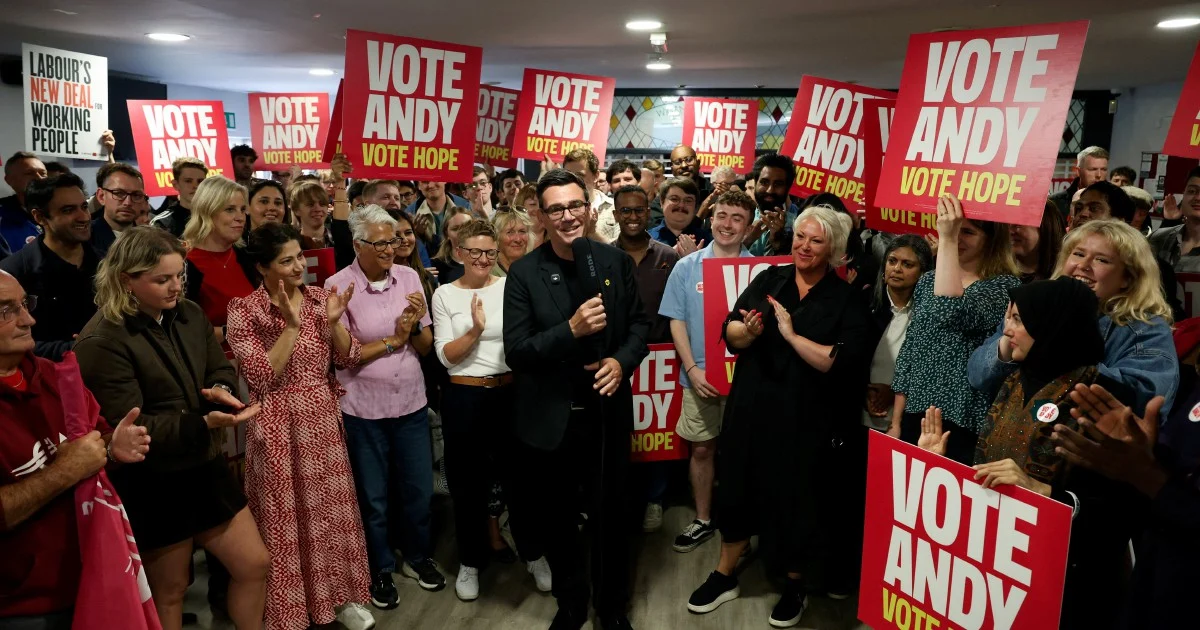
Andy Burnham's prospects of ultimately contending for the British prime ministership have been unexpectedly strengthened by internecine conflict within the country's right-wing populist movement. The Labour politician requires victory in Thursday's Makerfield election to secure the parliamentary platform necessary for mounting a serious leadership challenge against current Prime Minister Keir Starmer. Rather than consolidating around a single candidate, rival populist factions are locked in a damaging dispute that threatens to dilute their combined vote share across key constituencies.
The splintering of the right-wing vote represents a dramatic reversal from recent electoral cycles, when populist movements managed to concentrate support with considerable effect. The Makerfield contest, a traditionally Labour-held seat in the North West, has become unexpectedly competitive precisely because anti-establishment parties are cannibalising each other's support rather than presenting voters with a unified alternative. This dynamic underscores how electoral mathematics often determine political outcomes as much as policy platforms or leadership charisma do.
Burnham's position within Labour has evolved considerably since his previous leadership campaigns. His time as Mayor of Greater Manchester established him as a figure capable of commanding significant regional influence and delivering tangible results for communities beyond Westminster's immediate orbit. The devolved role provided him with a platform to build a distinct political identity separate from the national party machinery, appealing to voters in post-industrial areas who have grown sceptical of centralised governance.
Keir Starmer's tenure as Prime Minister has generated discussion about potential successors within Labour circles. While Starmer inherited the party after Jeremy Corbyn's tenure and delivered substantial electoral gains, internal dynamics suggest an appetite for alternative figures who might appeal to different segments of the party's coalition. Burnham represents a particular style of politics rooted in regional advocacy and cross-party problem-solving, contrasting with metropolitan liberalism that sometimes characterises senior London-based politicians.
The Makerfield seat carries symbolic importance beyond its electoral mechanics. The constituency's demographic composition—working-class communities with deep historical ties to manufacturing and traditional industries—reflects the broader realignment troubling British politics. These communities have successively abandoned long-held allegiances, first fragmenting towards populist insurgents and now potentially reconsidering centrist options as extremism's limitations become apparent.
Right-wing populist infighting stems from competing claims to represent anti-establishment sentiment and nationalist priorities. Rather than cooperating to maximise their combined electoral advantage, the factions are pursuing mutually destructive campaigns that alienate potential supporters through internal acrimony. This mirrors broader patterns observed across European populist movements, where personality clashes and ideological micro-differences frequently override strategic unity.
For Malaysian and Southeast Asian observers, the Makerfield contest illustrates how electoral systems, demographic change, and political fragmentation interact across different democracies. The phenomenon of populist movements failing to capitalise on deep public discontent mirrors dynamics visible in regional elections. When protest movements become institutionalised through multiple competing parties, their effectiveness often diminishes despite underlying voter frustration remaining potent.
Burnham's potential ascendancy would represent a particular ideological direction within Labour. Having articulated positions emphasising devolution, regional investment, and working-class advocacy, he embodies a different variant of social democracy than previous leadership eras. His emphasis on tangible local outcomes rather than transformative national projects appeals to constituencies experiencing economic stagnation and institutional neglect.
The broader British political landscape faces structural realignment as established party loyalties continue eroding. Labour's recovery after years of unpopularity under Corbyn remains fragile, dependent partly on opposition division rather than overwhelming popular enthusiasm. The question of succession becomes pressing if Starmer encounters difficulties, making figures like Burnham—with established regional credentials and demonstrated administrative experience—valuable assets to the party establishment.
The timing of potential leadership transitions within Labour remains uncertain, but internal succession planning invariably occurs beneath the surface of public politics. Burnham's consolidation of parliamentary representation through securing Makerfield strengthens his position considerably, providing him with the direct electoral mandate that Westminster politics values highly. A seat won despite limited personal campaigning appeal and primarily attributable to opponent self-destruction would nonetheless constitute a victory with considerable symbolic and practical utility.
Regional politicians increasingly matter within British Labour politics precisely because metropolitan-concentrated politics has delivered diminishing electoral returns. Burnham's grounding in Northwest England, his demonstrated administrative competence, and his capacity to articulate working-class concerns position him strategically within a party searching for renewed connection with its traditional constituencies. The Makerfield election outcome, shaped largely by populist dysfunction rather than Burnham's own compelling case, will nonetheless accelerate these internal positioning dynamics significantly.
Beyond immediate electoral mechanics, the Makerfield contest exemplifies how anti-democratic movements frequently contain inherent contradictions that undermine their consolidation. The infighting currently weakening right-wing populism suggests that opposition fragmentation offers temporary respite from serious political challenge, yet ultimately addresses neither the underlying grievances motivating populist support nor the institutional failures that enable populist exploitation of public anxiety.