The quarter-final meeting between France and Morocco on Thursday carries significance that extends far beyond football, anchored in a century of shared history and the migration patterns that have woven the two nations together. The fixture represents a rare intersection of sporting excellence and geopolitical legacy, with Boston providing an unexpectedly intimate setting for a contest that carries the weight of post-colonial relations expressed through the modern language of competitive sport.
France's protectorate governance of Morocco from 1912 until independence in 1956 established deep institutional and cultural connections that persist today. These links have evolved through education systems, business networks, and sustained migration flows, creating a distinctive relationship where nationals move freely between borders and maintain dual identities. Football has emerged as perhaps the most visible manifestation of this integration, with the sport serving as both a mirror of broader societal connections and a platform where these relationships achieve their most dramatic expression.
The composition of Morocco's squad itself provides compelling evidence of how profoundly France has shaped the nation's football development. Six players representing the Atlas Lions were born on French soil, while numerous others spent formative years in French academies or competing in Ligue 1 before committing to Morocco's national team. This phenomenon reflects a conscious strategy by Morocco's football federation to harness the talent potential of diaspora communities, transforming what could be considered a brain drain into a competitive advantage. The federation has systematically identified and developed players raised in superior European training environments, then convinced them to represent their ancestral nation.
Ayyoub Bouaddi exemplifies the complexity embedded in these transatlantic footballing relationships. The teenager was born in France, developed through Lille's renowned academy system, and represented France at youth level before ultimately choosing to play for Morocco. His trajectory encapsulates the multiple layers of identity negotiation that characterise contemporary football, where players navigate national belonging, family heritage, and professional opportunity within evolving eligibility frameworks. Such cases reveal how sport intersects with questions of identity and belonging in ways that transcend conventional national boundaries.
The connection between Kylian Mbappé and Achraf Hakimi, forged during their shared tenure at Paris Saint-Germain, provides another dimension to this narrative. Elite athletes moving between major European clubs create informal networks that bridge national teams, and these personal relationships often carry symbolic weight extending beyond football. Such friendships humanise international competition, transforming abstract fixtures into encounters between individuals with genuine affection for one another, complicating the nationalist narratives that typically frame World Cup encounters.
Boston presents a markedly different atmosphere for this rematch compared to venues in France or Morocco. The Moroccan community in the Boston metropolitan area, while smaller than diaspora populations in major European cities, nonetheless maintains established networks of families, students, and professionals. These communities experience the match not as a clean division of allegiance but as an occasion bringing people together across national lines. Mohammed Saadi, a 57-year-old taxi driver, observed that supporters from both nations often share living spaces and social circles, creating an environment where match-day becomes a shared family experience rather than a source of tension.
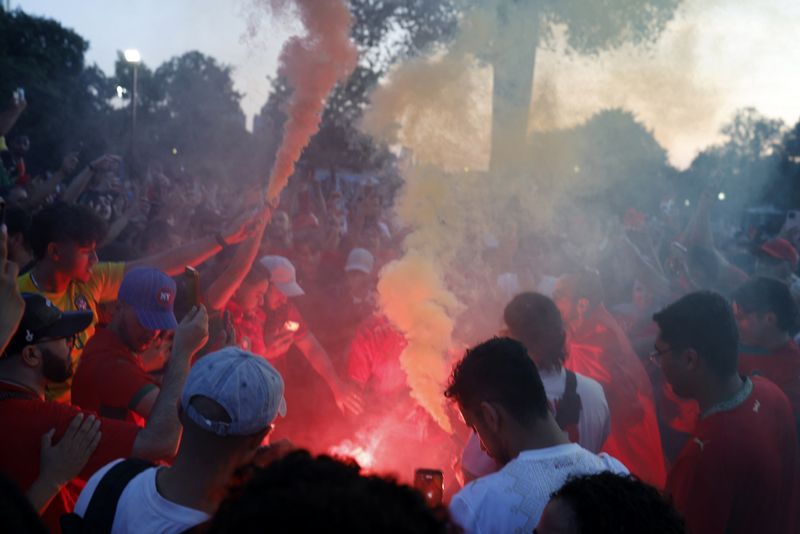
The atmosphere captured in Boston Common, where over a thousand supporters gathered to sing Dima l-Maghrib and wave flags, demonstrated the peaceful coexistence of rival supporters in an American setting. Youssef Bennani, a 36-year-old software engineer who travelled from Finland to watch Morocco's matches throughout the tournament, noted the cosmopolitan character of the gathering, which included both Moroccan and French supporters anticipating the quarter-final as a celebration rather than a conflict. This dynamic stands in marked contrast to the heightened security presence required in France for such fixtures.
Morocco's trajectory through this tournament has fundamentally altered the psychological texture of this particular matchup. In their previous encounter during Qatar 2022, which France won decisively 2-0, Morocco occupied the compelling underdog position. That run, in which they became the first African nation to reach a World Cup semi-final, captivated global audiences and established them as authentic contenders rather than romantic longshots. The intervening years have solidified their institutional development, with improvements in tactical discipline and player development creating a side capable of troubling established football powers.
France enters as defending World Cup champions from 2018, possessing the tournament experience and attacking potency expected of a side pursuing another title. However, Morocco's emphatic 3-0 victory over Canada demonstrated the pace, organisational rigour, and sustained ambition that have characterised their campaign. The Spanish-born manager Carlo Ancelotti's squad navigated past Paraguay, but Morocco's combination of defensive solidity and counterattacking threat presents a qualitatively different examination of France's championship credentials.
The federation strategy that has underpinned Morocco's rise reflects a sophisticated understanding of global talent markets. Rather than limiting themselves to domestically developed players, Morocco's administrators recognised that exceptional young talent could be developed in European academies and subsequently convinced to represent the national team. This approach acknowledges economic realities—Europe's superior training infrastructure and financial resources—while simultaneously asserting Morocco's ability to compete for diaspora loyalty. The strategy transforms what might appear as loss into strategic gain, as players developed elsewhere bring elite-level experience to Morocco's squad.
The quarter-final carries particular resonance for supporters with family ties spanning both nations, a demographic substantially represented in Boston's communities. For these individuals, the match cannot be reduced to simple binary choice but instead represents a complex negotiation of multiple belonging and loyalty. The Boston setting, removed from the heightened nationalism that sometimes characterises such fixtures in European cities, permits a more authentic expression of these nuanced relationships. Supporters can cheer for one side whilst maintaining genuine affection for the other, celebrating excellent football without requiring total victory for emotional satisfaction.
As Thursday's match approaches, the fixture represents far more than a World Cup quarter-final between two capable teams. It embodies the ongoing story of post-colonial relationship, the reality of modern migration, and the capacity of sport to express human connection across national boundaries. France and Morocco will contest for victory, but the broader context reminds observers that international football, properly understood, reveals the complex interdependencies and shared histories that define the contemporary world.

