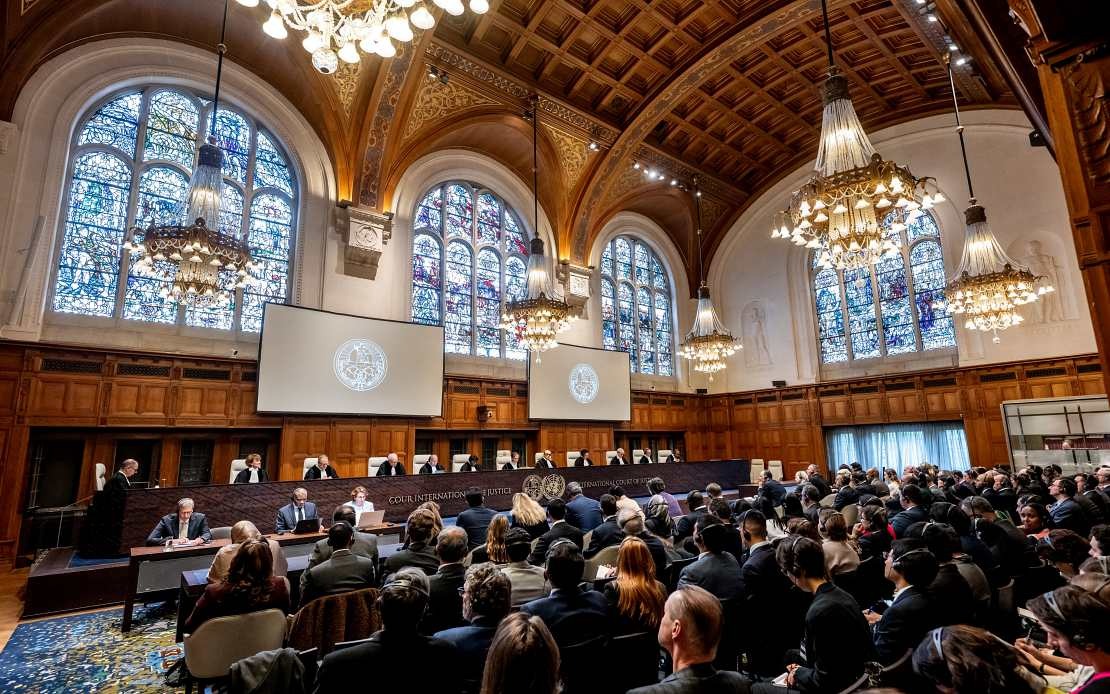
France has reinforced its commitment to the International Criminal Court, firmly pushing back against the United States' characterization of the tribunal as a threat to national sovereignty. The declaration from Paris underscores a widening diplomatic divide over the role and legitimacy of international justice mechanisms, particularly as Washington intensifies efforts to constrain the court's operations and encourage other nations to abandon their membership.
French Foreign Ministry spokesman Pascal Confavreux articulated the distinction that underpins Paris's position during a press briefing on Thursday. He emphasised that the ICC functions as a prosecutorial body focused on individuals rather than as an instrument targeting governments, a nuance that he contended addresses the core concern underlying American objections. The court, by design and charter, investigates and tries persons suspected of committing the gravest offences recognised in international law—genocide, war crimes, crimes against humanity, and aggression—not the states themselves. This foundational principle, Confavreux argued, removes the conflict of interest that Washington claims to perceive.
Confavreux reiterated France's unwavering position supporting the ICC's institutional resilience and its mandate to combat impunity for atrocities. France views the tribunal not as a threat but as an essential component of the global architecture for accountability and justice. The statement reflected a broader French perspective that sees international law and multinational institutions as vital to maintaining order in a rules-based international system, a philosophical stance that increasingly diverges from American policy direction under the current administration.
The French spokesman also denounced what he characterised as unacceptable attacks and intimidation directed at ICC personnel, judges, and others engaged in the court's work. This particular concern speaks to heightened tensions surrounding the tribunal's independence and the physical security of those serving it. Such remarks implicitly acknowledge the real pressures the court faces from external actors seeking to impede or delegitimise its operations.
The French position crystallised in response to recent statements by US Secretary of State Marco Rubio, who explicitly declared that the ICC represented a sovereignty challenge to the United States and announced Washington's intention to lobby other countries to withdraw their memberships. Rubio's declaration reflects a hardening of the American stance toward international courts and multilateral legal frameworks that do not fall under direct US control or veto authority. The Rubio position goes beyond mere criticism; it represents an active campaign to hollow out the court's membership base and constrain its operational capacity.
Adding substance to these rhetorical positions, the US State Department has simultaneously initiated a formal policy initiative designed to curtail what American officials describe as the ICC's ability to challenge American interests and assert jurisdiction over matters Washington regards as domestic affairs. This dual approach—rhetoric combined with institutional action—signals a comprehensive strategy to reduce the court's practical influence and legal reach. The initiative represents not merely a disagreement over legal philosophy but a deliberate restructuring of American engagement with international justice mechanisms.
The ICC, headquartered in The Hague, has operated since 2002 as the world's first permanent international tribunal with authority to prosecute individuals for the most severe crimes. Its establishment represented a significant milestone in the evolution of international humanitarian law, codifying mechanisms for accountability that transcended borders and national boundaries. The court operates on the principle of complementarity, intervening only when national judicial systems prove unwilling or unable to prosecute grave offences, thereby respecting state sovereignty even as it creates an avenue for justice when domestic systems fail.
A critical structural reality shapes this dispute: the United States has never accepted membership in the ICC. American policymakers have historically resisted surrendering judicial authority over American citizens to any international body, viewing such submission as incompatible with national sovereignty. This non-membership status paradoxically strengthens American freedom to criticise and oppose the court without facing reciprocal pressure. France, by contrast, represents the constituency of countries that have embraced the court and its mission, viewing international accountability mechanisms as complementary to national justice systems rather than competitors for authority.
For Malaysia and other Southeast Asian nations, this transatlantic disagreement carries significance beyond abstract principles of international law. The question of whether international institutions can function effectively against great power resistance directly affects the utility and credibility of such mechanisms for smaller states that depend on them for protection against more powerful actors. If major powers can successfully delegitimise and defund international courts through coordinated pressure, the systems that protect lesser powers lose their force. Conversely, if multilateral institutions maintain their independence and operational capacity despite opposition from individual states, they serve their intended function of creating accountability regardless of a nation's relative power.
The dispute also reflects deeper questions about the future architecture of global governance. France's stance, supported by numerous other democracies, suggests a vision of international order rooted in shared legal frameworks and institutional arrangements that constrain all actors equally. The American position, by contrast, suggests a preference for a system where major powers retain exceptional standing and the ability to opt out of constraints they deem inconvenient. These competing visions will likely shape debates over international law, human rights enforcement, and accountability mechanisms for years to come.

