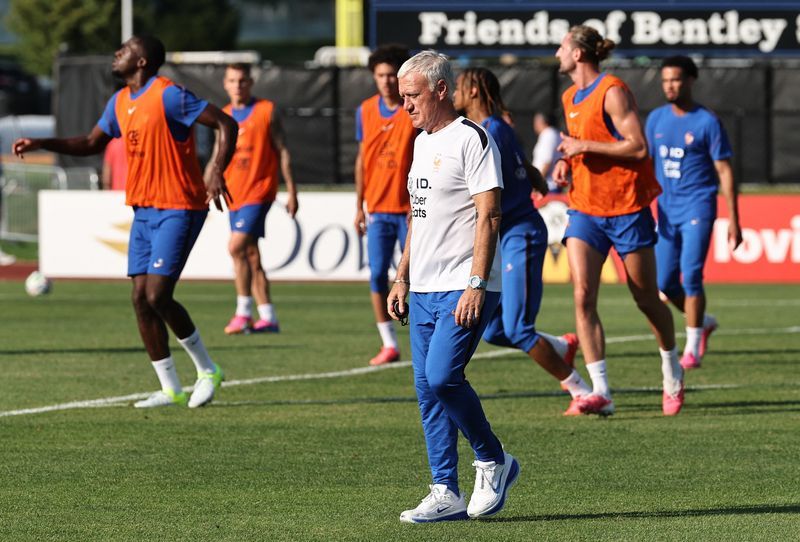
France begins its World Cup knockout campaign on Tuesday against Sweden as the tournament's most fearsome attacking unit, having stormed through the group stage with a flawless record and a barrage of goals that few teams appear equipped to contain. The French squad's layered depth across the forward positions, combined with individual brilliance from players like Kylian Mbappe and Ousmane Dembele, has created an attacking apparatus that seems almost impossible to neutralise. Yet beneath this glittering surface, coach Didier Deschamps has identified structural issues that must be resolved before facing an opponent unlikely to pose such a conundrum as the tournament's elite, but dangerous nonetheless through discipline and organisation.
France's progression through Group I was a masterclass in attacking football. The team's commanding performances against Senegal, Iraq and Norway yielded ten goals without conceding a single defeat, establishing them as group champions with maximum points. Mbappe has once again emerged as the tournament's central creative force, while Dembele's hat-trick performance against Norway showcased the technical brilliance available across the frontline. Michael Olise's contributions have added a creative dimension that makes France's attack multifaceted and difficult to predict, giving Deschamps options that rotate his attacking personnel without sacrificing cohesion or cutting edge.
However, the group stage masks an asymmetry in France's defensive shape that becomes increasingly relevant in knockout football. The left flank, crucial for both attacking width and defensive stability, has appeared unsettled throughout the earlier matches. Theo Hernandez's performances at left back have not fully satisfied the coaching staff, prompting Deschamps to consider bringing Lucas Digne into the lineup. Digne's experience and more cautious approach to positioning should provide additional security in transitions and cleaner delivery when initiating attacks from wide areas. This adjustment reflects a pragmatic recognition that Sweden, despite their relative underperformance in Group F, will likely exploit any defensive disorganisation through counter-attacking football and set-piece opportunities.
The personnel changes extend beyond the defensive line into the attacking midfield and forward areas. Bradley Barcola is expected to replace Desire Doue on the left side of France's attack, a switch that prioritises direct running and explosive pace in transition. Deschamps appears to recognise that against deep-sitting opponents like Sweden, manufacturing width through more conventional winger movement rather than narrow, interior passing may prove more effective. Barcola's aggressive ball-carrying and ability to threaten space behind defenders offers a different dynamic to Doue's more positional approach, potentially creating more chaos in Swedish defensive organisation whilst maintaining the left flank's attacking purpose.
The defensive spine should benefit from additional reinforcement through the return of William Saliba to central defence. Saliba's presence alongside France's other defensive options provides structural stability that allows the fullbacks to operate with greater freedom in attacking phases. This defensive foundation becomes critical when facing Sweden, who will almost certainly deploy a compact, organised shape and seek to exploit any spaces that emerge through counter-attacking movements or set-piece scenarios. France's defending, whilst generally effective, has occasionally appeared susceptible to being caught off guard when opponents transition quickly from defence to attack, a vulnerability that must be minimised against any opponent capable of clinical finishing.
Sweden, by contrast, arrives as an opponent defined more by functional organisation than spectacular individual talent. Their Group F campaign was wildly inconsistent, featuring a dominant 5-1 victory over Tunisia followed by a heavy 5-1 defeat to the Netherlands and an underwhelming 1-1 draw with Japan. This volatile run of results suggests a team lacking the consistency required to trouble France across ninety minutes, yet possessing sufficient physical presence and tactical discipline to create isolated moments of difficulty if France become complacent or impatient. The Swedish approach will almost certainly centre on defending deep, absorbing French pressure through compact shape, and attempting to exploit the spaces behind France's advancing fullbacks through quick transitions.
Sweden possess attacking talent capable of scoring goals, with Alexander Isak, Viktor Gyokeres and Anthony Elanga providing a front line with genuine offensive capability. Yet their combined output and consistency falls substantially short of the French attacking arsenal, a disparity that becomes more pronounced across knockout football where a single lapse in concentration often proves decisive. Former England international Gary Lineker has observed that whilst Sweden represent a competent opponent, they lack the sustained firepower to genuinely threaten France's progression. The Swedish challenge will likely depend upon discipline, organisation and capitalising upon rare defensive errors rather than sustaining an offensive threat that matches France's creative resources.
The transition from group-stage football to knockout competition represents a qualitative shift in challenge. During the group phase, France's occasional defensive vulnerabilities were offset by their capacity to overwhelm opponents through superior attacking output and relentless goal-scoring. Knockout tournaments compress the margin for error, requiring both defensive solidity and offensive efficiency in proportions that rarely favour teams reliant upon out-scoring their opponents. France's recent World Cup history offers encouraging precedent, with the team remaining unbeaten in knockout matches since 2014, with the notable exception of the 2022 final against Argentina. This record suggests both structural stability and mental resilience across decisive matches, attributes that Sweden will struggle to disrupt.
France's attacking bench strength represents perhaps their greatest advantage and, paradoxically, a potential source of vulnerability. The availability of Barcola, Doue, Rayan Cherki, Jean-Philippe Mateta and Marcus Thuram ensures that Deschamps can rotate personnel without significant performance degradation. Yet this reliance upon constant attacking players in the side may leave France structurally vulnerable to counter-attacks, particularly if Swedish opponents engineer quick transitions against a French defence spread across the pitch. The balance between defensive security and attacking ambition will determine how effectively France navigates this tie and, ultimately, their path through the knockout stages.
Victory against Sweden would progress France into the Round of 16 against either Germany or Paraguay, matchups that would present substantially different tactical challenges and likely require further adjustments to squad composition. The Swedish test, whilst not presenting the highest level of opposition available, offers Deschamps an opportunity to fine-tune his side's balance between attacking potency and defensive stability, lessons that will prove invaluable as the tournament enters its defining phase where both elements become equally crucial to success.

