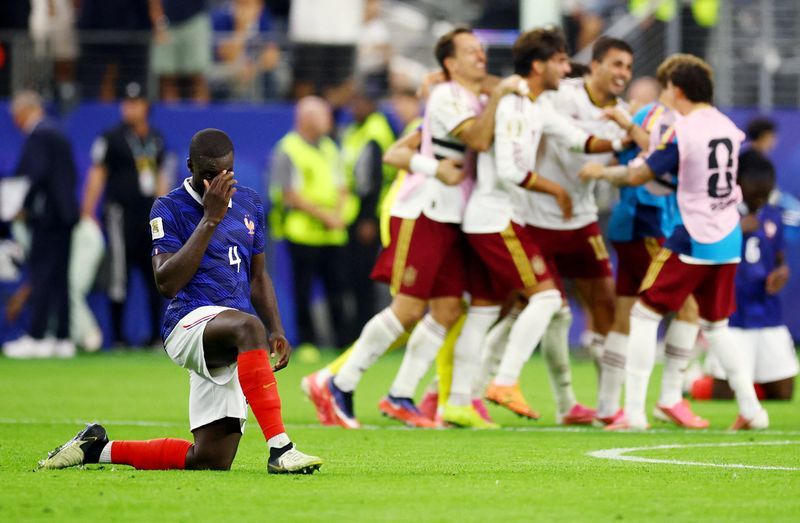
France's ambitious World Cup campaign collapsed in dramatic fashion on Tuesday evening when Spain dismantled the tournament favourites with a commanding 2-0 semi-final victory at Arlington, Texas. What unfolded was not a close contest decided by narrow margins, but rather a comprehensive demolition that left the French squad devastated and their supporters struggling to process how quickly their dreams of retaining the trophy had evaporated. For all the pre-match confidence surrounding Les Bleus, they crumbled when confronted with their first genuine examination of the tournament, offering no meaningful resistance to a Spanish side that proved both technically superior and tactically astute.
The magnitude of France's underperformance became apparent almost immediately to observers who had watched their opening period against Argentina in the 2022 World Cup final. That encounter, though difficult, had ultimately showcased French resilience and the capacity to recover from adversity. Here at Arlington Stadium, there was to be no such redemption narrative. France looked every bit as vulnerable as they had during their worst stretches two years earlier, yet this time they possessed no reserves of character to draw upon when the situation demanded it most. Coach Didier Deschamps acknowledged the harsh reality with characteristic candour, stripping away any excuses by stating plainly that his players had been outclassed where it mattered most—in technical execution and tactical awareness.
The Spanish approach, orchestrated with intelligence and maturity, centred on controlling tempo and denying France the space to impose their attacking philosophy. Remarkably, it appeared that those who had constructed pre-tournament predictions heavily favouring France had fundamentally miscalculated the true balance of power within the competition. The French players themselves contributed to this miscalculation, failing to adapt quickly when Spain's measured, possession-based approach began to suffocate their attacking avenues. Rayan Cherki, introduced as a second-half substitute, reflected afterwards that France had understood Spain's defensive intent but remained unable to execute the necessary adjustments, particularly in slowing down proceedings themselves to match their opponents' rhythm and deny them the initiative.
Spain's young sensation Lamine Yamal had entered the contest with the bold confidence of a teenager unafraid to declare that France were the ones who ought to harbour concerns about the impending encounter. That swagger proved justified as his team dismantled the pre-match favourites with composed authority. The most telling symbol of France's comprehensive failure proved to be Michael Olise, the midfielder thrust into conversations about elite playmakers and positioned as the creative fulcrum around which French attacking ambitions would revolve. Olise's performance at Dallas Stadium painted an entirely different picture from the one sketched by his pre-tournament billing. He appeared lost and bewildered, continually starved of both space and meaningful possession, his repeated surrenders of the ball creating dangerous transition opportunities for the opponent.
Olise's statistical return was damning by any measure—twenty turnovers without a single successful dribble completed. For a player France had specifically selected to unlock Spanish defensive structures and impose creative control, the contrast between expectation and reality could scarcely have been more pronounced. Yet Olise remained merely one component within a broader French attacking collapse. Ousmane Dembele generated minimal threat from his flank, while Bradley Barcola and his replacement Desire Doue proved similarly ineffectual, suggesting systematic dysfunction rather than isolated underperformance. Even Kylian Mbappe, the tournament's standout individual talent, failed to manufacture the moment of brilliance his supporters had anticipated. The afternoon's most enthusiastic crowd response arrived when David and Victoria Beckham appeared on the stadium's giant screen—a telling commentary on where public attention had shifted as the French attack sputtered.
Spain's midfield conductor Rodri orchestrated the victory with ruthless authority, gliding through the centre of the pitch with the confidence of a player operating at elite level against visibly second-rate opposition. His performance underscored how thoroughly France's midfield had been outmuscled and outwitted from the opening moments. Deschamps' double pivot setup, intended to provide defensive security, was rapidly overwhelmed by Spain's superior technical quality and movement patterns. Adrien Rabiot's early yellow card forced him to temper his natural aggressive instincts, rendering him cautious rather than commanding. Aurelien Tchouameni, returning from a hamstring injury that had sidelined him for two preceding matches, lacked the fitness and sharpness necessary to contend with Spanish pressing and transition play, his legs clearly unable to maintain the required intensity.
With the midfield breached and exposed, France's defensive line inherited an impossible task, forced to confront repeated Spanish attacking waves with insufficient protection from their shield. The Spanish breakdown came with clinical efficiency—Mikel Oyarzabal converting a penalty after twenty-two minutes before Pedro Porro added a second goal shortly before the hour mark. Both goals stemmed directly from defensive lapses born of midfield dysfunction, a chain reaction that demonstrated how comprehensively France's tactical blueprint had unravelled. The scoreline, ultimately reflecting perhaps the most decisive margin France would face throughout their tournament run, barely captured the gulf in quality displayed across ninety minutes.
As the final whistle sounded, the emotional toll became visibly apparent. Mbappe stood alone on the pitch, appearing isolated as his teammates either sank to their knees or buried their faces in their hands—visceral expressions of the shock and devastation accompanying such a sudden elimination from a competition they had genuinely believed they could win. All the pre-match rhetoric surrounding team cohesion and unity, repeated with monotonous frequency up to the eve of the semi-final, suddenly seemed hollow and irrelevant. The gap between aspiration and execution had rarely appeared so wide or so painfully exposed.
For Southeast Asian observers of international football, this result carries particular relevance in understanding how tournament momentum, squad depth, and tactical flexibility determine outcomes at the highest level. France's experience illustrates that pre-tournament favouritism, however logically constructed, means little when teams fail to execute under genuine pressure. Spain's performance instead demonstrated how systematic approaches to possession and tempo control can neutralise even the most talented opposition. The lesson for regional footballing nations aspiring to develop world-class competitive infrastructure concerns the importance of not merely assembling individual talent but ensuring coherent tactical systems, midfield control, and the mental resilience necessary to adjust rapidly when initial approaches prove ineffective. France's collapse serves as a cautionary tale about complacency masquerading as confidence.

