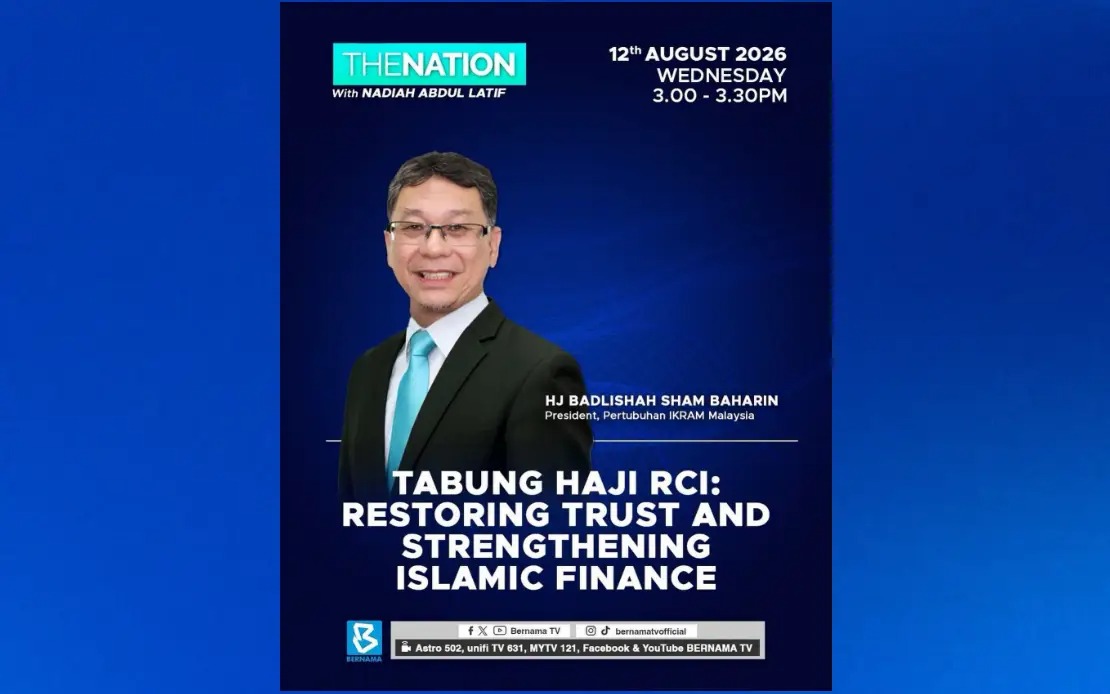
The push for a fresh Royal Commission of Inquiry into Tabung Haji has found a notable critic in Pertubuhan IKRAM Malaysia, whose president Badlishah Sham Baharin contends that existing investigative mechanisms are adequate to address institutional shortcomings. Speaking after a television discussion on strengthening Islamic finance, Badlishah Sham articulated concerns that establishing multiple RCIs risks eroding public confidence in such inquiries and diluting their intended purpose as instruments for examining genuinely significant governance failures.
The debate surrounding the pilgrim fund's oversight intensified following the public release of the initial RCI report on 29 July, which exposed substantial institutional weaknesses spanning the 2014-2020 period. Both government-aligned and opposition lawmakers have urged the administration to commission a successor inquiry covering the subsequent five-year interval from 2021 to 2025, citing gaps in the existing investigation's temporal scope. This division in the political landscape reflects deeper anxieties about the thoroughness of accountability mechanisms overseeing an organisation responsible for safeguarding the financial interests of nearly ten million depositors.
The financial trajectory that prompted such scrutiny proves sobering by any measure. Finance Minister II Datuk Seri Amir Hamzah Azizan disclosed that fourteen deficient investment initiatives generated cumulative losses approaching RM13 billion, with seven ventures resulting in complete capital erosion. The government's 2018 rescue operation through Urusharta Jamaah Sdn Bhd extracted RM10.2 billion from federal coffers, whilst further impairment charges totalling RM2.6 billion accumulated between 2018 and 2025 for ongoing portfolio obligations. For Malaysian depositors—predominantly middle and lower-income earners saving for hajj pilgrimage—these revelations underscore the vulnerability of faith-based savings vehicles to institutional mismanagement.
Among the portfolio's casualties, the Al-Rawda initiative stands as the most destructive single transaction, crystallising losses of RM1 billion by 2024. Between 2015 and 2017, the fund channelled approximately RM1.5 billion (1.4 billion Saudi riyals) to intermediaries securing leases on four accommodation properties in Islam's holiest cities. When the operator defaulted on rental obligations beginning in early 2019, Tabung Haji found itself trapped within a deteriorating contract yielding no salvageable recoveries. This episode exemplifies how geographical distance, currency exposure, and reliance upon third-party intermediaries compounded decision-making risks that internal governance structures failed to moderate.
Rather than endorsing the RCI expansion that lawmakers across the political spectrum advocate, Badlishah Sham articulated an alternative framework centred on preventative institutional architecture. He championed the establishment of a coordinated multi-agency task force capable of subjecting prospective investments to rigorous preliminary examination prior to capital deployment. Such an approach would shift emphasis from retrospective post-mortems towards antecedent diligence protocols, obliging decision-makers to document ethical compliance, procedural correctness, and grassroots stakeholder impact assessments before commitments crystallise. For Malaysia's Islamic finance sector broadly, implementing such front-loading mechanisms could establish replicable governance benchmarks applicable across other faith-based financial institutions and sukuk issuers.
The distinction between investigative depth and institutional durability animates IKRAM's reasoning. The organisation's leadership contends that Malaysian Anti-Corruption Commission involvement alongside conventional regulatory oversight furnishes sufficient jurisdictional authority to identify culpability and pursue prosecutorial remedies. Accumulating RCIs risk creating public perception that governmental institutions lack self-correcting capacity, necessitating perpetual external fact-finding exercises. Conversely, demonstrating that established enforcement agencies can extract accountability through existing statutory frameworks strengthens confidence in institutional self-governance—a particularly vital consideration for an Islamic finance ecosystem where depositor confidence remains foundational to market stability.
The parliamentary dynamics surrounding Tabung Haji discourse acquired an additional dimension when opposition members staged a walkout during the Dewan Rakyat's special deliberation on the original RCI report. Badlishah Sham characterised this boycott as a dereliction of legislative obligation, emphasising that elected representatives carry fiduciary responsibility towards constituents whose retirement savings remained imperilled by institutional failures. The walkout, he suggested, represented performative dissent disconnected from substantive parliamentary function—a criticism that resonates with broader Malaysian conversations about legislative seriousness amid polarised political environments where symbolic positioning sometimes supersedes deliberative engagement.
This contention intersects with significant questions about parliamentary efficacy within Malaysia's democratic framework. Opposition figures have historically employed legislative absence as protest mechanism against governmental procedural choices or policy directions they deem objectionable. Yet Badlishah Sham's invocation of depositor welfare as countervailing consideration reframes the conversation around fiduciary rather than partisan dimensions. The nearly ten million Malaysians holding Tabung Haji accounts transcend political affiliation; their accumulated savings constitute economic security for retirement, hajj pilgrimage, or family emergencies. From this perspective, parliamentary walkouts subordinate universal stakeholder interests to factional political positioning—a prioritisation particularly indefensible when institutional failures have already eroded depositor capital by billions of ringgit.
Implementation progress on the original inquiry's twenty-five recommendations provides cautious grounds for gradualism. By 30 July—a single day following public report release—Tabung Haji had operationalised approximately seventy-five per cent of suggested reforms, indicating institutional responsiveness to accountability mechanisms. This compliance trajectory suggests that extant RCI findings retain sufficient catalytic power to drive operational transformation without requiring supplementary inquiries. For Malaysian stakeholders, this demonstrates that comprehensive investigation produces actionable institutional change when combined with regulatory pressure and political attention.
The broader Southeast Asian context illuminates why Malaysia's Tabung Haji experience carries regional significance. Islamic finance constitutes expanding asset classes across the region, with comparable institutions managing pilgrim savings and investment portfolios in Indonesia, Brunei, and other Muslim-majority jurisdictions. Governance failures at regionally prominent faith-based financial intermediaries create demonstration effects influencing confidence across Islamic banking ecosystems. Malaysia's visible accountability response—encompassing RCI investigation, ministerial parliamentary accounting, and institutional reform implementation—potentially establishes precedent for regional peer institutions confronting comparable challenges.
Moving forward, the resolution between multiple RCI advocacy and single-inquiry sufficiency hinges upon whether emerging multi-agency task forces deliver tangible preventative governance improvements. Should coordinated regulatory mechanisms successfully insulate future investment decisions from repeat catastrophic failures, IKRAM's position gains retrospective vindication. Conversely, if subsequent problematic transactions materialise despite reformed processes, political pressure for supplementary inquiries will intensify irrespective of institutional reluctance. For Malaysian depositors and their political representatives, this dynamic establishes clear performance metrics against which reformed governance structures merit evaluation.

