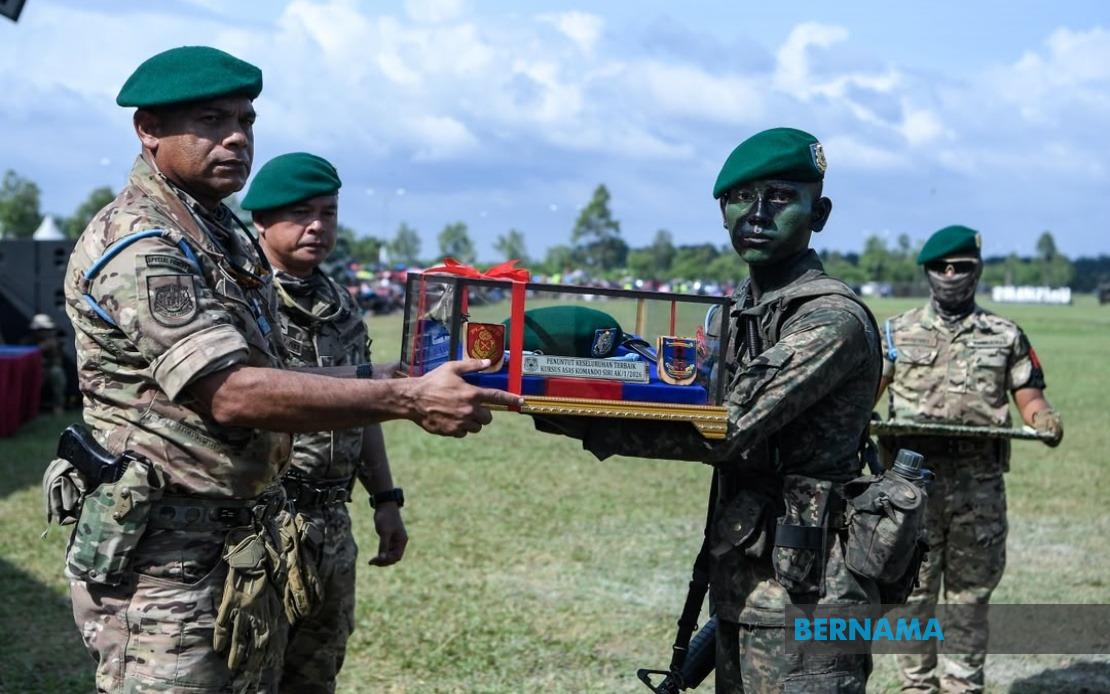
Second Lieutenant Muhammad Fadli Jamalluddin's journey to earning Malaysia's elite green beret exemplifies the resilience demanded of military officers pursuing the nation's most demanding combat qualification. The 24-year-old from Ampang, Kuala Lumpur, clinched the Best Overall Trainee award upon completing the Basic Commando Course Series AK/1/26 this month, but his path to this recognition was far from straightforward. What distinguished his achievement was not simply his technical competence, but his capacity to absorb failure and return with renewed determination—a quality increasingly valued as militaries worldwide stress psychological fortitude alongside physical prowess.
Muhammad Fadli's military trajectory began long before his commando training. His ambition to serve in uniform took shape during his secondary school years, eventually leading him to enrol at the National Defence University of Malaysia (UPNM), where he pursued formal officer education. Upon graduation, he joined the Royal Malay Regiment in 2024, positioning himself within one of Malaysia's most storied infantry formations. However, his initial attempt at the Basic Commando Course Series 3/2024 resulted in failure—a crushing outcome for any young officer whose career aspirations rest upon such credentials. Rather than accepting this as a career setback, he analysed the experience and prepared himself for another attempt, a decision that speaks to both his emotional maturity and his understanding of military culture, where persistence often determines advancement.
During his second attempt, Muhammad Fadli faced an additional crisis during the eighth week of the gruelling three-month programme. Having already invested weeks in intense physical conditioning and mental preparation, he faltered during a critical training exercise, an outcome that threatened to nullify his entire effort and force him to restart the course completely. The psychological weight of this near-disaster proved immense. He acknowledged breaking down emotionally after the failure, having already endured more than 100 kilometres of endurance marching and countless other physical trials that leave few recruits untouched. At that juncture, when doubt might reasonably have overtaken ambition, many around him counselled him to abandon the pursuit, citing the documented dangers and extreme demands of commando training.
Yet Muhammad Fadli refused to surrender to these rational objections. His reframing of failure as opportunity rather than terminus reveals something important about officer selection and development in modern militaries. He recognised that the commando qualification demanded not merely the ability to execute physical tasks, but the psychological architecture to persist when circumstances became genuinely dire. This mindset—learning to regard setbacks as information rather than pronouncements of unsuitability—represents precisely the cognitive flexibility required in complex military operations. His decision to continue despite well-meaning advice to quit demonstrates a maturity that often cannot be taught in classrooms, only forged through direct experience of adversity.
The young officer holds a Bachelor's degree in Global Policing and Intelligence with Honours, indicating that his qualification emerged from a foundation of structured intellectual preparation. Commando training in Malaysia's Special Warfare Training Centre (PULPAK) integrates both domains—the physical demands that dominate the public imagination and the strategic reasoning that separates elite operators from merely fit soldiers. Muhammad Fadli explicitly articulated this synthesis, noting that while commando status itself represents a formidable achievement, obtaining that qualification as an officer multiplies the complexity. Officers cannot rely solely on physical strength; they must possess the analytical capacity to plan operations methodically, make sound tactical decisions under pressure, and lead other personnel through similarly demanding environments.
The three-month course that ultimately delivered him his green beret encompasses integrated land and sea training designed to fracture and rebuild both physical capacity and mental resilience simultaneously. Such programmes typically employ progressive stress, introducing candidates to increasingly severe conditions while monitoring their psychological responses alongside physiological markers. The curriculum tests not only raw endurance but also decision-making under exhaustion, problem-solving with degraded cognitive function, and teamwork when individual reserves are depleted. Muhammad Fadli's emergence as Best Overall Trainee from this furnace suggests he excelled across these dimensions, suggesting an unusually well-rounded capability.
His motivation extended beyond professional ambition. Muhammad Fadli emphasised that his father, who suffered a stroke more than a year prior to the course, provided inspiration throughout his training. Unable to attend the closing ceremony, his father nonetheless occupied Muhammad Fadli's thoughts during the most demanding phases. This personal dimension—the desire to present a meaningful achievement to a parent facing health challenges—resonates deeply within Malaysian family culture, where filial duty remains a powerful motivational force. The young officer framed his qualification not as personal glory but as a gift to his parents and broader family, suggesting that his commitment emerged from relational bonds rather than pure careerism.
The broader significance of Muhammad Fadli's achievement extends beyond individual accomplishment. His success after initial failure sends an important signal within military hierarchies about resilience and second chances. In organisations where a single failure can derail careers, his story demonstrates that institutional practice might accommodate human fallibility without sacrificing standards. Furthermore, his emphasis on the intellectual dimensions of commando work reflects global trends in military professionalism, where even elite combat units increasingly demand officers capable of strategy, cultural competence, and complex decision-making alongside traditional martial skills.
The completion ceremony at Universiti Sultan Abdul Halim Mu'adzam Shah (UniSHAMS) in Kuala Ketil included five other officers and 33 other ranks who successfully qualified, indicating substantial cohort diversity. Muhammad Fadli's Best Overall Trainee award, presented by Colonel Nordin Abu as Commandant of PULPAK, represents formal recognition of his superior performance across the training spectrum. Yet his narrative holds particular power because it refuses the mythology of effortless excellence. Instead, it documents the messy reality of institutional achievement—initial failure, emotional crisis, community doubt, and ultimately triumph through sustained commitment.
For Malaysian military observers and younger officers navigating their own career pressures, Muhammad Fadli's journey offers a template for responding to institutional challenges. The commando qualification remains among the most prestigious achievements available in the Malaysian armed forces, functioning as a key credential for advancement to senior leadership positions. His ascent to this tier after setbacks suggests that the system, despite its severity, retains capacity to identify and develop individuals whose resilience outweighs their occasional performance gaps. As Malaysia's military continues modernising its officer corps—particularly in special operations and intelligence functions—the balance between maintaining punitive standards and preserving opportunity for redemption will remain consequential.

