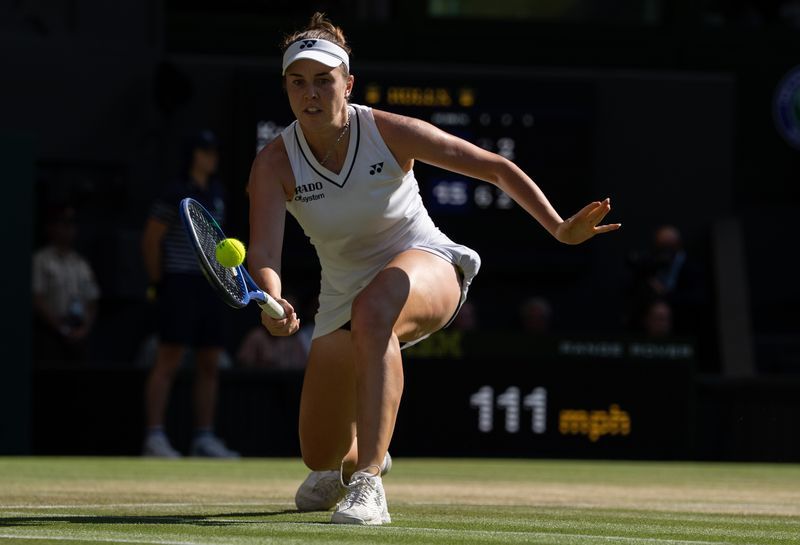
Linda Noskova's triumph at Wimbledon on Saturday stands as a testament to psychological fortitude rarely witnessed at tennis's highest level. The 21-year-old Czech ninth seed defeated compatriot and friend Karolina Muchova 6-2 5-7 6-3 in the women's singles final, claiming one of Grand Slam tennis's most coveted trophies despite a performance that would have shattered most players' resolve. What makes Noskova's victory extraordinary is not merely the final score, but the manner in which she recovered from a collapse that saw five separate match points evaporate before her eyes on a sun-bathed Centre Court.
The trajectory of the contest made Noskova's ultimate success even more improbable. Leading 5-2 in the second set with the trophy seemingly within touching distance, Noskova appeared destined to join an exclusive lineage of Czech women who have won the Wimbledon singles crown. Three match points disappeared as Muchova served at 2-5, a fourth slipped away when nerves triggered a double-fault at 5-3, and a fifth opportunity vanished during the ninth game. Rather than closing out victory, Noskova watched helplessly as Muchova seized momentum, reeling off five consecutive games to force a deciding set that had appeared improbable mere minutes earlier.
The psychological impact manifested visibly. After surrendering her dominant position, Noskova returned to her courtside chair visibly shaken, her hands pressed against her ears as if to block out the roaucous crowd and, perhaps, her own racing thoughts. Walking towards the player facilities for a comfort break, she carried the body language of someone confronting the prospect of losing the most significant match of her career—the kind of moment that defines or derails young athletes. Her title hopes, which had glowed so brightly mere games earlier, seemed to have dimmed considerably in the space of five games.
What happened during that brief respite proved decisive. As Noskova made her way off court, her gaze fell upon the trophies displayed nearby—both the Venus Rosewater Dish reserved for the champion and the runner-up's plate. In that moment, a psychological shift occurred. She recounted to reporters afterward how seeing those silverware pieces served as a catalyst for mental recalibration. "I was like, I'm not going to take the small one, I'm taking the big one," she explained, revealing the intensity of her internal resolve. The bathroom ritual itself—splashing cold water on her face—became more than mere physical refreshment; it was a deliberate act of resetting her mental state, of telling herself that the match was essentially beginning anew rather than ending in defeat.
Returning to court for the decisive third set, Noskova faced an immediate test in the opening game when serving to stay alive in the match. By her own analysis, holding serve in that first game proved transformative. "Let's say I'm brave enough to say that the third set would not have been the same if maybe I would have lost the first game," she reflected. That service hold seemed to flip an internal switch. The timing on her groundstrokes returned; her footwork became purposeful again; her shot-making regained its aggressive edge. When match points presented themselves once more at 5-3, more than an hour after that first devastating collapse, Noskova converted decisively, this time unwilling to be denied.
Noskova's victory carries particular significance for Czech tennis and regional pride. She becomes the third Czech woman to capture the Wimbledon singles title within four years, and at 21, she is the youngest women's champion since fellow Czech Petra Kvitova won her first Wimbledon title in 2011. The concentration of Czech success at the women's singles level underscores the strength of coaching infrastructure and competitive culture within Czech tennis, which continues to produce champions despite the nation's relatively small population. Her win reinforces Czechia's status as a heavyweight in women's professional tennis on the global stage.
Beyond her technical abilities, Noskova's demeanor and life philosophy suggest a maturity that extends well beyond the tennis court. She carries a nose ring and wears her individuality openly, but her worldview encompasses concerns far removed from professional sports. Her mother Ivana died of cancer two years ago, a tragedy that has informed her approach to life and competition—one marked by perspective and gratitude. Last year, during her off-season, she spent time volunteering in Zanzibar at a local school, an experience she credited with deepening her appreciation for her opportunities and circumstances.
Noskova has articulated a clear vision for her life beyond tennis, rooted in environmental advocacy and active stewardship. A self-described nature lover who grew up in a village in a Czech forest, she has spoken openly about her desire to engage in volunteer work focused on environmental conservation and sustainability. Even in previous interviews about different matches, she has demonstrated engagement with global issues and crises, suggesting an intellectual curiosity and social consciousness that distinguishes her from athletes focused exclusively on competition. This broader perspective may well have contributed to her ability to compartmentalize Saturday's devastating second-set collapse and approach the third set with renewed mental clarity.
For Malaysian and Southeast Asian tennis enthusiasts, Noskova's triumph offers several instructive lessons. Her victory demonstrates that mental resilience—the capacity to reset psychologically after catastrophic setbacks—can prove as decisive as technical prowess at tennis's highest levels. Her path also illustrates how success at Grand Slams does not require perfection; rather, it demands the capacity to overcome imperfection and recover from crisis when it strikes. Additionally, her engagement with volunteerism and social causes during her athletic career provides a model for how elite athletes can balance ambition with broader contributions to society and environmental stewardship.
Looking forward, Noskova's Grand Slam success at such a young age positions her to potentially dominate women's tennis for years to come. The psychological breakthrough achieved on Saturday—the ability to overcome five match points and maintain composure through the most pressurized moments—represents growth that bodes well for her handling of future high-stakes encounters. Having confronted and conquered the worst-case scenario in a Grand Slam final, she enters her future competitions with proven evidence of her capacity to survive extreme adversity. She herself reflected on the transformative impact of the victory, noting that the experience will remain unforgettable. As she processes the magnitude of her achievement at Wimbledon, Noskova has cemented her place among tennis's emerging superstars while embodying a model of principled athleticism that transcends sport itself.

