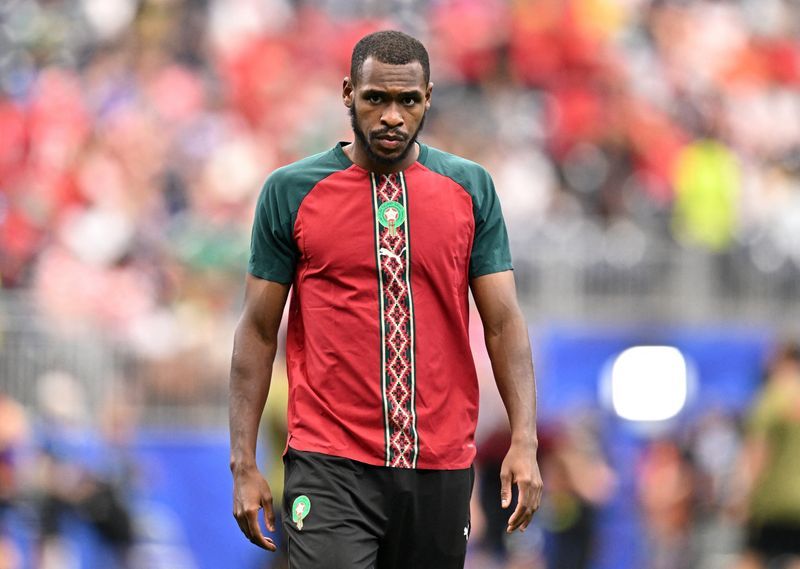
The narrative of Issa Diop's international football career reads like a soap opera with a dramatic third-act redemption arc. The 29-year-old Moroccan centre-back, born in Toulouse to a Senegalese father and Moroccan mother, has suddenly found himself in an extraordinary position: defending against Kylian Mbappé and France in a World Cup quarter-final on Thursday, despite spending years insisting he would never represent Morocco. The irony of the situation — a player who once spurned his heritage for the tricolour now tasked with containing one of the world's most dangerous attackers from that very nation — provides an unexpected layer of drama to an already compelling knockout encounter.
Diop's path to this moment was paved with conviction that he had already spent years articulating publicly. Seven years prior, while representing France's Under-21 programme, he declared his unwavering allegiance to the country that had raised him. "I am French. I was born in France. France has given me everything," he told Canal Plus, adding that switching nations would constitute an act of hypocrisy and settling for a default option. These were not throwaway comments but rather a clear statement of identity and loyalty. When Morocco and Senegal repeatedly approached him about switching his international colours, Diop consistently rebuffed their overtures, maintaining that his commitment lay exclusively with France.
The dramatic reversal of that stance materialized in March of this year, when Diop unexpectedly agreed to commit to Morocco. His decision triggered considerable backlash on social media, with critics and supporters alike questioning the authenticity of his newfound Moroccan patriotism. Many viewed the switch as opportunistic — a pragmatic calculation by a player whose French pathway had stalled rather than a genuine return to familial roots. The timing seemed particularly suspicious to observers, arriving just months before the World Cup, suggesting Diop had seized upon Morocco's defensive vulnerabilities as a pathway to tournament football that had eluded him with France.
Morocco's need for defensive reinforcement was genuine and acute. Captain Romain Saiss had departed the international scene following the Africa Cup of Nations in January, creating a void in the side's leadership and experience. The situation worsened when defender Nayef Aguerd suffered an injury in March, further depleting the squad's defensive options. Coach Mohamed Ouahbi identified Diop as the solution to these structural problems, recognizing that the Premier League veteran possessed both the quality and experience necessary to stabilize Morocco's backline ahead of the tournament. Ouahbi's confidence in recruiting a player with such a controversial recent history suggests the coaching staff believed Diop's commitment was genuine, regardless of public skepticism.
Diop's integration into the Moroccan setup proved remarkably swift and seamless. He made his competitive debut in a March friendly against Ecuador and immediately established himself as the first-choice centre-back, partnering alongside Crystal Palace defender Chadi Riad. Ouahbi publicly expressed satisfaction with Diop's transition, describing a player who appeared genuinely connected to Moroccan culture and maintained regular contact with the country. "I sensed someone who is committed, who lives a somewhat Moroccan lifestyle and visits the country frequently," the coach reflected, suggesting that Diop's integration extended beyond mere footballing considerations into a broader embrace of Moroccan identity.
The doubters were silenced, at least temporarily, by Diop's extraordinary contribution in Morocco's round of 32 encounter against the Netherlands. With his team trailing and the match ebbing toward a Dutch victory, Diop appeared in the penalty area during the 91st minute and powered home a header from a Chemsdine Talbi cross. The goal, arriving just one minute into stoppage time, rescued Morocco from elimination and forced the contest into extra time. Ultimately, Morocco prevailed on penalties, a result that owed significantly to Diop's dramatic intervention. His own recollection of the moment was characteristically understated — "I went forward, I don't know what I was doing there, it was the end of the match. I tried to find some space and scored" — but the impact was undeniable.
This dramatic contribution has substantially altered perceptions of Diop's decision to represent Morocco. The social media criticism has largely dissipated, replaced by recognition that the defender has delivered tangible value precisely when the team required it most. Rather than being viewed as an opportunistic late convert, Diop is now perceived as a crucial component of Morocco's World Cup ambitions. His eight seasons in the Premier League with West Ham United and Fulham have provided him with the physicality, tactical awareness, and experience necessary to compete at the highest levels of international football.
Thursday's quarter-final against France presents an entirely different challenge from the Netherlands encounter. Mbappé is not merely another striker but rather one of the sport's elite attacking talents, possessing a combination of pace, technical skill, and composure that has made him one of international football's most lethal finishers. The psychological dimension of the matchup cannot be overlooked — Diop will be defending against the very country he once insisted was his only possible home, playing for a nation he had previously rejected. This reversal of circumstances carries weight beyond the technical aspects of defending.
Yet Ouahbi appears confident that Diop possesses the mental resilience and professional commitment to compartmentalize any conflicting emotions and focus purely on his defensive responsibilities. The coach has emphasized that Diop's performance has dispelled any lingering doubts about his dedication to Morocco's cause. "We shouldn't dwell too much on the past but rather focus on what lies ahead. What matters most is his attitude on the pitch. I am certain he will be a very positive influence for Morocco and we've welcomed him with open arms," Ouahbi stated, signalling organizational confidence in Diop's commitment.
For Malaysian and Southeast Asian football enthusiasts, Diop's journey resonates with broader themes of identity, opportunity, and redemption in international sport. His experience reflects the complex realities facing players from diaspora communities, who must navigate competing national identities and opportune career pathways. Morocco's progress to the quarter-finals, built partially on the foundation of players like Diop who have made controversial switches, demonstrates how pragmatic selection choices can yield tangible results on the pitch, regardless of the initial controversy surrounding the decisions.
The clash between Diop and Mbappé transcends a simple defensive duel. It embodies questions of loyalty, ambition, and whether a player can authentically represent a nation after initially rejecting it. Morocco's ambition to reach a second consecutive World Cup semi-final now rests, in part, on whether a defender once committed to France can successfully neutralize the talents of the man wearing France's shirt. The narrative is compelling precisely because the stakes encompass both footballing achievement and the validation of deeply personal choices made only months earlier.

