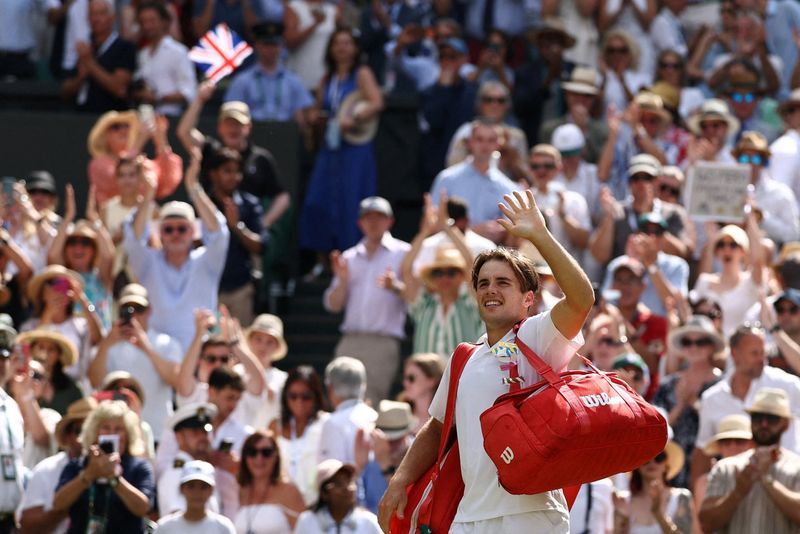
Arthur Fery, ranked 114th in the world, had resigned himself to spending this week lounging on a Greek beach with friends rather than competing in one of tennis's most prestigious tournaments. Yet the British wildcard's improbable journey through the Wimbledon draw—where he dispatched five opponents to reach the semi-finals—meant those vacation plans became collateral damage in what has proven to be one of the grasscourt championship's most captivating recent stories. His run ended at the hands of Alexander Zverev in straight sets on Friday, but not before Fery had etched his name into Wimbledon history as the first wildcard entry to penetrate the men's semi-finals in a quarter-century.
The magnitude of Fery's achievement cannot be overstated for those tracking British tennis fortunes. A 23-year-old with only two career Grand Slam matches to his credit before this fortnight has suddenly become a household name across the country, embodying the kind of underdog narrative that captivates audiences far beyond the tennis establishment. His presence at the tournament was never assured—he arrived as a wild card, a lottery ticket of sorts handed to him by the Wimbledon selection committee—yet he converted that opportunity into something genuinely extraordinary. The contrast between his expected itinerary and actual performance captures the essence of sport's unpredictability, where meticulous preparation sometimes matters less than momentum, confidence, and the peculiar alchemy of a major tournament draw.
Fery's good humour throughout the tournament has added another dimension to his appeal. When discussing his cancelled holiday, he revealed that one friend had ventured to Greece ahead of schedule, apparently betting that the young Brit would exit early enough to join him. The friend's faith proved misplaced, and he reportedly returned to England within forty-eight hours to support his mate instead. Such anecdotes humanise athletes and remind observers that these competitors are embedded within ordinary social networks where friendships are tested and reshaped by sporting outcomes. This levity masks the intense focus and mental fortitude required to navigate a major championship draw, particularly for someone accustomed to playing lower-profile events where the weight of expectation is considerably lighter.
The outpouring of national support afforded to Fery reflects something deeper about British sporting culture. Royal patronage arrived in the form of Queen Camilla and Princess Kate, both prominent fixtures at Wimbledon during the Championships. More intriguingly, England's World Cup football squad—themselves national heroes from their recent tournament campaign—sent video messages of encouragement to the tennis player. This cross-pollination of sporting support demonstrates how individual achievement in one discipline can galvanise support across athletic spheres, particularly when a British player is competing on home soil against an international field.
Fery's trajectory through the rankings now demands serious consideration. His current ranking of 114th was virtually meaningless as a predictive tool; his performance at Wimbledon has rendered it obsolete almost overnight. Tournament organisers and ranking systems will need to accommodate his anticipated rise into the mid-30s, a transformation that carries tangible consequences for his immediate future. Access to tour events, entry to higher-profile competitions, and invitations to tournaments that previously would have been beyond his reach will suddenly become available. For a player whose career path has been characterised by grinding through lower-tier competitions, this represents a genuine inflection point.
The financial dimension of his success provides immediate, measurable validation. Prize money of £900,000 for reaching the semi-finals supplies him with resources to stabilise his professional operations—better coaching, improved travel arrangements, enhanced training facilities, and yes, perhaps that upgraded holiday after all. Yet money, while important, functions as merely one metric of success. The psychological transformation wrought by proving himself capable of beating top-ranked opponents in a major championship environment may ultimately prove more valuable than the purse itself.
Fery's own reflections on the challenge ahead reveal an athlete grappling with the reality of changed circumstances. He acknowledges that expectations will intensify dramatically—from the public, from coaches, from sponsors, and from within himself. The comfortable obscurity of his previous status as a journeyman player has evaporated entirely. Every match at tour events will now be scrutinised through the lens of Wimbledon performance, with media and supporters asking whether he can sustain this elevated level. This psychological burden, while in many respects desirable, represents a genuine transition that requires considerable maturity to navigate successfully.
The upcoming North American hardcourt swing, culminating in his inaugural main-draw appearance at the US Open at Flushing Meadows, offers the logical next proving ground. Wimbledon's grass rewards different attributes than the hard courts of North America—movement patterns, defensive options, and service effectiveness vary significantly between surfaces. Fery will need to demonstrate that his breakthrough reflects genuine improvement rather than a surface-specific anomaly or an exceptional tournament moment. For Malaysian and Southeast Asian tennis followers, Fery's rise underscores how unlikely pathways to prominence can emerge in professional sport, offering inspiration to regional players competing against more celebrated rivals.
The narrative of the unexpected champion resonates across cultures and continents because it contradicts the established hierarchies that typically govern elite sport. Fery's achievement suggests that conventional wisdom about player rankings and tournament seeding, while generally reliable, cannot account for the intangible elements—confidence, momentum, mental resilience, and tactical adaptation—that occasionally allow underdogs to transcend expectations. His semi-final appearance at Wimbledon represents not merely a personal triumph but a reminder that tennis, like all sport, retains the capacity to surprise and captivate through human endeavour rather than algorithmic prediction.
As Fery processes the extraordinary events of the past two weeks and plans his immediate future, he faces the enviable challenge of consolidating this breakthrough into sustained success. Rest and reflection will precede his return to competition, allowing mental recovery from the intense focus required to navigate a major championship. The question now becomes whether his Wimbledon run represents the beginning of an elevated career trajectory or a singular moment of brilliance. Either way, his name is permanently inscribed in the tournament's history, and British tennis has gained a genuine sporting story that transcends the technical dimensions of the sport itself.

