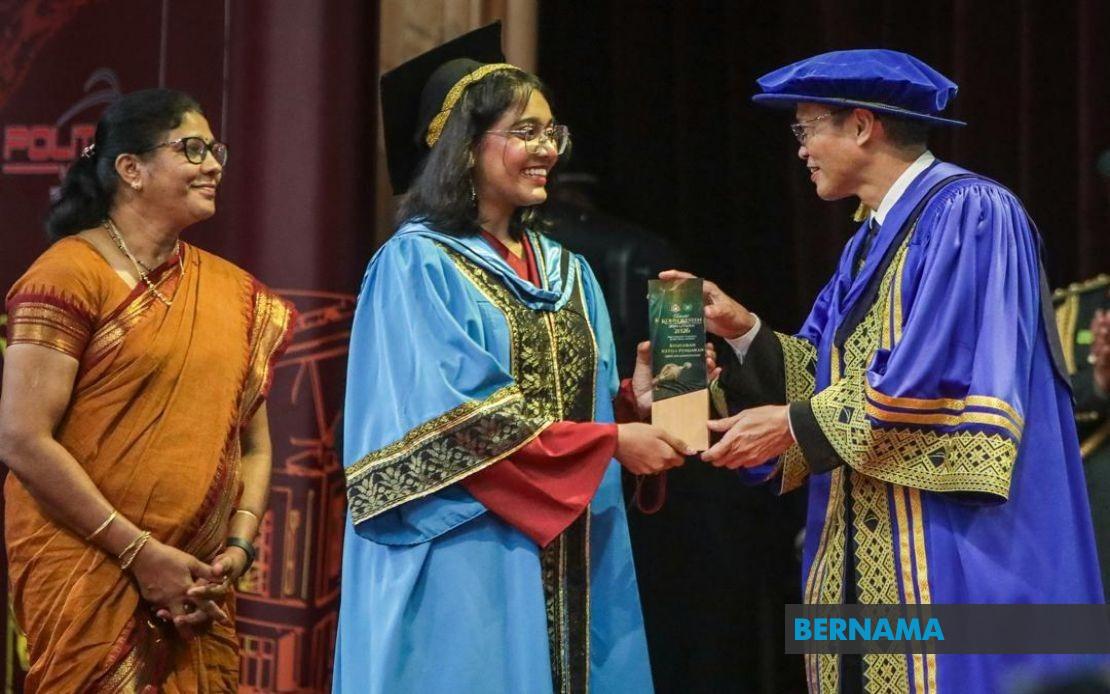
At Politeknik Tuanku Syed Sirajuddin in Arau, Perlis, a remarkable academic achievement has renewed focus on the resilience required to succeed in Malaysia's vocational education system. Teerti Ganapathi Rao, a 22-year-old Diploma in Digital Technology graduate, was recognised during the 2026 Northern Zone Polytechnic and Community College Convocation Ceremony for her exceptional performance, earning both the Director-General's Award and the Academic and Co-Curricular Excellence Award. What makes her accomplishment particularly noteworthy is that she achieved a cumulative grade point average of 3.61 whilst navigating one of life's most challenging periods—the loss of her father whilst sitting for her Semester Two examinations in 2023.
The convocation ceremony, which commenced on August 3 and runs through August 9, brought together 6,104 graduates from polytechnics and community colleges across three northern states: Perlis, Kedah and Penang. The event was graced by the Raja of Perlis, Tuanku Syed Sirajuddin Jamalullail, underscoring the formal significance of the occasion held at Dewan Harumanis. For Teerti, the moment held special meaning beyond the typical celebrations that accompany graduation. She explained to reporters that receiving the recognition felt almost improbable given the circumstances she had endured, yet the outcome validated her decision to persevere through profound personal hardship.
The foundation of Teerti's determination lay in the encouragement she had received from her late father. As the youngest of four siblings, she reflected on how her father had influenced her educational trajectory at a critical juncture. She had initially considered pursuing a foundation programme, a pathway that would have required additional time before degree-level study. However, her father consistently urged her to complete her diploma qualification, offering both practical wisdom and emotional support. This paternal guidance became an anchor during her grief, a constant reminder of what he had believed she could achieve. After his death, rather than abandoning her studies, she carried his faith in her capabilities forward, transforming her loss into motivation.
Throughout her three-year tenure at Politeknik Tuanku Syed Sirajuddin, Teerti demonstrated consistent academic excellence and comprehensive skill development. Beyond her strong overall grade point average, she secured the Head of Department's Award in four separate semesters—specifically Semesters One, Three and Four—indicating sustained performance rather than sporadic achievement. Her engagement extended far beyond classroom work; she served actively within the Student Representative Council, an involvement that cultivated essential professional competencies including leadership, interpersonal communication and collaborative teamwork. These experiences positioned her not simply as a high-achieving student but as a well-rounded graduate prepared for complex workplace environments.
Her academic profile extended into international engagement and practical innovation. Teerti represented her institution in a collaborative programme and delivered a seminar paper presentation at Universiti Putra Indonesia, facilitating knowledge exchange within Southeast Asia's tertiary education landscape. For her capstone project, she developed the Koop Printing System, a software solution engineered to enhance operational efficiency within cooperative printing service management. This final-year project demonstrated her capacity to identify real-world problems and engineer technological solutions—a critical competency in Malaysia's ongoing digital transformation agenda.
Beyond technical proficiency, Teerti's profile reflects the multicultural competencies increasingly valuable in Malaysia's knowledge economy. She commands fluency in five languages beyond Bahasa Melayu and English: Mandarin, Tamil, Telugu, with foundational knowledge of French, Japanese and Korean. This linguistic repertoire positions her uniquely to engage across Malaysia's diverse communities and to participate in regional and international professional contexts. Such capability is particularly relevant as Southeast Asian economies intensify cross-border collaboration and as multinational enterprises expand operations throughout the region.
Looking forward, Teerti's ambitions reflect a structured pathway toward advanced qualifications and specialised expertise. She is currently awaiting outcomes from her application to pursue a Bachelor's degree in Information Technology, with Universiti Malaya listed as her first preference. Beyond the undergraduate level, she harbours intentions to pursue doctoral studies, envisioning a PhD as the culmination of her academic journey. This trajectory from diploma through bachelor's and toward postgraduate research represents an increasingly common pathway in Malaysia's higher education system, where polytechnic qualifications serve as robust foundations for further specialisation.
Teerti's interest in information technology stems from early exposure to digital technologies and programming. At the age of sixteen, friends she met through video gaming communities introduced her to computers and coding, catalysing an intellectual interest that has shaped her entire educational trajectory. She acknowledges that the IT field presents substantial challenges and intellectual demands, yet her philosophy emphasises methodical learning and deep conceptual understanding. This approach—breaking complex problems into manageable components and building foundational knowledge systematically—mirrors the resilience she demonstrated in managing personal adversity whilst maintaining academic rigour.
Her achievement carries broader implications for Malaysia's vocational education sector and for student support systems within polytechnics. Teerti's success illustrates how institutional structures that recognise both academic excellence and co-curricular engagement can nurture graduates who are equipped not merely with technical skills but with the emotional and psychological resilience necessary to navigate demanding professional environments. The awards she received—acknowledging both academic performance and the integration of learning with broader competency development—reflect an educational philosophy increasingly central to Malaysia's push toward human capital development aligned with Industry 4.0 and emerging economic priorities.
The convocation ceremony itself represents a milestone in Malaysia's tertiary education landscape, bringing together graduates from multiple institutions across three states. This regional approach to formal recognition acknowledges the distributed nature of vocational and community college provision and elevates the profile of these institutions within Malaysia's broader higher education ecosystem. For graduates like Teerti, such formal recognition provides validation and momentum as they transition into professional practice or further academic study.

