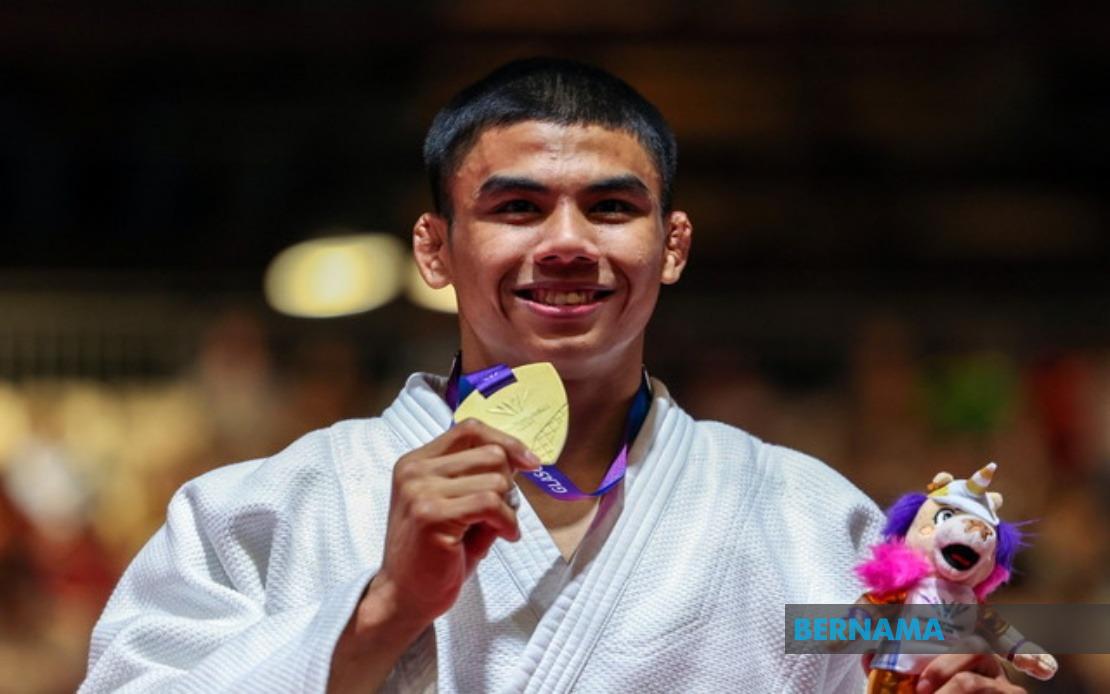
The transition from champion athlete to coach has presented Amir Daniel Abdul Majeed with an unexpected psychological challenge. The 21-year-old Commonwealth Games gold medallist now finds himself managing the nerves of thirteen athletes rather than channelling his own competitive energy on the mat. Speaking at the IDCC Ideal Convention Centre in Shah Alam on August 17, the national judoka revealed that the shift from personal competition to team mentorship carries a weight he did not fully anticipate when stepping into his role as assistant coach of Penang's judo squad at SUKMA Selangor 2026.
The nature of competitive pressure has fundamentally altered for Amir. When he was an active competitor, responsibility remained singular and internalised—success or failure depended solely on his preparation, technique, and mental fortitude during each bout. The pressure to perform was immediate and cyclical, resolved within the timespan of a match. Now, observing athletes he has watched develop from their formative years creates a different emotional burden. His familiarity with their journeys, their potential, and their vulnerabilities has deepened the stakes of his coaching decisions in ways that pure athletic competition never demanded.
This expanded responsibility extends across the spectrum of athlete management. Where previously Amir required only self-discipline and personal strategic planning during competition, coaching demands simultaneous attention to multiple athletes' physical conditioning, technical refinement, psychological readiness, and competitive scheduling. The thirteen members of his Penang contingent each bring distinct strengths, challenges, and developmental trajectories that require individualised attention. Managing this complexity while maintaining consistency in coaching standards and team cohesion presents logistical and emotional demands that exceed those of individual athletic pursuit.
Despite these challenges, Amir's coaching tenure has yielded tangible results. The Penang judo team concluded their three-day SUKMA campaign with an impressive medal haul of three gold, one silver, and five bronze medals. This performance elevated Penang to a joint-first position in the judo medal standings alongside Johor, a significant achievement that validated both his coaching contributions and the athletes' dedication. The visible progress of his charges provides the intrinsic reward that sustains many coaches through the demanding nature of their role, though Amir emphasises that this progress makes the emotional investment considerably heavier.
Beyond his immediate coaching responsibilities, Amir's career trajectory encompasses ambitions that extend well beyond domestic competition. He is currently awaiting official confirmation of his selection for the Aichi-Nagoya 2026 Asian Games in Japan, with the formal selection meeting scheduled for this week. This dual engagement—coaching domestically while pursuing international competition—requires careful mental and physical management. The Asian Games represent a significant stepping stone not merely as a competition but as preparation for his longer-term Olympic aspirations, a goal that demands sustained international exposure and high-level competitive experience.
The Japanese competitive environment holds particular strategic value for Amir's development trajectory. The judoka recognises that the calibre of competition in Japan significantly exceeds that available domestically or even regionally, offering opportunities to test himself against athletes who have honed their skills through Japan's richly competitive judo culture. Exposure to this elevated standard provides invaluable technical and tactical learning that cannot be replicated through domestic training or lower-tier international competition. Each match against stronger opponents functions as both a learning opportunity and a benchmark for progress toward elite international status.
Amir's strategic perspective on Asian Games participation reflects a maturity in his approach to athletic development. Rather than viewing Aichi-Nagoya 2026 as a destination event where success or failure determines career trajectory, he positions it as a developmental waypoint within a broader Olympic preparation programme. This framing allows him to extract maximum learning from the experience while managing pressure more effectively. The accumulation of high-level competitive experience serves the practical purpose of identifying technical gaps, building resilience against superior opponents, and developing the competitive instincts necessary for Olympic-level performance.
The SEA Games Malaysia 2027 presents another marker on Amir's competitive calendar. As a regional competitor, he carries expectations of strong performance at home, but the SEA Games also function within his broader Asian Games preparation framework. Competition at this level, while significant domestically, remains contextually important as preparation for higher international tiers rather than as an ultimate destination. This layered approach to competition planning demonstrates strategic thinking that extends beyond immediate results toward career-long athletic development.
Balancing coaching responsibilities with personal competitive ambitions requires exceptional time management and psychological compartmentalisation. Amir must maintain focus and energy for his Penang athletes while simultaneously preparing himself physically and mentally for international competition. This dual commitment can create scheduling conflicts and competing demands on recovery and training resources. However, the coaching role itself may provide unexpected benefits—the perspective gained from mentoring younger athletes can deepen his understanding of technique, psychology, and performance optimization in ways that purely competitive focus might not achieve.
The broader significance of Amir's transition from athlete to coach extends beyond his individual career progression. His willingness to embrace a mentoring role despite his own athletic ambitions contributes to the development pipeline of Malaysian judo. Young athletes benefit from guidance by someone who recently competed at the highest levels and understands contemporary competitive demands and training methodologies. This intergenerational knowledge transfer strengthens the domestic judo programme and creates a culture where advancement to international competition does not require complete departure from grassroots development.
Amir's experience also illustrates the evolving sophistication of athlete development in Malaysian sports. Modern elite athletes are increasingly expected to contribute to programme sustainability and junior development even while pursuing their own competitive goals. This expectation reflects recognition that individual athletic success becomes more meaningful when embedded within systematic programme development. Amir's coaching contributions to Penang's SUKMA success, combined with his own Asian Games preparations, exemplify this integrated approach to athletic development.
The confirmation of his Asian Games selection will determine whether Amir can successfully manage both coaching and competitive responsibilities simultaneously during the period leading to Aichi-Nagoya 2026. Should selection be confirmed, his participation would test his capacity to maintain focus across these parallel commitments while managing the distinct pressures each demands. The coming weeks will clarify whether this ambitious dual trajectory remains feasible or whether concentration on either coaching or competition takes precedence.

