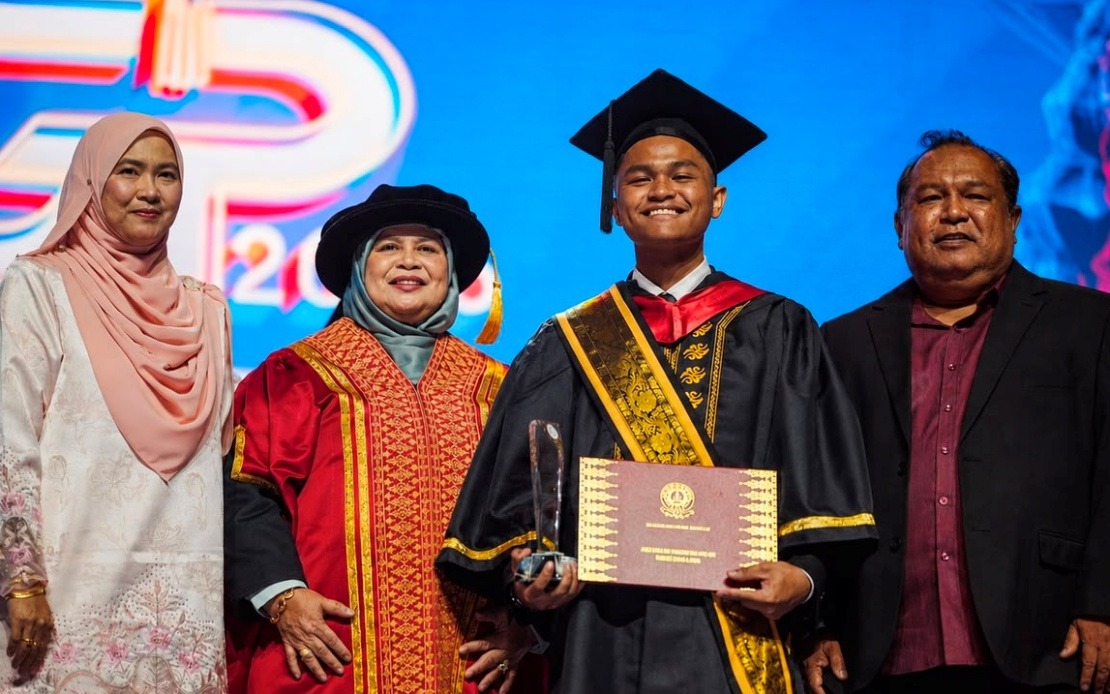
Muhammad Aaqif Dino Faezal's educational journey exemplifies how targeted sponsorship programmes can transform access to world-class education for Malaysian students of merit. The 19-year-old, who began his secondary studies at MARA Science Junior College (MRSM) Tun Ghafar Baba in Melaka, has now secured admission to Imperial College London to pursue a degree in Geology, marking a significant achievement for both his family and Malaysia's talent development ecosystem.
Aaqif's pathway reflects the strategic interventions of Majlis Amanah Rakyat (MARA), which identified and supported his potential through its Young Talent Development Programme. After his initial years at MRSM, he received sponsorship to complete the International Baccalaureate Diploma Programme (IBDP) at Kolej MARA Banting (KMB) from 2024 to May 2026. This progression demonstrates how Malaysia's educational infrastructure can create sequential opportunities for capable students who might otherwise lack the financial resources to access elite international institutions.
The financial barrier to international education remains one of Malaysia's most stubborn constraints on talent development. Aaqif's candid acknowledgement that he could not have afforded overseas study without MARA's intervention highlights a broader reality affecting many Malaysian families of moderate means. Even academically gifted students often forgo ambitious educational aspirations when confronted with tuition fees and living costs at premier universities. By removing this obstacle, MARA's sponsorship programmes directly influence whether talented Malaysians can compete globally or remain constrained by domestic circumstances.
Aaqif's academic credentials are formidable. Scoring 44 out of 45 points in the IBDP examination last May places him among the highest achievers in his cohort. However, his recognition as the 2026 MARA College Graduate Icon reflects more than raw academic performance. The selection criteria explicitly emphasise leadership qualities, societal contributions, and potential for future impact. During his time at KMB, Aaqif served as president of the Students' Representative Council (MPP), demonstrating the organisational and interpersonal skills that distinguish exceptional graduates from merely accomplished ones.
The multi-faceted approach to student development at KMB appears to have substantially shaped Aaqif's formation. His receipt of both the KMB Best Graduate Award and the Co-curricular Icon Award indicates consistent excellence across domains typically separated in conventional education systems. This holistic development matters considerably: Malaysia's knowledge-based economy increasingly demands professionals who can not only master technical disciplines but also lead teams, communicate persuasively, and navigate complex organisational environments. Universities like Imperial College London increasingly select students exhibiting precisely this combination of academic rigour and demonstrated leadership capacity.
Aaqif's chosen field of Geology positions him strategically within Malaysia's economic landscape. His stated intention to apply his expertise to Malaysia's oil, gas and energy sectors addresses a genuine national need. As global energy systems transition and domestic hydrocarbon sectors face structural shifts, Malaysia requires scientifically trained professionals capable of navigating these transitions, whether in conventional resource management or emerging renewable energy contexts. By investing in Aaqif's development, MARA contributes indirectly to Malaysia's energy security and economic competitiveness in the decades ahead.
The institutional recognition of Aaqif's achievements by KMB director Arfaseela Amir provides insight into institutional priorities and quality assurance. Amir's emphasis on producing graduates who possess both intellectual capability and strong character reflects an increasingly sophisticated understanding of educational outcomes. This contrasts with narrower metrics focused solely on examination results. The deliberate cultivation of teamwork capacity, leadership authenticity, and principled character suggests that MARA institutions are consciously preparing students for roles of significant responsibility rather than merely academic achievement.
Aaqif's family background as a Selangor-born student from a family of modest means adds another dimension to his achievement. As the second of three siblings, his educational advancement carries implications beyond individual aspiration. Successful transitions to elite global institutions often catalyse family trajectories across generations, influencing younger siblings' ambitions and creating demonstration effects within communities. Research on educational mobility consistently demonstrates that visible examples of successful advancement prove more influential than abstract statistics in motivating younger cohorts to pursue ambitious educational pathways.
The timing of Aaqif's transition to Imperial College London in September 2026 occurs within a context of intensifying global competition for scientific talent. UK universities, facing regulatory constraints on domestic student recruitment, increasingly compete for high-performing international students, particularly from Commonwealth nations and Asia-Pacific regions. Aaqif's admission reflects Imperial's assessment that he meets its rigorous standards for physics-based disciplines. His presence and eventual success will likely influence subsequent cohorts of Malaysian students contemplating applications to similarly elite institutions, potentially expanding Malaysia's pipeline of globally engaged scientists and engineers.
MARA's scholarship architecture demonstrates sophisticated understanding of talent development as a multi-stage process rather than a single intervention point. By supporting Aaqif through MRSM, then KMB, and ultimately enabling his transition to Imperial College, the institution has sustained consistent investment across his formative years. This longitudinal approach contrasts with sporadic or one-off scholarships, and appears more effective in enabling students to accumulate not merely credentials but deep capability, networks, and self-confidence necessary for success in demanding international environments. The model merits examination by other Malaysian educational institutions and government agencies seeking to maximise return on scholarship investments.
Aaqif's reflection on his award as a tribute to family, teachers, friends, KMB and MARA rather than purely a personal achievement demonstrates mature understanding of human development as fundamentally relational. This perspective aligns with growing recognition in developmental psychology that individual achievement emerges from supportive ecosystems rather than isolated effort. For Malaysian policymakers, Aaqif's acknowledgement of systemic support should reinforce commitment to maintaining robust scholarship programmes, quality secondary institutions, and institutional pathways connecting domestic excellence to global opportunities. Without such infrastructure, individual talent remains fallow and national potential incompletely realised.

