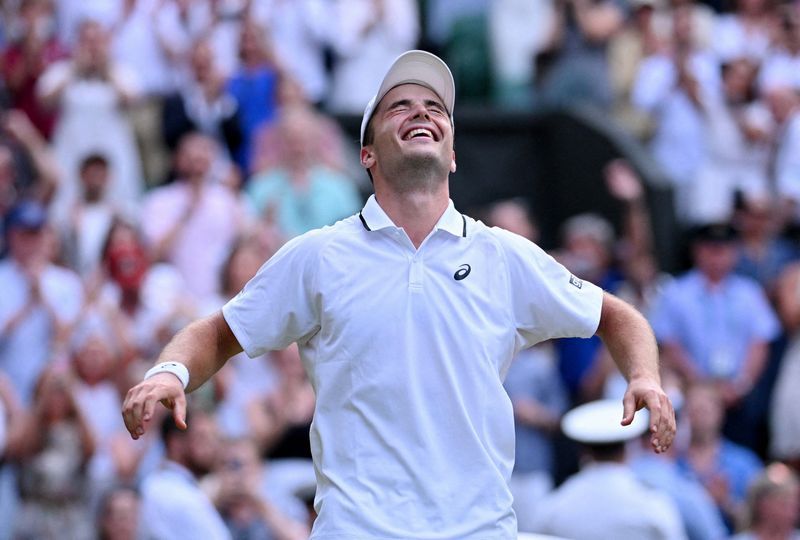
Arthur Fery's improbable journey through Wimbledon reads like a screenplay that Hollywood producers would reject as implausible. The 23-year-old Londoner, seeded outside the main tournament draw as a wildcard and ranked just 114th in the world, has fought his way to the semi-finals of tennis's most prestigious championship—a feat that has captivated British sports fans and confounded tennis analysts who track the sport's conventional hierarchies.
Fery's advance to Friday's semi-final clash against French Open champion and second seed Alexander Zverev came courtesy of a commanding display against Italian ninth seed Flavio Cobolli, whom he dispatched 6-4 7-6(4) 6-0 on Centre Court in sweltering conditions. The performance was not merely a victory but a statement of intent, showcasing a player seemingly emboldened by the roaring support of a home crowd. His achievement places him among only the fifth British male competitor in the modern professional era to reach the semi-final stage of Wimbledon, an exclusive club that underscores the rarity of homegrown success at the Championships.
What makes Fery's narrative even more extraordinary is the tantalising possibility that lies ahead. Should he overcome Zverev's formidable challenge, he would face the final on his 24th birthday with the opportunity to etch his name permanently into tennis folklore. A victory would make him only the second player ever to claim the Wimbledon singles title as a wildcard entrant, following Goran Ivanisevic's iconic triumph in 2001. That historical parallel has not been lost on observers watching a journey that seemed to belong to the realm of sporting fiction.
The young Londoner has navigated a gauntlet of increasingly difficult opponents to reach this juncture. His five-set victory over Grigor Dimitrov in the fourth round drew admiring glances from eight-time Wimbledon champion Roger Federer, whose presence and tacit approval offered validation of Fery's credentials against elite competition. Dimitrov, a player of proven Grand Slam experience, provided the kind of stern test that ordinarily terminates wildcard dreams, yet Fery prevailed through a combination of exceptional retrieval, tactical acumen, and mental fortitude.
Fery's personal story adds another layer to his compelling narrative. Growing up within walking distance of Centre Court, he attended King's College in Wimbledon and navigated the British tennis development pathway—a trajectory that roots him deeply in the local sporting community. Yet his background carries international dimensions that enriched his development. His father, Loïc Fery, is a prominent French hedge fund manager who owns Ligue 1 football club Lorient, whilst his mother Olivia competed professionally in tennis. Despite being born in Sèvres, a Parisian suburb near Roland Garros, Fery chose to represent Britain as a junior competitor and has maintained unwavering commitment to British colours throughout his career.
Fery's path to professional tennis diverged markedly from the typical trajectory of ambitious young players. Rather than committing exclusively to the professional circuit immediately upon reaching adulthood, he pursued tertiary education at Stanford University, where he majored in science, technology and society whilst simultaneously establishing himself as the top-ranked college player in the United States. This measured approach to career development—balancing intellectual development with sporting excellence—has cultivated a philosophical maturity evident in his measured demeanour under intense media scrutiny. When discussing the relentless schedule ahead, Fery displays the equanimity of someone who recognises that momentum and psychological stability matter more than extended preparation periods.
The composure Fery exhibits in post-match interviews mirrors the calmness he projects on court. Rather than succumbing to hyperbolic excitement or the weight of expectations that often overwhelm unlikely tournament contenders, he maintains a reflective temperament that suggests genuine self-awareness about the magnitude of his achievements. His characteristically understated response to his quarter-final victory—noting that the rapid succession of matches suits him rather than hindering his preparations—suggests a competitor who thrives under pressure and maintains perspective amidst the intensity of tournament competition.
Fery's emergence as an improbable standard-bearer for British tennis arrives at a moment when the home nation's singles contingent has experienced collective disappointment. Following a disastrous opening week that eliminated fifteen of nineteen British representatives in the opening round, Fery has become the sole remaining representative capable of delivering a meaningful homegrown narrative. His progress inadvertently illuminates a broader question about the depth of British tennis talent and the unpredictability inherent in Grand Slam competition, where sustained excellence and favourable draw management intersect.
The distinction between Fery's French origins and his British identity warrants examination, particularly given that French tennis authorities might harbour regret over his decision to represent Britain. Fery's father emphasised to French sports publication L'Équipe that his son's identity is fundamentally rooted in London rather than Paris—a comparison he drew by suggesting that Fery's relationship to Wimbledon mirrors that of someone who grew up in Boulogne playing at Roland Garros. The young player himself acknowledged that representing Britain involved no complicated deliberation, reflecting instead the organic consequence of his upbringing and education in London.
Fery's semi-final confrontation with Zverev represents an exponential leap in quality from his previous opponent. The German second seed combines powerful serving, aggressive baseline play, and the psychological resilience cultivated through multiple Grand Slam appearances. Zverev's French Open credentials suggest a player peaking at precisely the wrong moment for Fery's aspirations. Nevertheless, the semi-final provides Fery an opportunity to test his improvement against one of tennis's elite practitioners and potentially rewrite expectations about what wildcard entrants can accomplish at Grand Slam championships.
For Malaysian and Southeast Asian observers, Fery's trajectory offers instructive lessons about unconventional pathways to sporting success. His commitment to educational development alongside athletic ambition suggests that elite sporting achievement need not demand the sacrificial devotion required by conventional professional structures. The Wimbledon Championships have historically proven vulnerable to disruption by determined competitors with modest seedings but clear-eyed tactical sophistication. Fery embodies this principle, demonstrating that grass-court mastery, crowd support, and psychological resilience can overcome ranking disparities in ways that prove impossible on other surfaces.
As the semi-final approaches, Fery's narrative remains incomplete. Regardless of Friday's outcome, his Wimbledon campaign has already transcended expectations and established him as a player of genuine substance rather than merely a tournament feel-good story. The final chapter remains unwritten, leaving supporters and observers contemplating possibilities that seemed improbable mere weeks ago.

