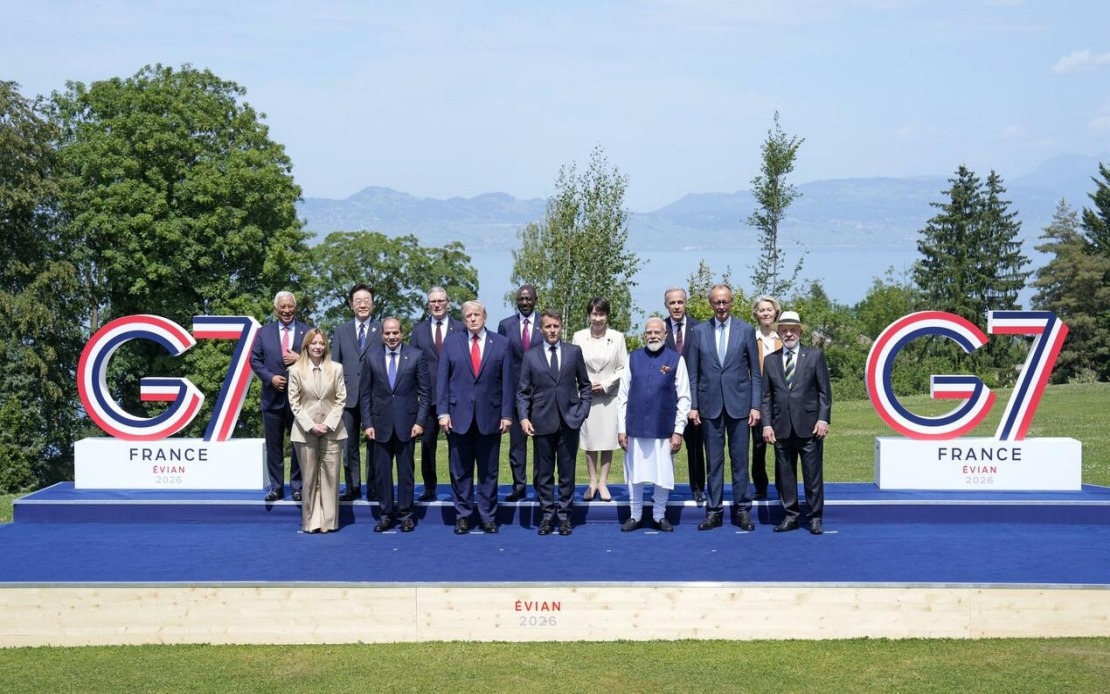
The Group of Seven summit in Evian-les-Bains, a lakeside resort town in southeastern France, became the stage for a carefully choreographed show of unity on Ukraine this week, even as underlying tensions between the United States and its European allies threatened to fracture the alliance. The gathering saw G7 nations affirm their collective resolve to sustain support for Kyiv while grappling with the divergent approaches that have increasingly defined relations between Washington and Brussels. At the centre of these discussions was a direct appeal from Ukrainian President Volodymyr Zelenskyy, whose presence underscored the personal stakes involved in the ongoing conflict and the diplomatic balancing act required to maintain Western cohesion.
President Donald Trump used the occasion to amplify his call for Russia to abandon military objectives and pursue negotiated settlement. Standing before reporters in the Swiss-adjacent French spa town, Trump framed the conflict in starkly transactional terms, emphasizing the devastating human cost borne by both Moscow and Kyiv as justification for ending hostilities. His rhetoric invoked recent diplomatic successes in other theatres—specifically a preliminary deal with Iran to reopen the Strait of Hormuz—as evidence that his administration possessed the negotiating prowess to broker peace in Eastern Europe. This comparative framing reveals how the Trump administration views geopolitical challenges through an interconnected lens, where breakthroughs in one region generate momentum and leverage in another.
The bargaining chips available to Washington extend beyond rhetoric. Trump indicated that the United States might consider lifting temporary sanctions imposed on Russia following the Iranian conflict, a reversal that would hinge on sustained oil flows through newly opened shipping routes. This conditional approach to sanctions—where economic relief becomes contingent on Russian compliance with American diplomatic objectives—represents a distinct methodology that prioritizes deal-making over the punishment-based sanctions regimes favored by many European capitals. Such divergence in strategic philosophy has long troubled the Atlantic partnership, and the Evian summit provided another forum where these philosophical differences surfaced.
Yet the summit's official communiqué reflected genuine consensus on supporting Ukraine's sovereignty and maintaining pressure on Russia to pursue constructive negotiations. Japanese Prime Minister Sanae Takaichi articulated the group's position with careful precision, emphasizing the importance of preserving G7 unity as a mechanism for compelling Moscow toward positive action. Her invocation of the principle that unilateral attempts to alter the status quo through military force warrant rejection carries particular resonance in an Indo-Pacific context where territorial disputes and spheres of influence remain contentious. Takaichi's additional concerns about Russia-North Korea military cooperation and deepening Moscow-Beijing military ties reflected growing recognition among G7 members that Ukraine represents merely one theatre in a broader competition between Western and authoritarian blocs.
Zelenskyy's contribution to the summit focused on concrete military and diplomatic requirements rather than open-ended commitments. His public statements highlighted the urgent need to strengthen Ukrainian air defences—a persistent vulnerability that has allowed Russian forces to conduct devastating strikes against civilian infrastructure and military targets. The Ukrainian president's emphasis on advancing diplomatic efforts alongside military support suggests Kyiv's growing awareness that prolonged stalemate serves no one's interests and that negotiated outcomes, however imperfect, may offer better prospects than indefinite attrition. This positioning distinguishes Ukraine's diplomatic stance from that of some European allies who view any negotiation with Russia as potentially rewarding aggression.
The summit's agenda extended well beyond Ukraine, encompassing the escalating tensions in West Asia following the preliminary Iran war ceasefire. The G7 leaders and representatives from Egypt, Qatar, and the United Arab Emirates engaged in substantive discussions about stabilizing the region and ensuring unimpeded maritime commerce through the Strait of Hormuz. Japanese officials emphasized that a final comprehensive agreement between Washington and Tehran remained essential, with particular attention to securing free navigation through this critical chokepoint. For Malaysia and other Southeast Asian economies dependent on stable energy supplies and predictable shipping routes, the outcome of these negotiations carries profound implications for commodity prices and regional security.
Takaichi's insistence on the strategic importance of maintaining open shipping lanes reflects concerns that extend far beyond the immediate parties to the Iran conflict. Disruption of oil flows through the Strait of Hormuz would reverberate through Asian energy markets, potentially destabilizing economies across the region. Malaysia, as a regional trading hub with significant energy imports, would face increased costs and supply uncertainty should tensions in West Asia remain unresolved. This nexus between Western geopolitical competition and Asian economic interests underscores why developments at G7 summits warrant close attention from Malaysian policymakers and business communities.
Beyond security and sanctions debates, the Evian summit marked France's leadership push to reform international development finance mechanisms. Recognizing that traditional official development assistance has proven inadequate for addressing the infrastructure and investment needs of poorer nations, the G7 sought to create frameworks attracting private capital to long-term development projects. This initiative reflects broader acknowledgment that the post-Cold War international financial architecture requires modernization to remain relevant. For developing nations in Southeast Asia, the willingness of wealthy economies to reshape development partnerships offers both opportunities and risks—opportunities to access larger capital pools, but risks of conditions attached to private investment that may not align with national development priorities.
The joint declaration on development cooperation emphasized mutually beneficial partnerships that accommodate both donor strategic interests and recipient nation objectives. This formulation represents a subtle but significant departure from traditional aid frameworks where developed countries wielded considerably greater leverage over policy outcomes. The inclusion of India, Brazil, and other major emerging economies among the summit's invited guests signalled recognition that global economic architecture increasingly reflects multipolar realities. Southeast Asian nations, while not formally represented at this particular gathering, occupy a middle position in these evolving dynamics—substantial enough to attract development finance but not sufficiently large to command the attention afforded to China or India.
The tension between maintaining G7 unity and accommodating Trump's distinct negotiating philosophy remained palpable throughout the summit. European leaders, particularly French President Emmanuel Macron, sought to leverage this gathering to reinforce collective positions on Ukraine and development assistance while constraining American unilateral actions. Trump's emphasis on dealmaking and conditional diplomacy—evident in his approach to both Russia and Iran—reflects a fundamentally different worldview from the institutional multilateralism favoured by Brussels and much of the G7. This philosophical gap cannot be bridged through summit declarations alone, suggesting that genuine coherence on major geopolitical questions will remain elusive.
For Malaysia and the broader Southeast Asian region, the Evian summit illustrated both the importance and fragility of Western unity on global security and economic governance. While the G7 remains the most influential mechanism through which wealthy democracies coordinate policy, its effectiveness depends on achieving workable consensus among members with increasingly divergent interests and philosophies. The successful negotiation of preliminary agreements on Iran and the reaffirmation of Ukraine support represent modest achievements that may prove sufficient to sustain the alliance through current turbulence. However, the underlying tensions evident at Evian suggest that more fundamental challenges to Western cohesion lie ahead, with implications for regional stability and economic opportunity across Asia.
The summit's outcomes will be assessed not merely by what was accomplished in the formal sessions but by whether commitments to Ukraine prove durable and whether development finance reforms translate into genuine new resources for Asian and African nations. Trump's assertion that his administration will exhaust all diplomatic avenues to end the Ukrainian conflict sits uneasily with his suggestion that sanctions pressure might be relaxed—a potential contradiction that European allies will monitor closely. As the summit concluded and leaders returned to their capitals, the real test of G7 unity would come not in photo opportunities at lakeside venues but in the months ahead, when implementation of agreed positions would reveal whether the consensus achieved in Evian possessed sufficient substance to withstand the centrifugal forces pulling the alliance toward fragmentation.