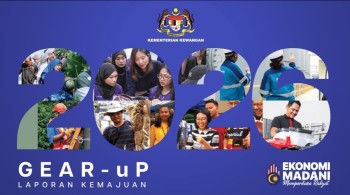
Malaysia's six major government-linked investment companies have dramatically scaled up their domestic deployment activities, allocating RM20.3 billion throughout 2025 under the Government-Linked Enterprises Activation and Reform Programme (GEAR-uP). This represents a substantial increase from the RM6.6 billion deployed in the preceding year, demonstrating accelerating momentum in capital mobilisation as the initiative enters its third operational year. Prime Minister Datuk Seri Anwar Ibrahim, who also serves as finance minister, underscored in the latest GEAR-uP Progress Report that this expansion reflects a fundamental shift in how Malaysia channels its accumulated wealth, moving away from passive investment strategies toward purposeful capital deployment aligned with national development objectives.
The GEAR-uP framework, launched in 2024 under the stewardship of the Ministry of Finance, carries an ambitious five-year target of unlocking RM120 billion in domestic investments. The programme's architecture centres on six cornerstone institutions: Khazanah Nasional Bhd, the Employees Provident Fund (EPF), Permodalan Nasional Bhd (PNB), Kumpulan Wang Persaraan (Diperbadankan) (KWAP), Lembaga Tabung Angkatan Tentera (LTAT), and Lembaga Tabung Haji (TH). This institutional concentration allows for coordinated strategy and strategic alignment across Malaysia's largest pools of investable capital, creating the foundation for comprehensive sectoral transformation rather than fragmented initiatives.
The programme's expansion into digital infrastructure exemplifies this strategic approach. KWAP-backed development of Google's Selangor data centre will inject an additional 320 megawatts of capacity whilst generating 26,500 employment opportunities across 2026 and 2027. This investment addresses both immediate capacity constraints in Malaysia's digital economy and longer-term positioning in the regional technology ecosystem. Concurrent with this initiative, Empyrion Digital is undertaking a phased development programme in Johor, further distributing digital infrastructure benefits beyond the Klang Valley corridor and supporting more geographically balanced economic growth.
Venture capital and enterprise development represent another critical deployment channel. Specialised GLIC-managed funds including Dana Impak, Dana Perintis, Dana Pemacu, and Ekuinas are systematically advancing Malaysian companies from early-stage venture phases toward sustained growth trajectories. Khazanah's planned Dana Ciptawan, bringing RM200 million in fresh capital, specifically targets Bumiputera enterprises and mid-tier Malaysian firms that have historically faced financing constraints. This layered approach to enterprise funding creates a more complete investment ecosystem than traditional banking channels typically provide, addressing documented gaps in equity financing for emerging Malaysian businesses.
Government-linked companies remain on track to achieve RM100 billion in cumulative market value increases by 2028, according to the progress report. The MY Value Up initiative extends disciplinary standards and performance frameworks to Malaysia's 88 largest listed companies, institutionalising expectations for value creation beyond the government sector itself. This broader market approach gains particular significance given the Capital Market Masterplan's target of achieving RM5.8 trillion to RM6.3 trillion in total market capitalisation by 2030—a milestone dependent on sustained pipeline development and investment momentum across listed companies.
Energy infrastructure investment remains pivotal to Malaysia's long-term competitiveness and environmental commitments. Tenaga Nasional Bhd's grid modernisation programme, operating under Regulatory Period 4, reflects escalating investment intensity, growing from RM12 billion allocated in 2025 toward RM15 billion in 2027. These grid investments directly support Malaysia's renewable energy transition pathway, targeting 70 per cent renewable energy within installed capacity by 2050. Such infrastructure backbone development typically requires patient capital and extended payback horizons—precisely the investment characteristics that government-linked entities can facilitate, unlike purely commercial investors constrained by quarterly earnings pressures.
Aviation infrastructure expansion demonstrates parallel long-term commitment. Malaysia Airports' five-year, RM11 billion capital programme encompasses comprehensive facility upgrades across the national airport network, with Kuala Lumpur International Airport's capacity planning targeting passenger volumes exceeding 100 million annually. This capacity expansion positions Malaysia to capture growing regional travel demand whilst generating substantial employment across operations, hospitality, and logistics sectors. Airport infrastructure typically catalyses broader regional economic development through supply chain creation and tourism-related business generation.
Bumiputera economic participation and wealth creation have received enhanced attention within the GEAR-uP framework. The programme targets listing of ten Bumiputera-led companies during 2026-2027, complemented by the 10 Bumiputera Champions Programme designed to scale successful indigenous enterprises toward regional competitiveness. Zakat Wakalah allocations are projected to reach RM100 million in 2026, expanding from RM28 million in the preceding year—a trajectory reflecting both programme maturation and increasing religious endowment participation in capital deployment. These initiatives acknowledge that inclusive growth requires deliberate mechanisms to broaden ownership and wealth accumulation beyond traditional commercial concentrations.
Finance Minister II Datuk Seri Amir Hamzah Azizan emphasised that capital deployment metrics must ultimately translate into tangible welfare improvements for Malaysian workers and communities. The GEAR-uP portfolio delivered an 8.0 per cent total shareholder return during 2025, demonstrating that purposeful capital deployment can simultaneously achieve financial performance benchmarks and broader developmental objectives. This framing represents a deliberate challenge to conventional finance theory suggesting tension between returns and social purpose—instead advancing evidence that these objectives can reinforce each other when capital deployment strategies incorporate comprehensive ecosystem development.
The external economic environment continues presenting challenges that underscored GEAR-uP's necessity. Global volatility and ongoing restructuring of international trade patterns require Malaysia to strengthen domestic resilience and reduce external dependencies. Earlier structural reforms implemented during 2023 created foundational capacity that allowed Malaysia to navigate turbulence without major disruption. GEAR-uP represents the acceleration phase, translating established reforms into accelerated capital deployment and capability building. The programme embodies recognition that attracting external capital matters less than converting deployed capital into sustainable domestic capabilities—infrastructure, enterprises, and employment ecosystems that endure beyond individual investment cycles.
The programme's three-year horizon through 2027 carries particular significance for Malaysian economic positioning. Most deployed capital is already in motion, with returns and employment effects becoming increasingly visible across sectors and regions. Data centre operations will commence generating capacity, digital services jobs, and energy demand within defined timeframes. Airport capacity upgrades will enter operational phases. Listed enterprises will demonstrate whether governance and performance improvements translate into shareholder value that sustains future investment. These convergent project trajectories create momentum that extends beyond individual initiative timelines, potentially establishing self-reinforcing cycles of investment and capability development.
The MADANI Economy framework anchors GEAR-uP's strategic direction, emphasising simultaneous elevation of economic ceiling and floor—growth that raises both maximum and minimum living standards rather than concentrating gains among existing wealth holders. This framework directly addresses Southeast Asian inequality patterns that constrain sustainable growth. By deliberately channelling capital toward supply chain localisation, skill development, and enterprise scaling across broader geographic and demographic distribution, GEAR-uP attempts to create growth models less vulnerable to the distributional instability that has historically limited Malaysian prosperity expansion. Whether this approach succeeds depends substantially on execution faithfulness across the programme's remaining deployment phases and government-linked entities' willingness to prioritise long-term capability building over short-term financial optimisation.

