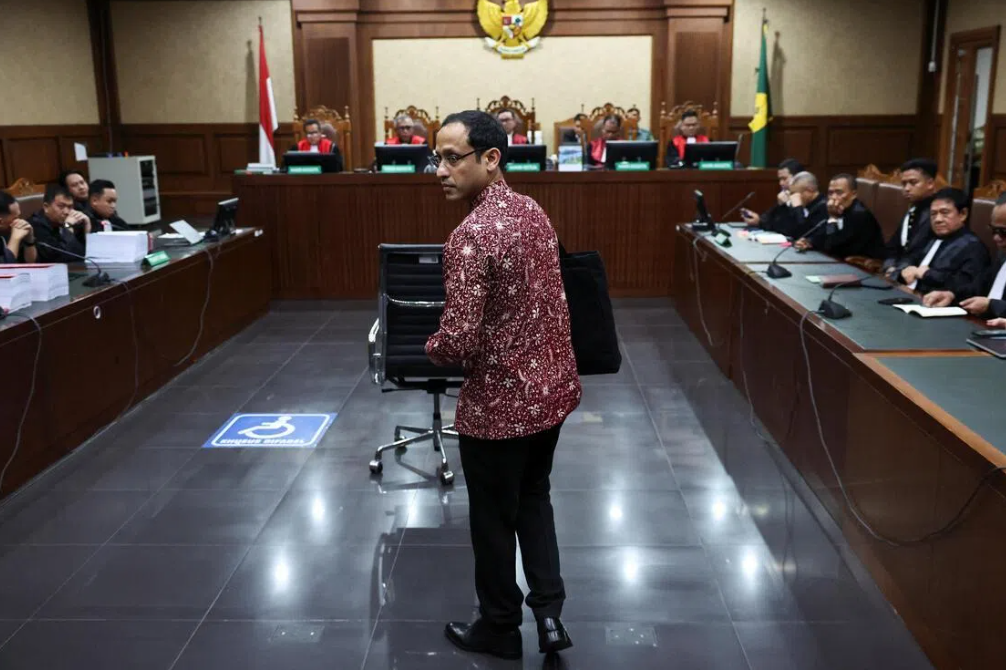
Nadiem Makarim, the Harvard-educated founder of Indonesia's first unicorn start-up Gojek, has been handed a 10-year prison sentence by the Jakarta Corruption Court after being found guilty of abuse of authority in connection with a sweeping school laptop procurement programme implemented during the global pandemic. The June 30 verdict concludes one of Indonesia's most intensely scrutinised corruption trials, delivering a stark reversal of fortune for a businessman who once embodied the promise of a technology-driven new generation of Indonesian leaders.
Beyond the custodial sentence, the court imposed a financial reckoning that extends Nadiem's legal jeopardy considerably. He faces a 1 billion rupiah fine, equivalent to roughly US$56,000, alongside a restitution obligation of 809.6 billion rupiah, or approximately US$45 million. Should he fail to meet the restitution demand, an additional five-year prison term will automatically commence, effectively doubling his time behind bars. The monetary penalties underscore the court's assessment of the scale of alleged wrongdoing and the state's purported financial loss.
Chief Judge Purwanto, delivering the ruling, articulated the court's central finding with precision: that Nadiem had deliberately engineered the Chromebook procurement policy with knowledge that it constituted an abuse of ministerial power designed to unlawfully enrich certain parties. The five-judge panel determined that his actions stemmed from a calculated motivation to strengthen Google's strategic relationship with his own corporation, a motive the bench characterised as fundamentally reprehensible given his sworn oath as a cabinet minister. This reasoning moved beyond technical procurement violations to address what the judges viewed as a betrayal of public trust at the highest level.
Nadiem's trajectory from celebrated entrepreneur to convicted felon represents one of Indonesia's most dramatic political downfalls. Before joining then-president Joko Widodo's administration in 2019 as education minister, the 41-year-old had built Gojek from a motorcycle taxi service into a sprawling digital platform encompassing food delivery, ride-hailing, and the GoPay financial services ecosystem. By 2019, the company commanded a valuation approaching US$10 billion, establishing Nadiem as a symbol of Indonesia's capacity to produce globally competitive technology enterprises. His recruitment to government signalled an embrace of technocratic expertise and market-driven problem-solving at the ministerial level.
The prosecution's case centred on a programme to supply approximately 1.1 million Chromebook laptops to Indonesian schools between 2020 and 2022, as the nation grappled with forced school closures and the abrupt transition to remote learning. Prosecutors alleged that the procurement scheme generated roughly 2.18 trillion rupiah in state losses and that Nadiem personally benefited to the tune of 809 billion rupiah through transactions routed via PT Aplikasi Karya Anak Bangsa, Gojek's parent holding company. They argued that Google's substantial investment in Gojek created a financial incentive structure that influenced Nadiem's decision-making, though Google itself has not faced indictment.
The prosecution had demanded an 18-year prison term, a substantially longer sentence than what the court ultimately imposed, alongside the 1 billion rupiah fine and 5.6 trillion rupiah in restitution. This gap between prosecutorial recommendation and judicial outcome suggests the court may have harboured doubts about certain aspects of the state's case, or weighted mitigating factors more heavily than the prosecution argued warranted. Nevertheless, the conviction itself represents a decisive rejection of Nadiem's consistent denials throughout the trial proceedings and his team's requests for outright acquittal.
Nadiem's defence mounted a countervailing narrative centred on pandemic-era necessity and good-faith decision-making under extraordinary circumstances. His legal team argued that the Chromebook programme was conceived and executed with the genuine intention of sustaining educational continuity during one of Indonesia's most disruptive periods in recent memory. They noted that approximately 97 per cent of the 1.1 million devices reached 77,000 schools by 2023, suggesting operational success rather than corrupt misappropriation. Critically, they maintained that Nadiem received no personal financial benefit from the procurement and challenged the prosecution's characterisation of Google's investment as a causal determinant of his policy choices.
Supportive evidence presented by the defence included ministry studies from 2018, conducted before Nadiem assumed office, that had identified Chromebook laptops as potentially unsuitable for remote and rural areas lacking reliable internet infrastructure. This information suggested that concerns about the procurement's efficacy predated Nadiem's involvement and that alternative approaches had been previously considered. The prosecution, however, pointed to an August 2019 group chat as evidence that a Chromebook-centric digitalisation strategy had been discussed even before Nadiem's formal cabinet appointment, implying premeditation.
The trial transcended typical corruption proceedings in its public resonance and emotional dimensions within Indonesian society. Dozens of Gojek drivers attended hearings to demonstrate solidarity, with Nadiem himself adopting symbolic gestures—arriving at one session wearing a Gojek driver jacket before changing into traditional batik for court proceedings. Court sessions were livestreamed, generating viral social media discussions and organised public viewing events. The Jakarta Corruption Court received amicus curiae briefs from Nadiem supporters, unusual submissions that formalised broader societal interest in the case's outcome. This public investment reflected both Nadiem's prominence and deeper national anxieties about whether talented professionals from the private sector could safely enter public service without legal peril.
Nadiem's familial pedigree added another layer to public perceptions of the case. His father, Nono Anwar Makarim, is a distinguished lawyer, while his maternal grandfather participated in Indonesia's independence struggle. This lineage situated Nadiem within Indonesia's professional and nationalist elite, potentially amplifying both support and scrutiny surrounding his prosecution. The convergence of his entrepreneurial accomplishments, government service, and prominent family background created a case that transcended individual accountability to implicate broader questions about Indonesia's governance standards and meritocratic aspirations.
In his final defence plea delivered on June 23, before the verdict was announced, Nadiem explicitly reframed the proceedings as a referendum on Indonesia's capacity to attract private sector talent to public administration. Addressing the bench directly, he posed a rhetorical question that resonated beyond the courtroom: whether young Indonesians and the global diaspora could view government service as a viable career path given the legal risks involved. This framing attempted to pivot the case from narrow questions of procurement propriety to encompassing questions about Indonesia's institutional maturity and attractiveness as a venue for public-spirited professional engagement. His invocation of younger generations signalled an attempt to appeal to judges' sense of the trial's historical significance.
Despite the conviction, Nadiem's statement released through his legal team's LinkedIn account on the eve of sentencing maintained a posture of respect toward Indonesia's judicial system. He thanked supporters and reiterated faith in the justice process despite months of intensive litigation, a measured response that avoided inflammatory rhetoric even as he faced imprisonment. This measured tone contrasted with his conviction and the severity of the sentence, suggesting either strategic communication discipline or a genuine philosophical commitment to institutional processes despite their adverse outcome for him personally.
The Nadiem Makarim case carries implications extending beyond individual punishment to address Indonesia's broader governance challenges and the nation's capacity to prosecute high-profile corruption cases effectively. The conviction demonstrates that even prominent figures with powerful networks and financial resources face genuine jeopardy within Indonesia's corruption courts, potentially strengthening public confidence in the judicial system's independence. Conversely, questions persist about whether the punishment commensurate with actual losses or personal enrichment, and whether the case reflects legitimate corruption prosecution or political instrumentalisation of the judiciary. For Southeast Asian observers, the trial illustrates the tension between attracting professional talent to government and maintaining rigorous accountability standards for those wielding public authority.

