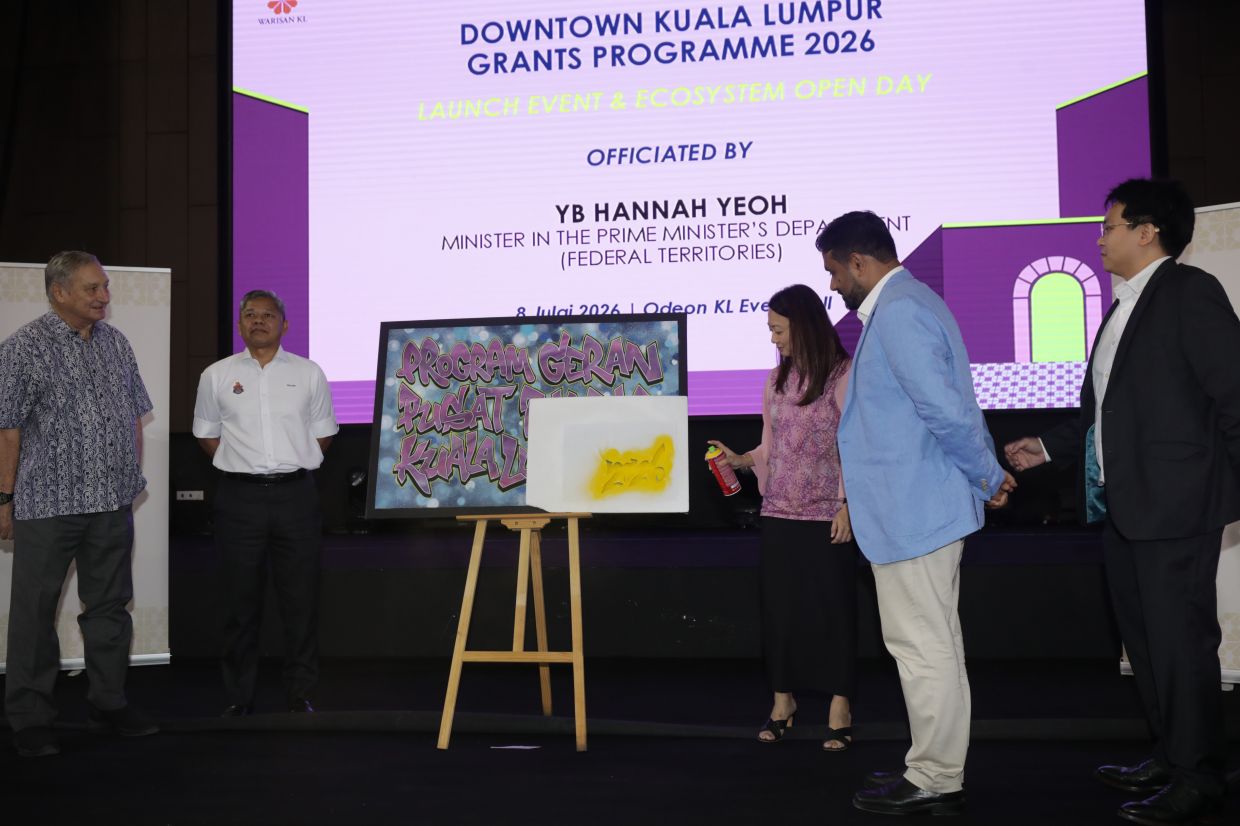
The Malaysian government has pledged RM1 million in fresh funding to breathe new life into Downtown Kuala Lumpur, signalling a sustained commitment to urban renewal in the capital's historic core. The investment, administered through the Downtown Kuala Lumpur Grants Programme 2026, represents an expansion of initiatives that began in 2020 and have already shown tangible results in revitalising deteriorating neighbourhoods and supporting creative enterprises. Minister in the Prime Minister's Department (Federal Territories) Hannah Yeoh unveiled the programme at ODEON Kuala Lumpur on Wednesday (July 8), emphasising that meaningful urban transformation depends not on government mandates alone but on genuine partnerships bridging the public sector, private enterprises, community groups and civil society organisations.
The funding mechanism distributes grants ranging from RM30,000 to RM100,000 to selected applicants, with the Downtown Kuala Lumpur Grants Programme operating under the strategic guidance of Think City, a placemaking organisation that has become instrumental in facilitating grassroots-driven development projects across Malaysia's capital. The programme reflects a philosophical shift in urban governance—one that recognises solutions often emerge from communities deeply invested in their immediate surroundings rather than from bureaucratic planning offices. This approach has proven particularly effective in Southeast Asian cities where informal economies, cultural heritage and community networks drive neighbourhood vitality.
Hannah Yeoh articulated this philosophy during the launch, noting that transformative ideas rarely originate in government headquarters but instead flourish among individuals genuinely committed to their localities. She framed government's role as providing essential scaffolding—financial resources, regulatory support and institutional backing—that enables community-driven visions to materialise and sustain themselves beyond the grant period. This perspective acknowledges that long-term urban success requires projects embedded in local culture and community needs, rather than top-down interventions disconnected from resident aspirations.
The 2026 programme targets six distinct thematic areas reflecting contemporary urban development priorities across Malaysia. The Museum and Gallery Network focus supports cultural infrastructure and artistic spaces, while the Placemaking and Space Rejuvenation category funds physical transformations of underutilised areas. Cultural Activation and Creative Content initiatives promote heritage preservation and contemporary artistic expression. Creative Business Seeding and Organisational Development supports entrepreneurs and creative enterprises, addressing Malaysia's growing digital economy and cultural industries. Community Engagement and Capacity Building strengthens social cohesion and grassroots leadership, while Digitalisation and Innovation integrates technology into urban solutions—increasingly vital as Malaysian cities navigate digital transformation.
The application deadline of August 21 allows potential applicants roughly six weeks to develop compelling proposals, with selected projects commencing implementation from November 2026 through June 2027. This timeline aligns with Malaysia's fiscal year and provides adequate runway for planning before execution begins. The compressed implementation window—eight months—suggests the programme favours projects with shovel-ready components or those building incrementally on existing initiatives, rather than entirely novel undertakings requiring extensive foundational work.
Downtown Kuala Lumpur's revitalisation carries particular significance for Malaysia's urban trajectory. The district encompasses the capital's heritage core, colonial-era landmarks and heritage shophouses alongside contemporary commercial spaces, creating complex layered urbanism requiring sensitive intervention. Previous grant cycles have supported initiatives ranging from heritage documentation projects to creative incubators in vacant commercial spaces, demonstrating how targeted funding catalyses neighbourhood renewal without displacing existing communities or erasing cultural character. These efforts directly counter sprawl patterns and support the government's broader sustainability objectives by activating existing urban infrastructure.
The presence of Kuala Lumpur mayor Datuk Seri Fadlun Mak Ujud and Think City managing director Datuk Hamdan Abdul Majeed at the launch underscores institutional alignment and coordination typically absent in fragmented urban governance. Municipal authorities, think tanks and national government working in concert creates enabling conditions for systemic change rather than isolated projects. This coordination model offers instructive lessons for other Malaysian cities confronting similar urban vitality challenges, particularly Penang, Ipoh and other state capitals where heritage districts compete for investment and resident loyalty against modern suburban peripheries.
For Malaysian business communities, creative entrepreneurs and civil society organisations, the grants programme presents tangible funding accessible without the bureaucratic complexity often characterising larger government contracts. The RM30,000 to RM100,000 band targets projects of meaningful scale—sufficient for substantive work yet modest enough to remain achievable for community organisations, small creative enterprises and neighbourhood associations lacking institutional resource advantages. This size range democratises access compared to larger development contracts typically monopolised by major corporations.
The programme's evolution since 2020 reflects learning from earlier iterations and responsiveness to emerging urban challenges. The inclusion of digitalisation and innovation responds to accelerating technology integration in Malaysian cities, while emphasis on community engagement acknowledges social cohesion pressures accompanying rapid urbanisation. These evolving priorities suggest programme managers actively assess effectiveness and adapt thematic focus accordingly, rather than perpetuating static funding categories disconnected from contemporary realities.
Downtown Kuala Lumpur's revitalisation carries implications extending beyond individual neighbourhood improvement. Successful downtown regeneration can reduce pressure on peripheral expansion, support sustainable transport use and strengthen economic resilience through diverse creative and cultural economies. For a capital city increasingly competing globally for talent and investment, vibrant human-scaled urban cores prove decisive advantages. Malaysia's deliberate investment here signals recognition that durable competitive advantage derives partly from place quality and cultural vitality, not merely regulatory convenience or infrastructure bulk.
The RM1 million commitment, while modest relative to major infrastructure projects, proves consequential for catalytic impact in targeted neighbourhoods. Grant funding functions as seed capital, often triggering additional private and philanthropic investment through co-funding and partnership arrangements. Documentation and knowledge sharing from successful projects creates replicable models deployable across Malaysian cities confronting similar urban vitality challenges. This multiplier effect amplifies the apparent funding allocation significantly beyond the raw monetary figure.

